Embroidered sampler
An 1827 sampler embroidered with a spread eagle, birds, trees and alphabets: an American-style design made by 14-year-old Hannah Bloomfield. Full commentary ↓
Couldn't load the puzzle image.
Turn on piece outlines to see piece positions on this picture too
Drag the pieces into place · When zoomed in, drag an empty spot to move around
You can also play with a keyboard — Tab to the board, thenSpace pick a piece, Arrow keys move it (with Shift for small steps),Esc deselect, R rotate a piece (Shift+R the other way)
Embroidered sampler is a textile by Hannah Bloomfield (1827) in the collection of The Metropolitan Museum of Art. It measures 47 × 36.2 cm.
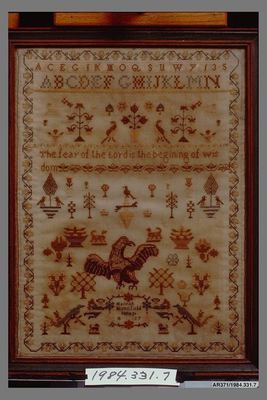
In the pictureOn pale fabric, two rows of alphabets run across the top, and below them birds, trees and flower baskets are scattered about. In the middle is the verse "The fear of the Lord is the beginning of wisdom," and at the bottom center an eagle with outspread wings is embroidered. At the very bottom is the maker's name, and the threads are mostly brown, green and red.
BackgroundThe spread eagle is a design often seen on early American samplers, bringing a national symbol into household needlework. Hannah Bloomfield was born in 1813, so in 1827 she was fourteen. The two rows of alphabets are the basic exercise for learning embroidered lettering, and the scattered birds and trees show her freely trying out the techniques she had learned. The way the motifs are placed here and there, with no fixed scheme, if anything reveals the maker's own hand.
Puzzle tipThe elements are small and scattered, so many pieces contain something. Fit the eagle and the verse first, and place the alphabet rows at the top by the order of the letters. Fill in the bare fabric pieces starting with those nearest the frame. 100 pieces is about right.
- Artist
- born 1813
- Classification
- Textiles
- Medium
- Embroidered silk on wool
- Dimensions
- 47 x 36.2 cm
- Credit line
- Gift of Barbara Schiff Sinauer, 1984
Source: The Metropolitan Museum of Art ↗
Stories about this work
- Why Embroidered Samplers Still Carry the Names of Girls from Centuries Ago
European embroidered samplers often carry the maker's name and the year she finished, stitched in together. The personal traces you meet as you assemble them as puzzles.
- Why Dogs and Horses Turn Up So Often in Old Master Paintings
Animals in old paintings were both decoration and symbol: the dog for loyalty, the horse for status and authority, the bird for freedom and the soul. Small supporting players you find while doing the puzzle.
Puzzles to try next
More European Embroidery & Costume puzzles· Stories and puzzle tips