Face of Senwosret III
Heavy eyelids, drooping mouth, deep lines: the Middle Kingdom pharaoh Senwosret III portrayed not as an idealized young king but as a weary ruler. Full commentary ↓
Couldn't load the puzzle image.
Turn on piece outlines to see piece positions on this picture too
Drag the pieces into place · When zoomed in, drag an empty spot to move around
You can also play with a keyboard — Tab to the board, thenSpace pick a piece, Arrow keys move it (with Shift for small steps),Esc deselect, R rotate a piece (Shift+R the other way)
Face of Senwosret III is a stone object by an unknown maker (ca. 1878–1840 B.C.) in the collection of The Metropolitan Museum of Art.
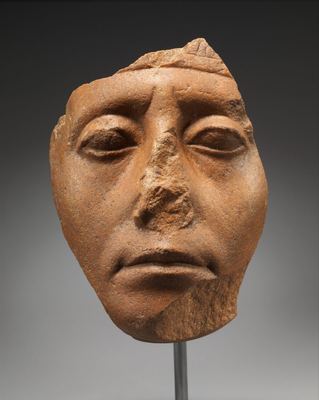
In the pictureOnly the face remains from a block of red quartzite. The eyelids hang heavy, the folds between nose and mouth are deep, and the corners of the mouth turn down. Traces of the stripes of a headdress remain above the forehead, showing that this was a statue of a king. It is a little over 16 cm tall.
BackgroundEgyptian sculpture usually showed kings as eternally young and perfect, but the portraits of Senwosret III in the 19th century B.C. are the exception. An aged, care-worn face recurs across his many surviving statues, and whether it reflects his actual face or carves an ideology of "the king who worries for his people," it is counted as the most individual royal face in the history of Egyptian art. He was the king who led the Middle Kingdom to its height through campaigns in Nubia and administrative reforms.
Puzzle tipEven with few pieces, the texture of the stone makes it hard. Fit the pieces with the dark shadows of the eyes, nose and mouth first, and establish the shape of the face with the outline pieces where the gray background meets the red surface of the stone. Fill in the uniform red pieces inside the face last.
- Period
- Middle Kingdom
- Dynasty
- Dynasty 12
- Medium
- Red quartzite
- Dimensions
- H. 16.5 × W. 12.6 × D. 11.4 cm (6 1/2 × 4 15/16 × 4 1/2 in.)
- Credit line
- Purchase, Edward S. Harkness Gift, 1926
Source: The Metropolitan Museum of Art ↗
Stories about this work
- Why Egyptian Statues Step Forward on the Left Foot: Rules of Pose Kept for 3,000 Years
Why do Egyptian sculptures all look alike? Their poses follow conventions, and once you know them, the puzzle pieces look different too.