The Chief of Police, Mentuhotep
Mentuhotep, a Middle Kingdom chief of the guard, seated in a short curled wig: a statue of an official in smoothly worked dark granodiorite. Full commentary ↓
Couldn't load the puzzle image.
Turn on piece outlines to see piece positions on this picture too
Drag the pieces into place · When zoomed in, drag an empty spot to move around
You can also play with a keyboard — Tab to the board, thenSpace pick a piece, Arrow keys move it (with Shift for small steps),Esc deselect, R rotate a piece (Shift+R the other way)
The Chief of Police, Mentuhotep is a work by an unknown maker (ca. 1981–1917 B.C.) in the collection of The Metropolitan Museum of Art.
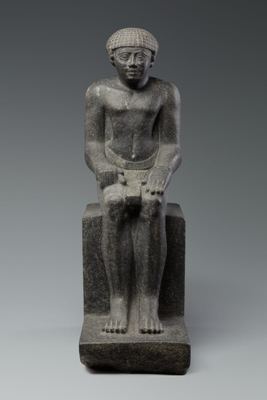
In the pictureA man made of black stone sits on a backless seat with both hands resting on his knees. He wears a tightly curled wig and nothing but a short kilt, and hieroglyphs are carved on the kilt. His shoulders and chest are broad, his limbs are solid, and his feet rest neatly side by side on the base. The statue is 46 cm high.
BackgroundMentuhotep was an official who led a security force in Egypt around the 20th century B.C., and the inscription on his kilt records his name and title. In Egyptian sculpture the seated pose stands for eternal rest; placed in a tomb or temple, such a statue served as the spot where the dead received offerings. Granodiorite is very hard to work with bronze tools, so a surface this smooth is the result of long polishing.
Puzzle tipThere are only two colors, the statue and the gray background, so finding the outline pieces is the key. The curled texture of the wig, the face, and the pieces with writing on the kilt are easy to tell apart, and the smooth black pieces of the body can be sorted top from bottom by where the reflected light falls. The photo is tall and narrow, so 48 pieces works well.
- Period
- Middle Kingdom
- Dynasty
- Dynasty 12
- Medium
- Granodiorite
- Dimensions
- H. 45.9 × W. 14.2 × D. 29.2 cm, 22.1 kg (18 1/16 × 5 9/16 ×
- Credit line
- Rogers Fund and Edward S. Harkness Gift, 1922
Source: The Metropolitan Museum of Art ↗
Stories about this work
- How to Move Puzzle Pieces with Only a Keyboard, No Mouse
Keyboard controls are built in so you can finish a puzzle even when a trackpad is awkward or a mouse is hard to use.
- Colorless Egyptian Statue Puzzles: What to Look At Instead
Egyptian sculpture from thousands of years ago has almost no color contrast, which sharply raises the puzzle difficulty. Here is what to look at instead of color.
- What "Unknown Artist" Means, How It Is Written in English, and Why 149 Met Works Have No Name
"Unknown artist" means the maker of a work is not known or was never recorded. Here is how the Korean terms jakga misang and jakja misang differ, the English labels (Unknown, Anonymous, Attributed to), and examples from 149 museum works.