Self-Portrait
Van Gogh's 1887 self-portrait, its face and background built up from short dabs and strokes of color, from the time he took up pointillism in Paris. Full commentary ↓
Couldn't load the puzzle image.
Turn on piece outlines to see piece positions on this picture too
Drag the pieces into place · When zoomed in, drag an empty spot to move around
You can also play with a keyboard — Tab to the board, thenSpace pick a piece, Arrow keys move it (with Shift for small steps),Esc deselect, R rotate a piece (Shift+R the other way)
Self-Portrait is an oil painting by Vincent van Gogh (1887) in the collection of The Art Institute of Chicago. It measures 41 × 32.5 cm.
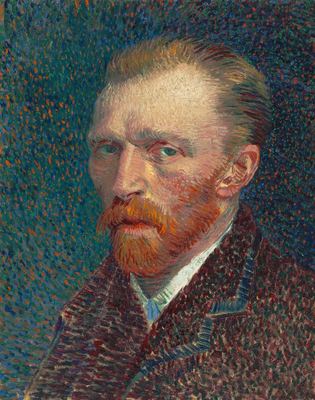
In the pictureA man with a red beard turns his body and face halfway toward the left of the picture, with only his eyes directed toward us. His forehead is bright with pale yellow and pink, his eyes are blue-green, and his beard and mustache are thick strokes of orange and red. His reddish-brown coat is densely mixed with short strokes of red, green and blue, and inside the lapels a white shirt collar and a small blue tie are visible. On the dark blue-green background, orange and red dots are scattered, spreading out as if to encircle his head.
BackgroundArriving in Paris in early 1886, Van Gogh lived with his brother Theo in Montmartre and encountered the work of the Impressionist and Neo-Impressionist painters. Among these was the pointillism Seurat displayed in A Sunday on La Grande Jatte, a painting that is also now at the Art Institute of Chicago. Van Gogh did not follow the method exactly, but stretched the dots into short strokes to give them direction. Painted in 1887, this picture is on board rather than canvas. In his Paris years, when he had no money for models, he painted more than twenty self-portraits while looking in a mirror.
Puzzle tipFit the face first. The orange beard and the bright forehead stand out most, and the ear on the right and the white shirt collar help fix their positions. The coat has a blue lapel line running across its reddish-brown ground, so join pieces along that line. The background, a blue-green dot pattern taking up nearly half the picture, is the hardest part. The dots flow in a circle around the head, so look at the direction the dots lean to decide whether a piece belongs left or right of the head. The coat's strokes are elongated while the background's dots are smaller and rounder, so where the two get mixed up, separate them by the shape of the marks. 100 pieces is about right.
- Classification
- Painting
- Medium
- Oil on artist's board, mounted on cradled panel
- Dimensions
- 41 × 32.5 cm
- Credit line
- The Art Institute of Chicago, 1954.326
Source: The Art Institute of Chicago ↗
Stories about this work
- 17 Must-See Paintings at the Art Institute of Chicago, from Seurat's Dots to American Gothic
Seurat's A Sunday on La Grande Jatte, Caillebotte's Paris Street; Rainy Day, Van Gogh's The Bedroom and Grant Wood's American Gothic. The stories of 17 must-see paintings at the Art Institute of Chicago, what to check before you go, and how to meet them first as puzzles.