Sir Henry Blount (1602–1682)
Sir Henry Blount, a 17th-century English traveler in a long curly wig, in a portable portrait miniature on a 7 cm oval of vellum. Full commentary ↓
Couldn't load the puzzle image.
Turn on piece outlines to see piece positions on this picture too
Drag the pieces into place · When zoomed in, drag an empty spot to move around
You can also play with a keyboard — Tab to the board, thenSpace pick a piece, Arrow keys move it (with Shift for small steps),Esc deselect, R rotate a piece (Shift+R the other way)
Sir Henry Blount (1602–1682) is a work by Nicholas Dixon (1660s) in the collection of The Metropolitan Museum of Art.
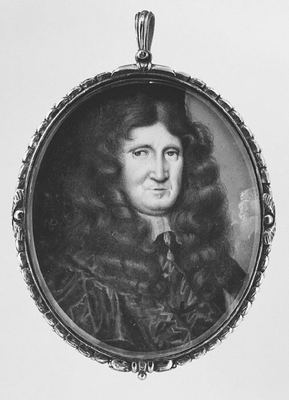
In the pictureIn an oval picture set in a silverwork frame is a man with curly hair falling to his shoulders. The museum's image is black and white, but the lines of the face, the curls of the wig and the sheen of the clothing still read clearly. The actual height is 67 mm, an object that fits in the palm of the hand.
BackgroundPortrait miniatures like this were carried in lockets or boxes in 17th-century England, a way to keep the face of a family member or lover close in an age before photography. Henry Blount traveled through the Ottoman Empire in the 1630s and wrote A Voyage into the Levant, and this portrait was painted when he was around sixty. Nicholas Dixon was a miniaturist active in the reign of Charles II.
Puzzle tipBecause a tiny original has been greatly enlarged, brushstrokes show in every piece. The ornamental pieces of the silverwork frame form the border and are easy to lay down first, and the face pieces have distinct brightness. The pieces of the curly wig run every which way, so it is faster to work with the preview on. Normal (about 48 pieces) is a good fit.
- Artist
- British, active by ca. 1660–died after 1708
- Classification
- Miniatures
- Medium
- Vellum laid on card
- Dimensions
- Oval, 2 5/8 x 2 1/8 in. (67 x 55 mm)
- Credit line
- Bequest of Mary Clark Thompson, 1923
Source: The Metropolitan Museum of Art ↗
In these collections: Portrait and Self-Portrait Puzzles
Stories about this work
- Why It Pays to Do the Face Last in a Portrait Puzzle
The face takes up only 3 to 4% of the picture, so it pays to do it last. Where each portrait gets stuck, and how to find an eye split across two pieces.