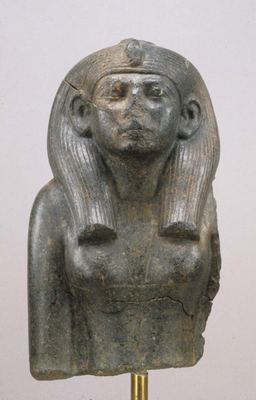
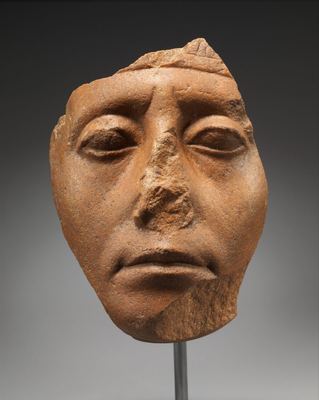
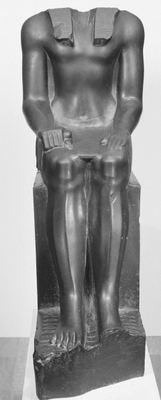
Statue of a Seated Man in a Cloak
A man in a long wig, wrapped in a cloak and seated on a chair, a Middle Kingdom seated statue carved from white limestone as one simple block. Full commentary ↓
Couldn't load the puzzle image.
Turn on piece outlines to see piece positions on this picture too
Drag the pieces into place · When zoomed in, drag an empty spot to move around
You can also play with a keyboard — Tab to the board, thenSpace pick a piece, Arrow keys move it (with Shift for small steps),Esc deselect, R rotate a piece (Shift+R the other way)
Statue of a Seated Man in a Cloak is a stone object by an unknown maker (ca. 1802–1640 B.C.) in the collection of The Metropolitan Museum of Art.
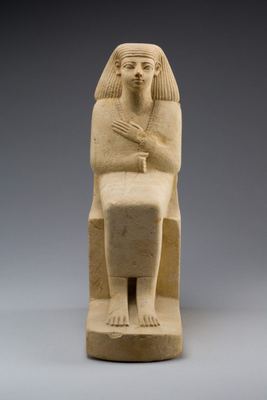
In the pictureA man made of white limestone sits on a backless seat. He has a shoulder-length wig, a necklace and a cloak that covers his whole body, and one hand emerging from the cloak rests on his chest. His feet are placed side by side on a base, and his face looks straight ahead. It is 31 cm tall.
BackgroundSeated statues wrapped in cloaks were widely made in the late Middle Kingdom of Egypt. Covering the body with a cloak to form a single block, instead of carving the arms and legs separately, made the stone less likely to break and saved labor, which suited medium-sized statues dedicated in temples or placed in tombs. His name has not survived, but the wig and necklace show that he was a person of some standing.
Puzzle tipThe statue and the background are both light in color, so the outline pieces are key. Fit the vertical stripes of the wig, the face and the feet first, and judge top from bottom for the plain cloak pieces by where the shadows fall. 24 or 48 pieces is about right.
- Period
- Middle Kingdom
- Dynasty
- Dynasty 13
- Medium
- Limestone
- Dimensions
- H. 31 cm (12 3/16 in); width of base 10 cm (3 15/16 in.); de
- Credit line
- Theodore M. Davis Collection, Bequest of Theodore M. Davis, 1915
Source: The Metropolitan Museum of Art ↗
Stories about this work
- Three Middle Kingdom Egyptian Statues That Hide the Body in a Cloak
Statues that cover the limbs with a cloak instead of carving them, turning the body into a single block. Why did this form, which saved stone and labor, become popular?