Seated Statue of King Senwosret I
A seated statue of Senwosret I, its head lost but its body intact, an early Middle Kingdom royal statue in dark stone inscribed with the king's name. Full commentary ↓
Couldn't load the puzzle image.
Turn on piece outlines to see piece positions on this picture too
Drag the pieces into place · When zoomed in, drag an empty spot to move around
You can also play with a keyboard — Tab to the board, thenSpace pick a piece, Arrow keys move it (with Shift for small steps),Esc deselect, R rotate a piece (Shift+R the other way)
Seated Statue of King Senwosret I is a stone object by an unknown maker (ca. 1961–1917 B.C.) in the collection of The Metropolitan Museum of Art.
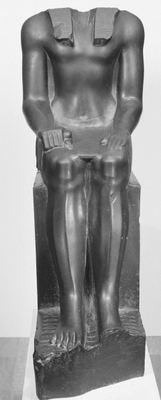
In the pictureA headless seated male figure faces forward. The broad shoulders, the firm chest and arms, the hands resting on the knees and a short pleated kilt remain, and hieroglyphs are carved on the kilt and the sides. The surface of the black stone is polished smooth, and it stands more than 1 meter tall.
BackgroundSenwosret I, second king of the Middle Kingdom's 12th Dynasty in the 20th century B.C., built a pyramid at Lisht and extended Egypt's territory as far as Nubia. Even without the head, the inscription on the kilt tells us who this is, and the idealized youthful body symbolizes the king's eternal power. Comparing it with the lined face of Senwosret III, a descendant of roughly his grandsons' generation, shows how the image of the king changed within the same dynasty.
Puzzle tipWith only a black statue and a bright background, the outline pieces are the key. Fix positions using the reflected light on the knees and arms and the pleats and inscribed pieces of the kilt, and check the plain torso pieces against the preview. The photo is very tall and narrow, so the pieces are slim; Normal (about 48 pieces) is recommended.
- Period
- Middle Kingdom
- Dynasty
- Dynasty 12
- Medium
- Greywacke
- Dimensions
- h. 103.5 cm (40 9/16 in); w. 41.9 cm (16 1/2 in); d. 69.9 cm
- Credit line
- Gift of Jules S. Bache, 1925
Source: The Metropolitan Museum of Art ↗
Stories about this work
- Colorless Egyptian Statue Puzzles: What to Look At Instead
Egyptian sculpture from thousands of years ago has almost no color contrast, which sharply raises the puzzle difficulty. Here is what to look at instead of color.
- Why Egyptian Statues Step Forward on the Left Foot: Rules of Pose Kept for 3,000 Years
Why do Egyptian sculptures all look alike? Their poses follow conventions, and once you know them, the puzzle pieces look different too.