Statuette of a striding man
A man in a shoulder-length wig and long kilt steps forward on his left foot: a 32cm greywacke statuette from the mid-12th Dynasty of Egypt's Middle Kingdom. Full commentary ↓
Couldn't load the puzzle image.
Turn on piece outlines to see piece positions on this picture too
Drag the pieces into place · When zoomed in, drag an empty spot to move around
You can also play with a keyboard — Tab to the board, thenSpace pick a piece, Arrow keys move it (with Shift for small steps),Esc deselect, R rotate a piece (Shift+R the other way)
Statuette of a striding man is a stone object by an unknown maker (ca. 1919–1878 B.C.) in the collection of The Metropolitan Museum of Art.
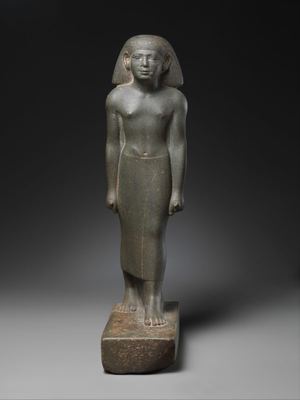
In the pictureCarved from dark gray-green stone, a man stands on a base with his left foot stepping forward. His shoulder-length wig, which leaves the ears exposed, is incised with fine lines, and his face wears a faint smile. Below the bare chest a long kilt falls from waist to ankle, with the line of its front overlap running vertically. His arms are held against the body, and his hands are clenched in fists. The background is gray, black at the top and lighter toward the bottom. The chest and knees are smoothly finished, and the front of the base shows reddish veins in the stone.
BackgroundStanding with the left foot forward was the basic form of Egyptian male standing statues from the Old Kingdom to the Roman period. Because the heel stays on the ground, it reads less as a moment of walking than as a stillness ready to step out. Museum records date the statue to the middle of the 12th Dynasty of the Middle Kingdom (about 1919–1878 B.C.), and the material is hard greywacke. It is 32.2cm high and entered the museum in 1907 through the Rogers Fund; no name is inscribed, so who it represents is unknown. Greywacke is said to have been quarried at Wadi Hammamat in Egypt's Eastern Desert.
Puzzle tipThe photograph is tall and narrow, so the pieces are long and slim. Fit the brightly reflecting face, wig and chest pieces first, and anchor the bottom with the straight edges of the base and the forward left foot. The long kilt has no pattern, so place it by the vertical overlap line and the outlines of the arms on either side. Fill the background by sorting the black pieces at the top and the gray pieces at the bottom in order of brightness. The two clenched fists sit at the same height on either side of the body, giving a reference for matching left and right. 48 pieces is about right.
- Period
- Middle Kingdom
- Dynasty
- mid-Dynasty 12
- Medium
- Greywacke
- Dimensions
- H. 32.2 cm (12 11/16 in.); W. 9.2 cm (3 5/8 in.); D. 15.6 cm
- Credit line
- Rogers Fund, 1907
Source: The Metropolitan Museum of Art ↗
Stories about this work
- Why Egyptian Statues Step Forward on the Left Foot: Rules of Pose Kept for 3,000 Years
Why do Egyptian sculptures all look alike? Their poses follow conventions, and once you know them, the puzzle pieces look different too.