Two Paintings Where Diaz, Painter of the Fontainebleau Forest, Left the Woods
Published
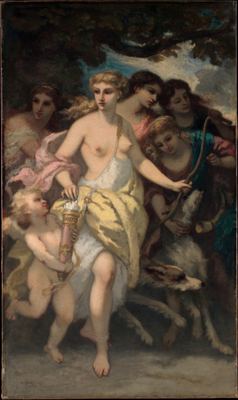
A golden-haired goddess walks out of the forest leading her nymphs. In another painting, a single bare, withered tree reaches into a sky full of dark clouds. Both are by Narcisse-Virgile Diaz de la Peña, yet for a painter who spent his life painting the interior of the Fontainebleau forest, they feel somehow unfamiliar.
I told part of Diaz’s story once before, in a post that walks into the forest through three of his Fontainebleau paintings. The two works it left out are this goddess and this withered tree. Until now they have only appeared scattered as examples in other, unrelated posts. One leaves the forest to paint a goddess from myth, and the other moves in on a single tree instead of the whole forest. This time, these two exceptions take center stage and are compared with the three earlier works.
| Work | Subject | Year |
|---|---|---|
| Diana | Mythological figure painting | 1849 |
| Autumn: The Woodland Pond | Forest landscape | 1867 |
| The Edge of the Woods | Tree close-up | 1872 |
| A Vista through Trees: Fontainebleau | Forest landscape | 1873 |
| The Forest of Fontainebleau | Forest landscape | 1874 |
A goddess walking out of the forest
 Solve this painting as a puzzle → about 5 minutes on Easy
In Diana, the goddess of the hunt walks out of the forest, followed by four nymphs, hunting dogs and a putto carrying a quiver. Diaz was a Barbizon School painter known for his Fontainebleau forest landscapes, but for the Salon he often submitted paintings like this one, with mythological figures in the forest. His skill at setting pale skin against a dark forest is exactly the same as the way the sky breaks through the trees in his landscapes. The subject moved to myth, but his habits of handling light stayed the same.
As a puzzle, put together the skin-toned pieces of the figures, the yellow cloth and the gray dog first, and the vertical central axis of the picture falls into place. Divide the dark foliage pieces into those mixed with sky color and those that are simply dark, and fill them in from the edges. It is a tall painting, so working from top to bottom is easiest.
A single tree instead of a forest
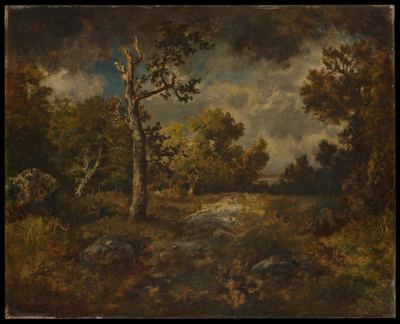
The Edge of the Woods is an exception that goes even further. A single withered tree with almost no leaves reaches skyward from the center of the picture, and behind it a little blue sky opens between dense dark clouds. The painter who painted whole forests narrowed the picture here to one dead tree. Diaz lost a leg in a childhood accident and roamed the Fontainebleau forest on an artificial leg as he painted, and he often used this composition pairing a dead tree with a stormy sky. The thickly applied paint that leaves the surface uneven is another of his trademarks.
The withered tree in the center and the blue sky behind it form the axis of the picture, so in the puzzle, set up this axis first and attach the dark forest on the left and right. The stormy sky looks broad, but its large differences in brightness make it fit together better than you might expect. Tips for handling broad areas like the sky are covered separately in strategies for paintings with large solid areas.
The forest interior he repeated all his life
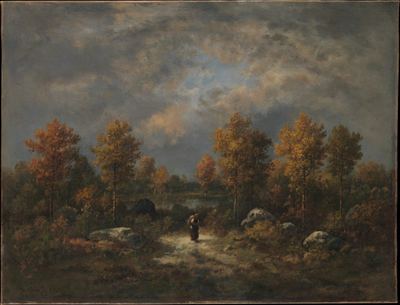
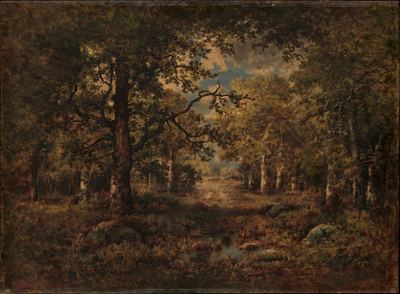
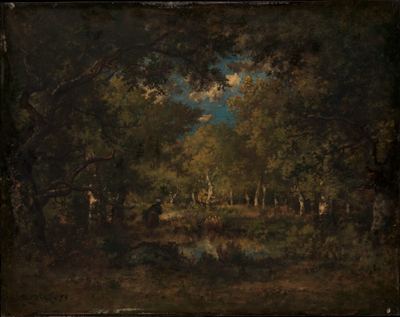
The remaining three works show the approach Diaz repeated all his life, discussed in depth in the earlier post. In Autumn: The Woodland Pond, a single person walks toward us between golden trees. A Vista through Trees looks out between thick oaks to distant fields. The Forest of Fontainebleau looks out from inside the dark forest and is the darkest and deepest of his pictures. Until late in life, Diaz painted the interior of this forest, the places light hardly reaches.
As puzzles, the three also differ in character. Autumn: The Woodland Pond divides into three layers of sky, trees and dirt path, so you can fill them in order from the top. In A Vista through Trees, put together the bright field in the middle first to open a hole, then use the oak trunk on the left as your next clue. The Forest of Fontainebleau is one of the hardest puzzles on this site. Anchor the center with the blue sky and pale tree trunk pieces, and it is easier on the mind to start out planning to solve it over several days, as in making puzzles a daily habit. Why forest paintings are especially difficult is discussed further in how to choose landscape puzzles.
The rule the exceptions reveal
Lay the five works side by side, and it is actually the two exceptions that make it clear the other three represent the way he painted most. Even when he moved to myth, his habits of handling light remained, and even when he narrowed in on a single tree, his favorite subjects of death and storm stayed. The habits of a painter who painted one forest all his life show more clearly when he briefly left it.