Why Forest Puzzles Are So Hard, and How to Choose a Landscape Painting
Published · updated
At the same 100 pieces, some landscapes are done in no time, while others show no progress however long you stay with them. Landscapes are the most popular puzzle subject and also the most variable in difficulty. Open more than ten landscapes one by one, from forests and villages to beaches and imaginary scenery, and you find that what decides the difficulty is less what is painted than where in the picture the clues are.
Wide skies and packed forests
On one side are paintings where sky, water or sand takes up most of the picture. Call this type A. The broad even areas make the pieces look alike, so you need the strategy for solid areas of color. But even within this type, the difficulty varies quite a bit depending on what the sky looks like.
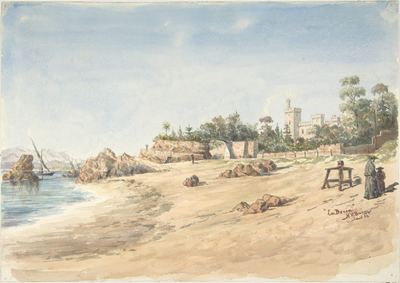 Solve this painting as a puzzle → about 5 minutes on Easy
In Burgy’s watercolor La Bocca, a pale blue sky spreads across the top and a sandy beach across the bottom, with rocks, trees and a building with a tower only in the middle band. Both the sky and the sand are smoothly blended gradients without distinct clouds, so the differences between pieces are very small. The only option is to line them up by brightness and estimate top and bottom. Dudley’s Landing the Shore End of the Atlantic Cable is a different story. The sky is half the picture, but it has dark clouds and golden gaps, so a single mass of cloud serves directly as a position marker. The same goes for Diaz’s The Edge of the Woods, topped with a stormy sky. When the sky is mottled with clouds, type A is friendlier than you might think.
On the other side, type B is a painting filled with forest or vegetation. The exact opposite of type A, the whole picture is dense with detail. With so many clues it seems like it should be easy, but in practice every piece contains a similar amount of detail, so there is actually nothing to tell them apart. You have to catch by eye the difference between one mass of leaves and another.
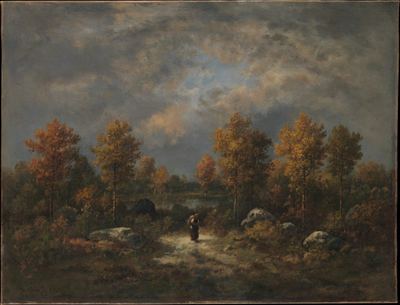
Autumn: The Woodland Pond straddles the two types. Trees in autumn color form a band across the middle of the picture, but the sky takes up nearly the upper half, and a small figure on the path becomes a central reference point. The title says woodland, but the way to solve it is closer to type A.
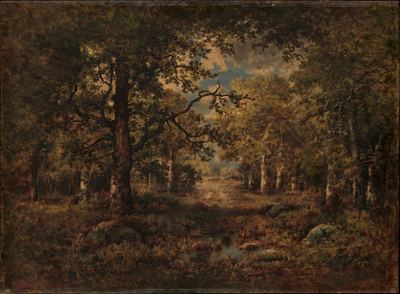
A Vista through Trees: Fontainebleau is close to type B. It is almost entirely brown and gold, and the sky is little more than a small hole. The French Barbizon painters loved to paint forests, and this site has four forest paintings by Diaz alone. The most extreme of them is The Forest of Fontainebleau. The edges are almost black leaves, and trunks and sky emerge toward the center. It is one of the hardest puzzles here. The paintings Diaz made when he briefly left this forest are gathered separately in two paintings where Diaz left the woods.
In a forest, find the trunks first
Forest paintings are solved by structure rather than color. First, find the trunks. In The Edge of the Woods it is a single withered tree, and in A Vista through Trees it is the thick oak trunk on the left that divides the picture vertically. A dark line running vertically is clearly different from the leaves, and if you take that trunk as an axis, the picture divides vertically.
Next are the places where light comes in. The blue sky showing between the leaves at the top of The Forest of Fontainebleau and the distant field in the middle of A Vista through Trees are such places. They are among the few areas in the picture that cannot be confused with anywhere else. Finally, separate top from bottom. Even in the same browns, leaves are painted with strokes that hang down from above and ground grass with strokes that rise from below, so you can sort them by direction.
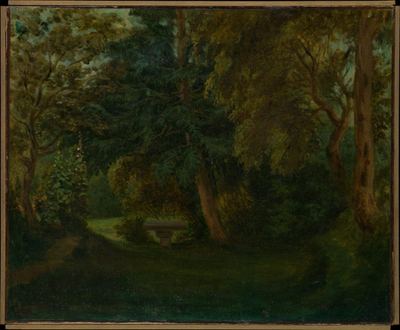
George Sand’s Garden at Nohant looks manageable because it is a garden, but it is almost all green. The site’s commentary also recommends 100 pieces or fewer. The reference points are the stone bench at the lower center, the open sky at the upper left and the brown of the tree trunk on the right, and that is about all. Divide the rest of the green into two piles, bright yellow-green and dark blue-green, then turn on the preview and solve. The circumstances in which this painting was made are covered in five scattered Delacroix works.
Sketches where the paper is the sky
Not all landscapes are oil paintings. There are also several sketches drawn quickly on paper, and in pictures like these the sky is often not painted at all.
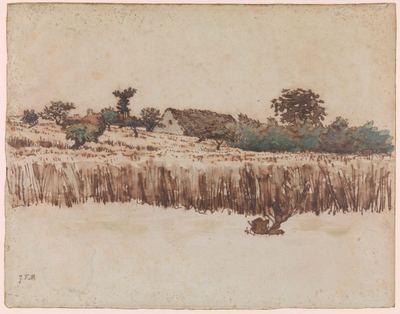
Millet’s Hamlet in a Wheat Field, Vichy leaves wide bands of almost bare paper above and below, with a wheat field, houses and trees drawn in brown pen line only in the middle band. Daubigny’s The Hamlet of Optevoz draws houses and trees in charcoal on brown paper and dabs white paint across the sky. In pictures like these, blank paper is a surface without clues. Complete the houses, trees and reflections of the middle band first, and the rest settles above and below on its own. For village sketches, 48 pieces is about right, and you can see three more in detail in village sketches by the Barbizon painters.
For a first try, a painting divided into zones
If you are new to landscapes, a painting with a moderate amount of sky or water and at least one reference point, such as a building or a figure, is a good choice.
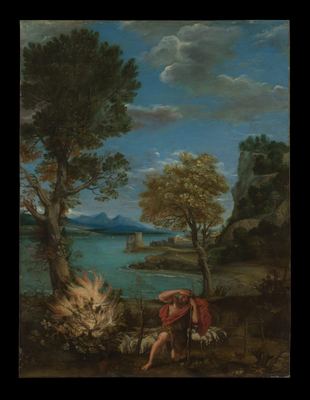
Domenichino’s Landscape with Moses and the Burning Bush is clearly divided into zones of blue sky and lake, green trees, brown ground and red clothing. Start from the bottom, where Moses, the flames and the flock of sheep are, and 100 pieces is about right. Dughet’s Imaginary Landscape is wide and very green, so it is no pushover, but you can build the middle band first with the bright pieces of sky and the gray pieces of the lake. Both paintings are covered separately in Roman ideal landscapes.
The painting’s proportions set the piece count
As I said in how to choose a difficulty level, how hard a puzzle feels is not determined by the piece count alone. Starting a forest painting at 300 pieces takes real resolve. On narrow screens such as phones, or on touch devices tablet-sized or smaller, the 300-piece level is not available at all.
The “about 100 pieces” in the difficulty name does not come out to exactly 100, because the number of cells is chosen to match the painting’s width-to-height ratio. The wide Imaginary Landscape becomes 13 cells across and 8 down at the 100-piece level, for 104 pieces, and La Bocca becomes 11 × 8, for 88 pieces. At 48 pieces or fewer, one dotted cell in the preview equals one piece. For type A, first count which row from the top the horizon falls on. That lets you estimate in advance roughly how many sky pieces there are.
Once it is done, you can see the brushwork
When you finish a forest puzzle, you learn how that painter painted leaves. That the painter did not paint leaves one by one but built up lushness by repeating a few kinds of brushstroke, and that through all the repetition the direction of the light never wavered. These are things you can barely see without examining the picture piece by piece. You can walk further into Diaz’s forest in the post that walks into the forest. The harder a painting was to solve, the longer it stays in memory.
Frequently asked questions
Why are landscape puzzles hard?
The two types are hard in different ways. Paintings that are mostly sky, water or sand have many similar solid-colored pieces, while paintings full of forest have a similar amount of detail in every piece, so there is nothing to tell them apart.
How do I solve a forest puzzle?
Solve it by structure rather than color. First find the tree trunks that divide the picture vertically, then take the few distinctive areas where light comes in, such as gaps where the sky shows through.
What is a good painting for a first landscape puzzle?
A painting with a moderate amount of sky or water and at least one reference point, such as a building or a figure. Domenichino's Landscape with Moses and the Burning Bush is clearly divided into zones of sky, lake, trees, ground and red clothing.