Village Sketches in Pen and Charcoal by Millet, Daubigny and Decamps
Published
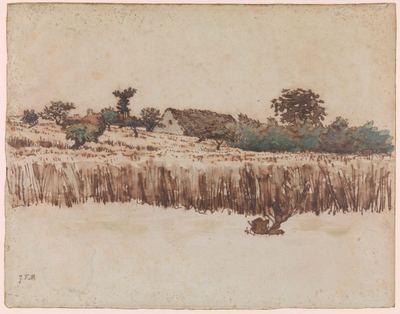
Say Millet and the first thing that comes to mind is a peasant bent over in a field. Yet one small sheet of paper he drew in Vichy has no people in it at all. Only a wheat field, thatched roofs, and the sky above them. Here are three village sketches by three painters connected with the Barbizon school, Millet, Daubigny, and Decamps, set down quickly in pen, charcoal, or watercolor. These are not pictures finished in oil like Diaz’s paintings of the Fontainebleau forest; they are moments caught on the spot.
| Work | Artist | Medium | Date |
|---|---|---|---|
| Hamlet in a Wheat Field, Vichy | Jean-François Millet | Pen and brown ink, watercolor | 1867 |
| The Hamlet of Optevoz | Charles-François Daubigny | Charcoal and white paint | ca. 1852 |
| Landscape | Alexandre-Gabriel Decamps | Watercolor | ca. 1840 |
Millet’s summers in Vichy
 Solve this painting as a puzzle → about 5 minutes on Easy
For several years from 1866, Millet spent his summers in the spa town of Vichy so that his wife could take the cure. There, the painter known for his Barbizon peasant pictures left many quick sketches of landscapes without people on small sheets of paper, and Hamlet in a Wheat Field, Vichy is one of them.
He did not draw each ear of wheat. He built the texture of the field by repeating short lines in the same direction. The brown pen lines that fill the lower half of the picture give the impression of wheat ears, and the white of the untouched paper becomes the sky as it is, and the bright parts of the field.
When you assemble the puzzle, the direction of those pen lines is the key. Once you learn which way the lines lean, the similar-looking wheat-field pieces sort out much faster.
Daubigny, who set up a studio on a boat
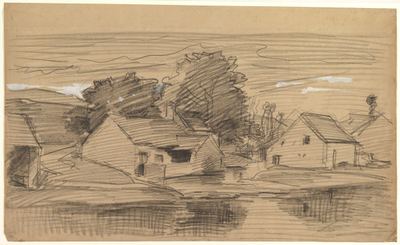
Optevoz is a small village east of Lyon. Daubigny went there several times in the 1850s to paint, and that work later led to an oil painting of the village of Optevoz. The Hamlet of Optevoz is a charcoal study drawn along the way.
Daubigny is famous for fitting out a studio on a boat and painting as he traveled along the river. This study, too, appears to have been caught quickly on the spot. He drew the houses and trees in charcoal on brown paper and dabbed on white paint to make the clouds. Letting the brown of the paper carry the middle tone is the same principle as the drawings on colored paper covered in Degas and Lautrec drawings.
When sorting pieces, look at the white dots first. The white dots of the clouds and the reflections on the water stand out sharply against the dark charcoal, so they make good reference points.
Decamps’s fields, after his return from the East
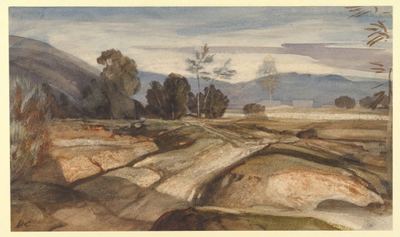
Of the three, the least familiar name is probably Alexandre-Gabriel Decamps. He made his name with Middle Eastern landscapes and figures after traveling in the East, but there is nothing exotic in Landscape. There are only plain French fields and distant mountains. It is closer to a study of light and color.
This way of painting rocks and fields simply with a broad brush is said to have influenced the Barbizon painters who came later. Decamps himself is not classed with the Barbizon school. Even so, his color studies became a seed for those who followed. What catches the eye is the skill with which he built a wide space out of only a few browns, greens, and blues.
This picture is built in layers of color: brown rocks in front, trees in the middle, blue mountains behind. Assemble it from front to back in that order.
The first judgment, before refinement
All three are studies drawn before being finished in oil, or regardless of whether they ever would be. In a finished work you see the painter’s final intention; in a sketch you see what the painter looked at first on the spot and what was put off until later. Millet caught the texture of the wheat ears first. Daubigny caught the shadows reflected in the water, and Decamps the layers of color. These first judgments, which are easily erased in the move to oil, remain intact on paper.
In all three, the base color of the paper or canvas remains part of the picture, so even the areas the paint never touched are easier to tell apart than you might expect. We recommend 48 pieces. Sketches have a lot of empty space, so raising the piece count too high only adds more featureless stretches. General tips for choosing landscape puzzles are collected separately in How to choose a landscape puzzle.
In a museum we usually see only finished pictures. If Diaz’s forest conveys the air of the woods in a completed oil painting, these three sheets show the handwork that came before. Looking into a state in which the painter has not yet made every decision is a different kind of pleasure from standing in front of a finished work.