The Little Street
Women and children absorbed in their tasks in front of a red brick house: one of only two Delft street views that Johannes Vermeer left. Full commentary ↓
Couldn't load the puzzle image.
Turn on piece outlines to see piece positions on this picture too
Drag the pieces into place · When zoomed in, drag an empty spot to move around
You can also play with a keyboard — Tab to the board, thenSpace pick a piece, Arrow keys move it (with Shift for small steps),Esc deselect, R rotate a piece (Shift+R the other way)
The Little Street is an oil painting by Johannes Vermeer (ca. 1658) in the collection of Rijksmuseum. It measures 54.3 × 44 cm.
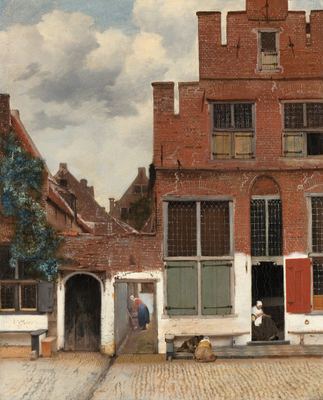
In the pictureOn the right of the picture stands a red brick house topped with a stepped gable, its ground-floor wall covered in white limewash. Inside the open door sits a woman in a white cap, sewing, and on the pavement in front of her two children crouch at play. At the end of the narrow passage between the two houses on the left, a woman in a red top and blue skirt bends over her work. The wall of the house on the left is covered with bluish vines, and above the roofs gray and white clouds spread wide. The window shutters are green and red, and a long wooden bench stands against the front wall of the house on the left.
BackgroundPainted around 1658, it is one of only two street scenes by Vermeer, who is famous for his interiors; the other is View of Delft. A signature can be seen at the bottom of the white wall of the house on the left. Which street it shows was long debated, and in 2015 a study based on Delft's old canal tax records identified it as two houses on the Vlamingstraat. One of them is said to have been home to Vermeer's aunt. The painting simply records an ordinary moment in the neighborhood, with nothing in particular happening.
Puzzle tipThe red of the brick fills the right half, so divide the house into stories using the white window frames, the leaded panes, and the green and red shutters as guides. The sky at upper left can be followed along the boundary between the blue and the gray clouds, and because the cobbled pavement at the bottom has a uniform texture, start with the row that meets the white wall above it. The small figures fall into place when fitted along with the white limewashed wall, and the dark arched doorway on the left is also a good marker. The recommended size is about 100 pieces.
- Classification
- Painting
- Medium
- Oil on canvas
- Dimensions
- 54.3 × 44 cm
- Credit line
- Rijksmuseum, SK-A-2860
Source: Rijksmuseum ↗
Stories about this work
- From a Street in Delft to The Love Letter: Eight Vermeer Paintings in the Order He Painted Them
The Milkmaid, Woman Holding a Balance, The Love Letter and five more: eight Vermeer paintings in the order he painted them, the stories behind works spread across three museums, and tips for assembling white walls and dark rooms as puzzles.
- 16 Must-See Paintings at the Rijksmuseum in Amsterdam
Rembrandt's The Night Watch, Vermeer's The Milkmaid, a Van Gogh self-portrait, plus Hals and Jan Steen. The stories of 16 must-see paintings at the Rijksmuseum, what to check before you go, and how to meet them first as puzzles.