From a Street in Delft to The Love Letter: Eight Vermeer Paintings in the Order He Painted Them
Published
It begins in a red-brick street in Delft and ends in a bright room glimpsed through a doorway. That is what happens when you set eight Vermeer paintings in the order he painted them. Vermeer was born in Delft in 1632 and died in 1675 at forty-three, and he left only thirty-some paintings in his lifetime. Eight of them are available as puzzles: two at The Metropolitan Museum of Art in New York, two at the National Gallery of Art in Washington and four at the Rijksmuseum in Amsterdam. All three museums have released the images into the public domain, which made it possible to gather them in one place.
Seen museum by museum, they are separate paintings, but lined up in the order they were painted, they show what one painter held on to for more than ten years. He comes in from the street into the room, and inside the room he moves steadily closer to a single person by the window. The numbers in the table are a rough starting point; how to choose the difficulty that suits your own hands is covered separately in how to choose a jigsaw puzzle difficulty.
| Order | Work | Date | Collection | Suggested pieces |
|---|---|---|---|---|
| 1 | The Little Street | ca. 1658 | Rijksmuseum | about 100 |
| 2 | The Milkmaid | ca. 1660 | Rijksmuseum | about 100 |
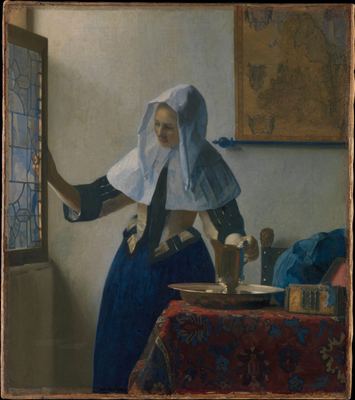
| 3 | Young Woman with a Water Pitcher | ca. 1662 | The Metropolitan Museum of Art | about 100 |
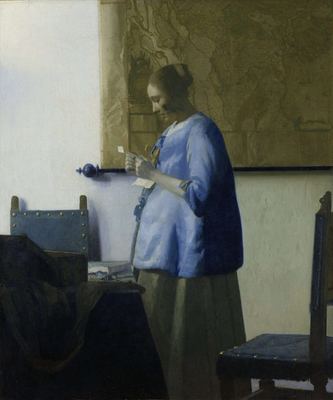
| 4 | Woman in Blue Reading a Letter | ca. 1663 | Rijksmuseum | about 100 |
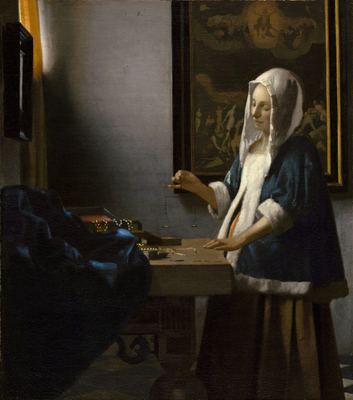
| 5 | Woman Holding a Balance | ca. 1664 | National Gallery of Art | 100 |
| 6 | Study of a Young Woman | ca. 1665–67 | The Metropolitan Museum of Art | about 100 |
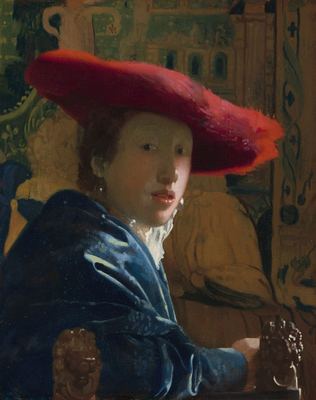
| 7 | Girl with the Red Hat | ca. 1669 | National Gallery of Art | 48 |
| 8 | The Love Letter | ca. 1669–70 | Rijksmuseum | about 100 |
Every date is “circa.” Vermeer rarely dated his paintings, so each museum uses a date estimated from studies of style and materials.
It started in the street
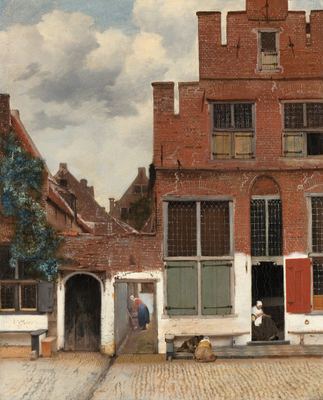 Solve this painting as a puzzle → about 5 minutes on Easy
The Little Street is one of only two paintings of the outdoors by Vermeer, who is famous for his interiors. The other, View of Delft, is in The Hague. A woman sews in the doorway of a red-brick house, and two children crouch at play on the pavement. In 2015, a study based on Delft’s old canal tax records identified the scene as two houses on the Vlamingstraat, and Vermeer’s aunt is said to have lived in one of them.
The red of the brick fills the whole right half, so as you assemble it you end up with a heap of brick pieces alone. You cannot tell where any piece goes from the brick alone, so first sort them into floors using the white window frames and the green and red shutters. Because blocks of color like the red brick and the sky divide so clearly, it is among the easier of the eight.
Four women at the window
The four paintings numbered 2 through 5 are composed almost the same way. There is a window on the left, light comes in through it, and one woman is absorbed in something. The Milkmaid is a maid in a kitchen, and in Young Woman with a Water Pitcher the woman is opening the window, about to wash. In Woman in Blue Reading a Letter the window is outside the picture, but the light still comes from the left. In Woman Holding a Balance, an orange curtain hangs over the window and the room has grown dim.
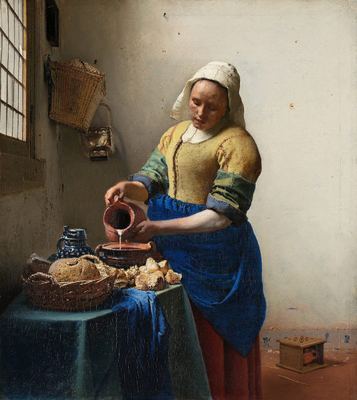
Set the four side by side and the props repeat: a white headscarf, blue cloth, a map on the wall, a rug on the table. This means he painted them over several years with the same room and the same furniture. Yet what each woman is doing is different every time. She pours milk, opens a window, reads a letter, holds an empty balance. Not one of them is a painting in which some event takes place.
White walls, starting from the window side
When you assemble the first three as puzzles, you get stuck on the white wall, because the wall pieces make up close to a third of the picture. Finish the figure and the table first and leave the wall for later. The wall is bright on the window side and grows darker the farther it is from the window, so if you lay out the remaining wall pieces in a single row from brightest to darkest, their horizontal positions sort themselves out. In The Milkmaid, the nail and nail hole painted on the wall make good landmarks. There are more tips for handling large single-color areas in how to solve puzzles with large plain areas.
Woman Holding a Balance used to be called a woman weighing pearls or gold. The interpretation changed when close examination confirmed that the pans of the balance are empty. Because the picture hanging on the wall behind the woman is a Last Judgment, in which souls are weighed, the painting is often read as speaking of moderation in the face of the pearls and gold coins on the table. In this room, with the curtain covering the window, the problem is the darkness more than the wall. If you first join up the parts that catch the light, like the white fur sleeve and the pearls, the dark pieces are left as the empty spaces in between.
Young Woman with a Water Pitcher is said to be the first Vermeer to come to the United States. Henry Marquand gave it to The Metropolitan Museum of Art in 1889. The Rijksmuseum bought The Milkmaid in 1908. A post that looks at the Met’s Vermeers alongside Rembrandt and Bruegel from the same era is five masterpieces by Vermeer, Rembrandt and Bruegel. That post covers only five works in the Met’s collection.
Moving in on the face
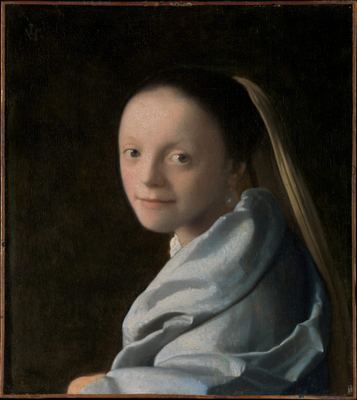
In Study of a Young Woman, the room disappears. All that remains is a face turning to look over the shoulder against a black background. It has almost the same composition as Girl with a Pearl Earring in The Hague, and it is thought to be a “tronie,” a study of expression and costume rather than a portrait of a particular person. Who the model was is not known. In the puzzle, the black background is what remains to the end, but if you zoom in, the area near the figure is slightly lighter. Join the grayish headscarf and the pearl earring first, then work outward from around them by following the brightness.
Girl with the Red Hat goes in the same direction. At 22.8 centimeters tall it is the smallest of the eight, and it is painted on a wooden panel, which is unusual for Vermeer, who mostly used canvas. X-ray examination is said to have shown that a portrait of a man, placed upside down, was painted first beneath this picture. The red hat and the blue clothing divide the picture into large areas, so if you are assembling Vermeer for the first time, it is easiest to start with this painting at 48 pieces.
Stepping back out of the room
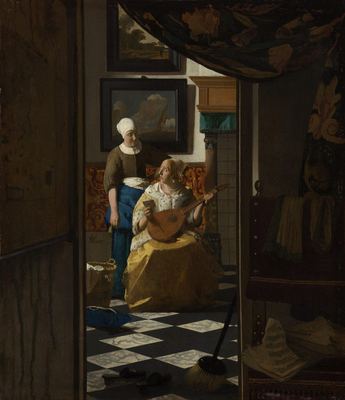
In the last painting, The Love Letter, Vermeer does the opposite and steps far back. The composition looks into a bright room between a dark door frame and a curtain, so the viewer stands in the position of someone peering into another person’s house. The mistress, holding an instrument, has just taken a letter and looks up at the maid. The seascape hanging on the wall is interpreted as an allusion to a distant lover. This painting was stolen in 1971 during an exhibition in Brussels, the canvas cut from its frame with a knife, and it was restored after it was recovered.
The darkness of the door frame in front is wide, so when you assemble it as a puzzle, that part is what remains to the end. The yellow skirt catching the light in the inner room is the brightest area, so start there and walk your way out toward the door frame.
It is curious that the very first and the very last of the eight are both pictures looking in from outside: a house seen from across the street, and a room glimpsed through a door frame. In the ten-odd years between them, Vermeer moved close to a single person at the window, then stepped back again and stood in the doorway.
Frequently asked questions
How many paintings by Vermeer survive?
He left only thirty-some paintings in his lifetime. This site has eight in all: two from The Metropolitan Museum of Art, two from the National Gallery of Art in Washington and four from the Rijksmuseum in Amsterdam.
Is Girl with a Pearl Earring available as a puzzle too?
No, because it is in the Mauritshuis in The Hague. Instead, there is The Metropolitan Museum of Art's Study of a Young Woman, painted with almost the same composition.
How many pieces should I start with for a Vermeer puzzle?
Girl with the Red Hat, with its large blocks of color, suits 48 pieces, and for the other seven, with their wide white walls or dark rooms, about 100 pieces is recommended. If you are new to them, learn the composition on Easy (about 24 pieces) first and then move up.