The Love Letter
Beyond the doorway of a dark room, a mistress holding a letter exchanges glances with her maid: a late Vermeer notable for its peeping composition. Full commentary ↓
Couldn't load the puzzle image.
Turn on piece outlines to see piece positions on this picture too
Drag the pieces into place · When zoomed in, drag an empty spot to move around
You can also play with a keyboard — Tab to the board, thenSpace pick a piece, Arrow keys move it (with Shift for small steps),Esc deselect, R rotate a piece (Shift+R the other way)
The Love Letter is an oil painting by Johannes Vermeer (ca. 1669–70) in the collection of Rijksmuseum. It measures 44 × 38.5 cm.
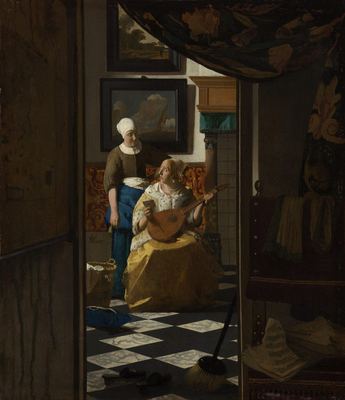
In the pictureA dark door frame and a curtain screen both sides of the picture, and between them a bright room can be seen. A woman in a yellow skirt and a white fur-trimmed jacket sits with a stringed instrument on her lap, a letter in her hand, looking up at the maid standing behind her. The maid wears a white cap and a blue apron. On the back wall hang a landscape painting and a painting of the sea with a sailing ship, and to the right of them a fireplace column and a green decorative band can be seen. Black and white tiles alternate across the floor, and on them lie a broom, a pair of slippers that have been taken off, and a laundry basket. Sheet music rests on the chair at the front right.
BackgroundIt dates from around 1669–1670. The instrument the woman holds is a stringed instrument called a cittern. In Dutch painting of the time, letters and musical instruments were subjects that hinted at love, and the seascape on the wall is also interpreted as alluding to the longing for a distant lover. The broom and slippers on the floor show that the housework has been briefly interrupted. The signature is low on the wall to the left of the maid. In 1971 it was stolen while on exhibition in Brussels and damaged when the canvas was cut out of its frame with a knife; after it was recovered, it was restored.
Puzzle tipStart with the bright room in the middle. The yellow skirt, the maid's blue apron and the white cap are the most eye-catching colors. The floor goes quickly if you follow the rows formed by the white tiles. The door on the left and the curtain and chair on the right are broad stretches of brown and black, so use the parts with crisp edges, such as the two pictures on the wall with their black frames, the yellow floral pattern on the curtain and the white paper of the sheet music, as reference points, and fill the rest last. The recommended piece count is about 100.
- Classification
- Painting
- Medium
- Oil on canvas
- Dimensions
- 44 × 38.5 cm
- Credit line
- Rijksmuseum, SK-A-1595
Source: Rijksmuseum ↗
Stories about this work
- From a Street in Delft to The Love Letter: Eight Vermeer Paintings in the Order He Painted Them
The Milkmaid, Woman Holding a Balance, The Love Letter and five more: eight Vermeer paintings in the order he painted them, the stories behind works spread across three museums, and tips for assembling white walls and dark rooms as puzzles.
- 16 Must-See Paintings at the Rijksmuseum in Amsterdam
Rembrandt's The Night Watch, Vermeer's The Milkmaid, a Van Gogh self-portrait, plus Hals and Jan Steen. The stories of 16 must-see paintings at the Rijksmuseum, what to check before you go, and how to meet them first as puzzles.