The Rocky Mountains, Lander's Peak
A lake, a waterfall and a Native American village beneath sunlit snowy peaks: the painting that showed the West to Easterners who had never seen it. Full commentary ↓
Couldn't load the puzzle image.
Turn on piece outlines to see piece positions on this picture too
Drag the pieces into place · When zoomed in, drag an empty spot to move around
You can also play with a keyboard — Tab to the board, thenSpace pick a piece, Arrow keys move it (with Shift for small steps),Esc deselect, R rotate a piece (Shift+R the other way)
The Rocky Mountains, Lander's Peak is an oil painting by Albert Bierstadt (1863) in the collection of The Metropolitan Museum of Art. It measures 186.7 × 306.7 cm.
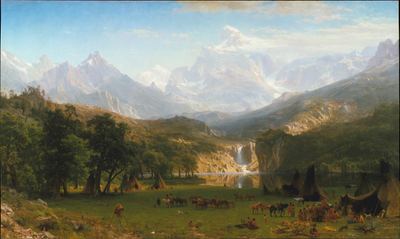
In the pictureThe upper half of the picture holds snow-covered peaks catching light through the clouds; the lower half, green meadows, a calm lake and an encampment of Native Americans with tents pitched. On the right a waterfall drops, and people with horses and dogs are dressing game. The mountains are painted much higher and steeper than they really are.
BackgroundIn 1859 Bierstadt went to the Rocky Mountains with a survey expedition to the West, gathering sketches and photographs, and in 1863 he completed this painting in his New York studio. The peak was named after the expedition's leader, Frederick Lander. Exhibited as if in competition with Church's Heart of the Andes, it was a great success and became an image that spurred railroads and migration to the West. The Native Americans in the painting were driven from that land a few years later.
Puzzle tipFirst divide it into top (mountains and sky) and bottom (meadow and encampment). The bottom has plenty of shapes, such as people, horses and tents, so it goes smoothly, while at the top the white pieces of snow and cloud are confusing. Join the pieces with the rocky ridgelines of the peaks (dark lines) first to establish the shape of the mountains, then fill in the white pieces between them.
- Artist
- American, Solingen 1830–1902 New York
- Culture
- American
- Medium
- Oil on canvas
- Dimensions
- 186.7 x 306.7 cm
- Credit line
- Rogers Fund, 1907
Source: The Metropolitan Museum of Art ↗
In these collections: Winter Masterpiece Puzzles
Stories about this work
- From Washington Crossing the Delaware to Madame X: Six American Paintings as Puzzles
A 3-meter panorama shown for an admission fee, a history painting full of errors, a portrait that scandalized the Salon. Six works by 19th-century American painters who helped shape the nation's image, and why big paintings are actually easier as puzzles.