Trousers
19th-century Indian trousers of orange silk, embroidered below the knee with flowering sprigs and small mirrors and banded at the ankle with a geometric border. Full commentary ↓
Couldn't load the puzzle image.
Turn on piece outlines to see piece positions on this picture too
Drag the pieces into place · When zoomed in, drag an empty spot to move around
You can also play with a keyboard — Tab to the board, thenSpace pick a piece, Arrow keys move it (with Shift for small steps),Esc deselect, R rotate a piece (Shift+R the other way)
Trousers is a textile by an unknown maker (19th century) in the collection of The Metropolitan Museum of Art. It measures 88.9 cm.
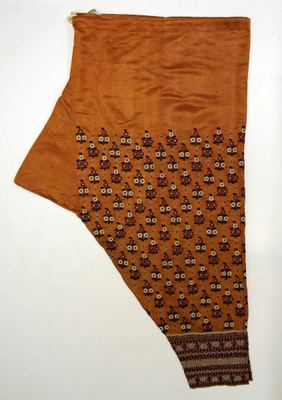
In the pictureA pair of orange silk trousers is laid out so that only one leg shows. A white cord sticks out at the waist at the top, the hip area is wide and plain, and the leg narrows toward the bottom. From knee height down, small flowering sprigs, white round flowers with red buds and dark green leaves, repeat in rows offset by half a step, with small round mirror embroideries set between them. Each sprig has a red bud rising above a single white flower. At the ankle is a band with white wheel motifs and wavy lines embroidered on a dark ground.
BackgroundThe Met's record describes them as women's trousers made in India in the 19th century, of silk with mirror embroidery. They are 88.9 cm long and 91.4 cm wide, wider than they are long, apparently because of a generous cut that is cinched at the waist with a cord. They were given by Ethel Frankau in 1950, and their accession number continues the C.I.50.16 series shared with an ocher child's garment (86116) from the same gift. Embroidery that fixes small pieces of mirror by encircling them with thread was a technique widely used in western India and the Sindh region.
Puzzle tipThe boundary between the plain upper part and the embroidered lower part is clear. First fix the top and bottom ends with the dark ankle-band pieces and the white cord at the waist, then join the sprig pieces by matching the slant of their rows. In the plain upper area, the large horizontal folds show the direction. Tell the triangular part jutting out to the left from the plain orange pieces by their sheen and folds. The mirror spots appear as small gray circles, which can be used to match the spacing between sprigs. 48 pieces works well.
- Classification
- Main dress-Womenswear
- Medium
- Silk; mirror embroidered
- Dimensions
- 88.9 cm
- Credit line
- Gift of Ethel Frankau, 1950
Source: The Metropolitan Museum of Art ↗
Stories about this work
- How Mirror Embroidery from Western India Made Its Way to a London Shop
An embroidery technique that fixes small pieces of mirror in place with thread. A pair of trousers worn by the people who made it, and a dress sold to the European upper class through a London shop.