Choga
A late 18th–early 19th-century Indian choga of tan wool with red bands embroidered with small animals and flowers and two pairs of silver fastenings. Full commentary ↓
Couldn't load the puzzle image.
Turn on piece outlines to see piece positions on this picture too
Drag the pieces into place · When zoomed in, drag an empty spot to move around
You can also play with a keyboard — Tab to the board, thenSpace pick a piece, Arrow keys move it (with Shift for small steps),Esc deselect, R rotate a piece (Shift+R the other way)
Choga is a textile by an unknown maker (late 18th–early 19th century) in the collection of The Metropolitan Museum of Art.
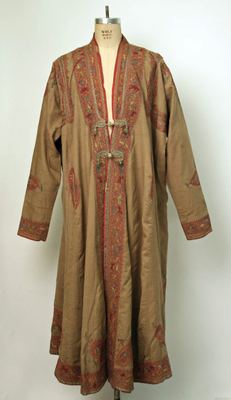
In the pictureAn ankle-length outer garment of tan wool is shown on a mannequin. Red-ground embroidered bands run along both front edges, the cuffs and the hem; within the bands are small animals, birds and flowers in blue, off-white and red, and the outer edges are jagged like teeth. Two pairs of paisley-shaped silver ornamental fastenings are attached at the chest. Separate almond- and paisley-shaped embroideries are placed at the sides, upper arms and near the hem, and a red lining shows inside the front edges.
BackgroundThe Met's record describes it as a coat made in India in the late 18th to early 19th century, with the materials wool, silk and embroidery. It measures 140.3cm long and 189.2cm wide, longer than the other chogas on this site, 86171 (124.5cm), 86176 (119.4cm) and 86177 (95.3cm), and also the earliest. It was given by Mrs. Frederick James Dennis in 1962. Working small animals and paisleys in colored thread on fine wool is said to be related to Kashmir shawl embroidery, but the exact place of manufacture is recorded only as India. The material of the silver fastenings is not recorded either.
Puzzle tipThe tan ground and red bands are clearly separated, which makes it pleasant to solve. Fit the two red bands down the front and the two pairs of silver fastenings at the chest first to set up the central axis, then anchor the lower outline with the bands at the cuffs and hem. The almond motifs at the sides and the paisley on each upper arm are markers that show left and right positions. Fill the broad tan pieces by the vertical shadows of the folds. 100 pieces is about right.
- Classification
- Main dress-Menswear
- Medium
- Wool, silk; embroidered
- Dimensions
- Overall:
- Credit line
- Gift of Mrs. Frederic James Dennis, 1962
Source: The Metropolitan Museum of Art ↗
Stories about this work
- Angarkha, Choga, and Kurta: Embroidery and Weaving in Indian Menswear
The kurta is a long shirt worn across South Asia, the angarkha a robe that fastens diagonally across the chest, the choga a loose open-front robe. Nine 18th–19th century garments at the Met show the differences and the embroidery.