Water-Moon Avalokiteshvara
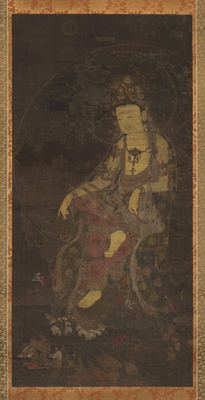
Avalokiteshvara sits on a rock gazing down at the boy Sudhana, in another version of a 14th-century Goryeo Water-Moon painting with gold still visible. Full commentary ↓
Couldn't load the puzzle image.
Turn on piece outlines to see piece positions on this picture too
Drag the pieces into place · When zoomed in, drag an empty spot to move around
You can also play with a keyboard — Tab to the board, thenSpace pick a piece, Arrow keys move it (with Shift for small steps),Esc deselect, R rotate a piece (Shift+R the other way)
Water-Moon Avalokiteshvara is a painting by an unknown maker (14th century) in the collection of The Metropolitan Museum of Art. It measures 102.9 × 51.8 cm.
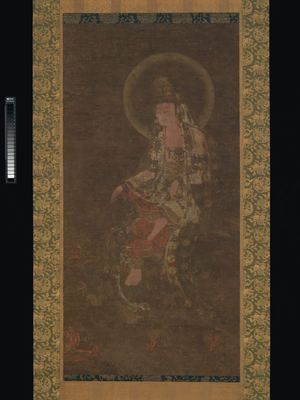
In the pictureWithin a mounting of blue patterned silk, Avalokiteshvara sits at ease on a rock. Behind the head is a large circular halo, and a sheer white veil, a red skirt and jewelry painted in gold stand out against the dark ground. At lower left a small figure stands with palms pressed together, and beside him is a ritual water bottle holding a willow sprig.
BackgroundViewed alongside the other Water-Moon Avalokiteshvara in the same museum, it shows how the same iconography changes from painter to painter and period to period. In this painting the circle of the halo is larger and sharper, and more of the gold survives. Goryeo-dynasty Buddhist paintings used a technique called baechae, applying color to the back of the silk as well to soften the colors on the front, which is why the colors endure over time.
Puzzle tipMost of it is dark background, so the circle of the halo and the outlines of the figures are the key. Assemble the red skirt, the face and the gold jewelry pieces first, then look for the dark pieces that the halo's circle passes through. The blue patterned pieces of the mounting sit at the edges and are easy. Normal (about 48 pieces) or Hard (about 100) is a good fit.
- Period
- Goryeo dynasty (918–1392)
- Culture
- Korea
- Classification
- Paintings
- Medium
- Hanging scroll; ink, color, and gold on silk
- Dimensions
- 102.9 × 51.8 cm
- Credit line
- H. O. Havemeyer Collection, Bequest of Mrs. H. O. Havemeyer, 1929
Source: The Metropolitan Museum of Art ↗
Stories about this work
- Faces That Are Not Bodhisattvas: A Monk's Portrait and a Hand-Copied Sutra
Korean Buddhist art brings bodhisattvas to mind first, but it also includes portraits of monks, sutras written in gold powder, and paintings of guardian deities. Five works show another side.
- The Gold Lines of Goryeo Buddhist Paintings Only Appear When You Zoom In
Goryeo Buddhist paintings are exquisite down to each fine gold line. We assemble four from the Met, including Water-moon Avalokiteshvara, telling them apart by what the figures hold and how their robes are rendered.