Faces That Are Not Bodhisattvas: A Monk's Portrait and a Hand-Copied Sutra
Published
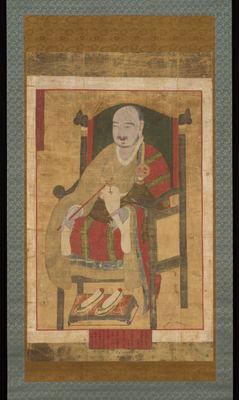
A pair of shoes sits neatly on the footrest beneath a chair. The man seated above them is neither a bodhisattva nor a Buddha, but an old monk who led warrior monks during the Imjin War (the Japanese invasions of Korea). Korean Buddhist art first brings to mind the faces of Avalokiteshvara or Kshitigarbha, and those bodhisattva paintings were already covered in Buddhist paintings of Goryeo and Joseon. But Buddhist art also has many faces that are not bodhisattvas: portraits of monks who actually lived, sutras copied by hand, and crowds of deities who guard the Buddha. Five works give a sense of that range.
| Work | Period | Type |
|---|---|---|
| Portrait of the Great Master Seosan | Late Joseon | Portrait of an eminent monk |
| Illustrated manuscript of the Lotus Sutra | Goryeo, around 1340 | Hand-copied sutra |
| Shakyamuni triad | Joseon, 1565 | Buddhist painting |
| Water-Moon Avalokiteshvara | Goryeo, 14th century | Buddhist painting |
| Brahma with Attendants and Musicians | Joseon, late 16th century | Painting of guardian deities |
The monk who raised an army past seventy
 Solve this painting as a puzzle → about 5 minutes on Easy
In Portrait of the Great Master Seosan, an old monk with a shaved head sits in a chair and looks straight ahead. The Great Master Seosan, Hyujeong (1520–1604), gathered warrior monks from across the country during the Imjin War, when he was past seventy, and fought the Japanese army.
A portrait like this is called a jinyeong. In late Joseon temples, portraits of great monks were painted, enshrined in a patriarchs’ hall, and honored with memorial rites. The seated, frontal pose and the pair of shoes on the footrest below the chair are fixed conventions of the jinyeong. Unlike the way Buddhas and bodhisattvas are painted, this is a picture that honors a person who actually lived.
As a puzzle, the straight lines of the chair and footrest are helpfully clear. Build the framework with these lines, then fill in the face and the monk’s robe. 48 pieces is about right.
A sutra written in gold on indigo paper
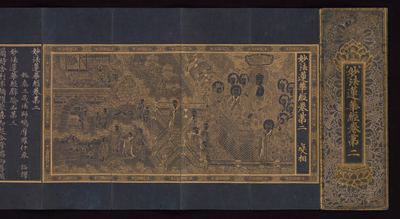
Strictly speaking, the Illustrated manuscript of the Lotus Sutra is more a book than a painting. The text was written in gold and silver on paper dyed indigo, and only the opening has a scene of the Buddha preaching, drawn in gold line.
Sagyeong is the practice of copying sutras by hand. In Goryeo, it is said, people dyed paper indigo and wrote the text in gold and silver powder to accumulate merit. Copying each character one by one was itself an act of faith. Such manuscripts were commissioned by the royal family and aristocrats, and they are counted among the representative works of Goryeo Buddhist art from the period of Mongol domination. It is a small book, 23 centimeters tall, but the effort put into it is out of all proportion to its size.
With rows of gold and silver characters, you can join pieces by following the direction of the lines of text. The gold-line picture on the left is better assembled separately, and 48 pieces is recommended for this one too.
A great Buddhist project in a Confucian state
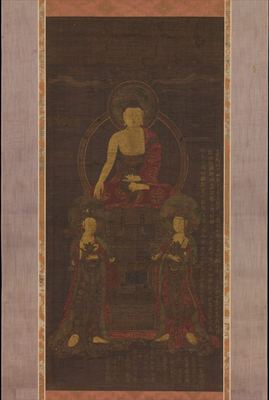
Shakyamuni triad shows the Buddha Shakyamuni and two bodhisattvas in gold and color. 1565 is the year Queen Munjeong, mother of King Myeongjong, had 400 Buddhist paintings made to mark the rebuilding of Hoeamsa Temple, and this painting appears to have come from that commission.
In Joseon, which took Confucianism as its state ideology, it was rare for the royal house to undertake a Buddhist project of this size. That is why the paintings from this time became reference works for gauging early Joseon Buddhist painting. That a royal woman sponsored Buddhist art on this scale is remarkable in itself.
The same Avalokiteshvara, a different hand
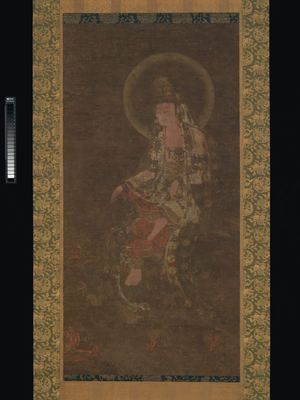
Water-Moon Avalokiteshvara is worth viewing side by side with the other Water-moon Avalokiteshvara in the same museum, discussed in the earlier post. You can see how the same iconography changes with the painter and the period. In this painting the circle of the halo is larger and clearer, and more of the gold paint survives.
There is a reason the colors of Goryeo Buddhist paintings last. Painters used baechae (back-coloring), applying color to the back of the silk as well, so that it gently supports the color on the front. Rather than painting the front and stopping there, they laid down color once more from behind.
For Buddhist paintings like the triad and the Avalokiteshvara, where the places of the central figure and the surrounding figures are clearly divided, start from the center and widen outward along the round rim of the halo. Choose anywhere between 48 and 100 pieces.
A procession of deities painted on hemp
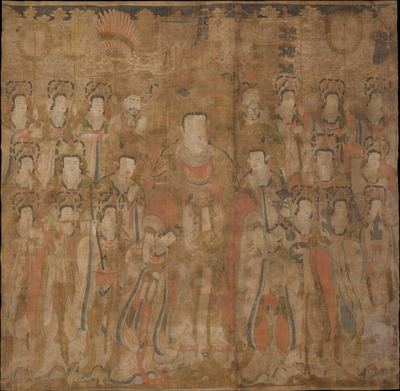
Brahma with Attendants and Musicians is a large painting, more than 2 meters both wide and tall. More than twenty figures stand in rows around Brahma. Brahma is the Indian god who entered Buddhism and became a guardian deity protecting the Buddha’s teachings.
The first thing that catches the eye in this painting is its ground. It was painted not on silk but on cheap hemp cloth. This is the basis for the guess that temples were not well off around the time of the Imjin War. Even so, every figure has a different face and there are many kinds of instruments, so the painting is also used as a source for research on Joseon-era musical instruments. A picture painted for faith unexpectedly tells us about daily life in its time.
A painting of guardian deities with more than twenty figures in rows will wear you out if you try to assemble it all at once. It is better to divide it into small groups of three or four figures and finish them one at a time. As a large Buddhist painting crowded with figures, it is recommended at 100 pieces.
Transcendent faces, human faces, nameless hands
Placed together, the five works show that Korean Buddhist art did not stop at painting the faces of bodhisattvas. It honored people who actually lived, made copying sutras an act of faith, received lavish royal sponsorship, and in temples short of money, painted the deities with whatever materials could be found. General tips for assembling Korean paintings are in the Joseon painting puzzle guide, and paintings made to keep a record continue in the post on record paintings.
Beside the transcendent faces of Buddhas and bodhisattvas is the bare face of the aged Master Seosan. And behind the gold characters of the copied sutra is someone who did not leave even a face behind. The hand of that person, who must have held their breath so as not to get a single character wrong, is what stays with me longest among the five.