Woman in Blue Reading a Letter
A woman in a blue jacket stands before a wall map reading a letter: one of Vermeer's best-known interiors, made of blue light and stillness. Full commentary ↓
Couldn't load the puzzle image.
Turn on piece outlines to see piece positions on this picture too
Drag the pieces into place · When zoomed in, drag an empty spot to move around
You can also play with a keyboard — Tab to the board, thenSpace pick a piece, Arrow keys move it (with Shift for small steps),Esc deselect, R rotate a piece (Shift+R the other way)
Woman in Blue Reading a Letter is an oil painting by Johannes Vermeer (ca. 1663) in the collection of Rijksmuseum. It measures 46.6 × 39.1 cm.
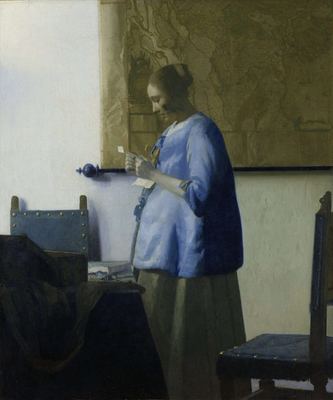
In the pictureA woman stands in profile in the center of the picture, holding a letter in both hands and reading. An olive skirt falls below her loose blue jacket, and her hair is tied back. On the wall behind her, a large map faded to yellow hangs from a black rod, with blue knobs at its ends. On the table at left front are a dark cloth, a box and papers, and on either side are blue leather chairs studded with brass nails. No window is visible, but light coming from the left brightens the white wall and the woman's face and hands. The chair on the right is half cut off by the edge of the picture.
BackgroundIt dates from about 1663. The map on the wall is known to be a map of Holland that was actually published at the time, and it is said to appear in other paintings by Vermeer. Neither the letter's contents nor its sender is shown, so viewers are left to guess at the story. Because of her ample jacket, some interpret the woman as pregnant, while others argue it was simply a common style of dress at the time. During the 2010–2011 restoration, the yellowed varnish was removed and the blues became vivid again.
Puzzle tipThe blue jacket is the easiest place to start. The hands holding the letter and the face are small but bright, so they are easy to find. Next, join the horizontal rod of the map, the blue knobs at its ends and the rows of brass nails on the chairs to make reference lines. The map has many fine lines on a yellowish ground, so match pieces by the direction of the lines; the white wall on the left and the gray-green wall at lower right differ only subtly in brightness, so leave them for last. For the dark table at lower left, use the folds of the cloth as clues. The recommended size is about 100 pieces.
- Classification
- Painting
- Medium
- Oil on canvas
- Dimensions
- 46.6 × 39.1 cm
- Credit line
- Rijksmuseum, SK-C-251
Source: Rijksmuseum ↗
Stories about this work
- From a Street in Delft to The Love Letter: Eight Vermeer Paintings in the Order He Painted Them
The Milkmaid, Woman Holding a Balance, The Love Letter and five more: eight Vermeer paintings in the order he painted them, the stories behind works spread across three museums, and tips for assembling white walls and dark rooms as puzzles.
- 16 Must-See Paintings at the Rijksmuseum in Amsterdam
Rembrandt's The Night Watch, Vermeer's The Milkmaid, a Van Gogh self-portrait, plus Hals and Jan Steen. The stories of 16 must-see paintings at the Rijksmuseum, what to check before you go, and how to meet them first as puzzles.