Why Every Painting Puzzle Here Is Free to Use: CC0 and the Public Domain
Published · updated
“Are these paintings okay to use, copyright-wise?” It is the question I hear most often while running a puzzle site. The short answer is yes. The paintings posted here are only images that The Metropolitan Museum of Art (The Met) and the Art Institute of Chicago have released as CC0 (public domain). The long answer has to start with what CC0 releases and what it leaves untouched.
A declaration of giving up rights
CC0 is a tool created by Creative Commons, used by a copyright holder to state that they are giving up their rights as far as they can. If the public domain is “the state of having no copyright,” CC0 is the document that lets the rights holder bring a work as close to that state as they can on their own. Some countries do not legally recognize a waiver of rights, so in those places it is designed to work instead as the broadest possible license.
The paintings themselves are usually not a problem. The painters died long ago, so the protection period has ended (how long that period lasts differs from country to country). The tricky part is the photograph of the painting. Even if the original is in the public domain, it is hard to say flatly that the photo is free as well, and interpretations differ by country. When a museum releases images it photographed itself and pins them down as CC0, that ambiguity disappears. That is also why we insist on museum-released images rather than painting photos turned up in a search.
Attribution is not a condition of CC0. Even so, every puzzle page carries a link to the original holding museum at the bottom. I think of it as the least we can do for the people who painted the pictures and for the museums that put the images out for free.
Why museum images are so sharp
Images of unknown origin vary in quality, and there is no way to check their copyright status. Large museums like The Met photograph the originals themselves at high resolution and release them through an API along with organized metadata such as artist, date, and technique. In practice, about two-thirds of the originals we have downloaded are more than 3000 pixels on the long side.
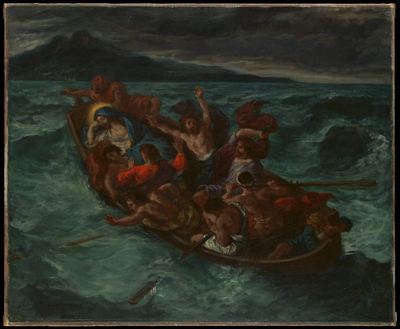 Solve this painting as a puzzle → about 5 minutes on Easy
This is why Christ Asleep during the Tempest looks especially sharp.
Not the entire collection is open
The Met began releasing images of its collection as CC0 under its Open Access policy in 2017. A point people often miss is that this covers not the entire collection but only works the museum has judged to be in the public domain. If copyright is still in force, the work is left out even if an image exists.
So the criterion for choosing works is simple. Only works marked as public domain in the museum’s API and accompanied by an image become candidates. When we tried skimming the modern art department, where 20th-century works are concentrated, we looked through 300 works and found only a couple we could use, so we gave up. Older fields such as Egypt, the Islamic world, and the Middle Ages are the opposite, and we gathered plenty. There are now 334 works in eight categories, and the range has widened from European paintings to Korean paintings of the Joseon dynasty.
Don’t read the credit line as terms of use
If you expand “More about this work” on a puzzle page, there is a line labeled “credit line.” It is copied straight from the museum’s credit line. For the Christ Asleep during the Tempest mentioned above, it reads “H. O. Havemeyer Collection, Bequest of Mrs. H. O. Havemeyer, 1929.” It means Mrs. Havemeyer bequeathed it in 1929. It only tells you how the work came into the museum and has nothing to do with the conditions under which the image may be used.
If you want to know the terms of use, it is more accurate to click the “Source” link below it and check the museum’s original page. The museum’s official guidance, not this site’s explanation, should be the standard.
If you want to use the images here
The museums have stated that because the painting images are CC0, they are free to use, even commercially. But the things layered on top of them are a different matter. The commentary, blog posts, page layout, and the edited form of the printable PDFs are listed in the terms of use as rights of the site.
Nor does CC0 clear rights held by third parties, such as trademarks or rights of publicity. This post is an explanation to the extent the operator understands the matter, not legal advice. If you intend to use the images commercially or cannot decide, I recommend reading the museum’s usage policy yourself.
In the end, all of this is a mechanism for letting anyone hold a centuries-old painting in their hands and look closely at it. Once you experience how a painting starts to look different as you fit the pieces together one by one, you feel anew how grateful you are that the museums opened up their images.
Frequently asked questions
Are there any copyright issues with the painting images on this site?
We use only images that The Metropolitan Museum of Art and the Art Institute of Chicago have released as CC0 (public domain). We consider only works the museums have judged to be in the public domain and released as such, and we do not include works whose protection period after the artist's death has not yet ended. Image files for works from the Art Institute of Chicago are downloaded from Wikimedia Commons, where the images released by the museum have been copied.
What does CC0 mean?
It is a Creative Commons declaration in which a copyright holder states that they are giving up their rights as far as possible. It does not make attribution a condition, but this site always shows a link to the original holding museum on every puzzle page.
Can I take the images from this site and use them?
The museums have stated that the painting images themselves are CC0, so they can be used freely, including for commercial purposes. However, the commentary, blog posts, and the edited layout of the printable PDFs created by this site belong to the site, and CC0 does not clear other rights such as trademarks or rights of publicity. If in doubt, check the museum's usage policy directly.