From Goryeo Buddhist Paintings to Joseon Screens: 18 Korean Paintings as Puzzles
Published · updated
Bamboo leaves are swept to one side by the wind. There is not a single color; the painter captured even the direction of the wind using nothing but the difference between dark and light ink. Ink paintings like this have found their way into a puzzle list that started out mostly with Western masterpieces. They are Korean paintings that The Metropolitan Museum of Art has released into the public domain, now 18 in all: five Goryeo Buddhist paintings and sutras, twelve paintings from the Joseon dynasty, and one folding screen from the early 20th century. Here is a short tour, genre by genre.
Literati painting: the mind drawn in ink
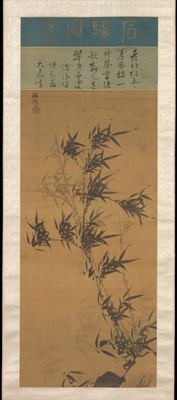 Solve this painting as a puzzle → about 5 minutes on Easy
The bamboo at the opening is Bamboo in the Wind, an ink bamboo painting by Yi Jeong, a painter of the mid-Joseon period. Without color, he expressed the grain of the leaves and the direction of their swaying through the shading of ink alone. Literati painting is not meant to show off technique. It tries to hold the mind and integrity of the person who painted it, so the eye goes to restrained brushwork rather than splendor. Assembling it as a puzzle makes you feel much more clearly how finely he controlled the darkness and lightness of the ink.
There is one more ink painting of wind. In Grapevine in the Wind, a 16th-century work by an unknown artist, thick vines and leaves lean to one side as if swept by the wind. It is the same idea as painting bamboo in the wind. In the early-19th-century Grapevine and Squirrels, squirrels perch on the same kind of grapevine. Grapes with many berries and squirrels that bear many young were a wish for thriving descendants. For solving with a child, Jeong Hong-rae’s Hawk at Sunrise is actually the better choice. The red sun, the brown hawk and the blue rocks each take up their own area, so the colors are distinct.
Gold lines on dark silk: Buddhist paintings
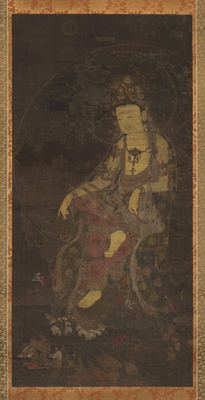
Water-moon Avalokiteshvara shows Goryeo Buddhist painting at its finest. On a dark silk ground, the bodhisattva’s gold ornaments and the lines of the thin, sheer fabric come softly to life. Most of the picture is dark, so if you first solve it at around 48 pieces to get your eyes used to it and then raise the piece count, following each individual line becomes a pleasure.
There are four Goryeo Buddhist paintings in all: two of the Water-moon Avalokiteshvara, one of Amitabha with Kshitigarbha, and one of Kshitigarbha. The story of lines drawn in gold paint and color applied from the back of the silk is told separately in the gold lines of Goryeo Buddhist painting. Joseon Buddhist paintings have a different character. The Shakyamuni triad, painted in gold and colors in 1565, is a small picture about 60 centimeters tall, while Brahma with Attendants and Musicians, more than 2 meters in both height and width, was painted on hemp instead of silk. These two, along with a sutra written in gold and silver on indigo paper, are covered in paintings that are not the face of the Buddha.
Down to a single hair: portraits
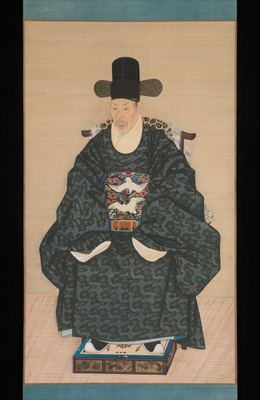
Joseon portraiture is famous for a realist tradition summed up in the saying, “If even one hair is different, it is not the same person.” Age spots and wrinkles on the face were not hidden. The Portrait of Yun Dongseom (1710–1795) is a typical example of late Joseon portraiture in this sense. Yun Dongseom (1710–1795) was a civil official under Kings Yeongjo and Jeongjo, and the double-crane rank badge on his chest marks a high-ranking civil official. The cloud pattern on the robe is large, but the face alone is drawn in very fine lines. So as a puzzle, it is better to fix the pieces that differ in color first, such as the face, the rank badge and the footstool.
The painting is recorded as dating from around 1790–1805. Since Yun Dongseom died in 1795, this record alone cannot tell us whether it was painted during his lifetime or copied after his death. The Portrait of the Great Master Seosan is a portrait of a different kind. It was painted long after Hyujeong (1520–1604) died. Such portraits of masters were kept in a temple’s hall for patriarchs, so everything, from the pose of sitting in a chair facing forward to the shoes on the footstool, follows a fixed convention.
Long, flat landscapes and screens
For landscapes, there are two from the Eight Views of the Xiao and Xiang rivers: Wild geese descending to sandbar and Evening bell from mist-shrouded temple; Autumn moon over Lake Dongting. Mist and empty silk take up a large share of the picture, which puts them among the hardest puzzles on the whole site. Tips for solving them are in the post on the Eight Views.
There are two ten-panel folding screens: the early-20th-century Books and Scholars’ Possessions, and Still life with bronze vessels and flowering plants, painted by Jang Seung-eop in 1894. Unfolded, the still-life screen is more than 4 meters wide. The puzzle grid comes out flat as well, so start by standing up the pieces of the vertical margins between the panels to divide the picture into sections. Gathering of government officials, a record of a meeting of officials, is covered together with the books screen in paintings made to keep a record.
Next to a European portrait of the same era
Around the same time, Europeans painted people and landscapes in oil, while in Joseon painters tried to capture the spirit with ink and brush. Assembling the two in turn lets you feel the difference at your fingertips. Comparing portraits makes it even clearer. Drouais’s Portrait of a Young Woman as a Vestal Virgin, painted in 1767, dresses an aristocratic woman as a Roman priestess, but who she was has not come down to us. The portrait of Yun Dongseom gives a clear name and office, and keeps even the blemishes on his face. That is not to say all Western portraits are like this. It is only a comparison from setting these two side by side. There is more on this in paintings look different once you assemble them.
I plan to keep adding Korean paintings. The ones available now can be seen at a glance in the full list on the home page. Holding on to a single bamboo leaf swept by the wind, or a single age spot in a portrait, as a puzzle piece, you begin to understand a little of what the old painters were determined not to miss.
Frequently asked questions
How many Korean paintings are on this site?
There are 18 Korean paintings that The Metropolitan Museum of Art has released into the public domain: Goryeo Buddhist paintings, literati paintings, portraits, landscapes and folding-screen paintings.
How many Goryeo Buddhist paintings are there?
Four: two Water-moon Avalokiteshvara paintings, one of Amitabha with Kshitigarbha, and one of Kshitigarbha.
Who painted Bamboo in the Wind?
It is an ink bamboo painting by Yi Jeong, a painter of the mid-Joseon period. Without any color, using only the shading of ink, he painted the grain of the bamboo leaves and the direction in which they sway in the wind.