The Bible, Shakespeare and a Friend's Garden: Five Paintings by Delacroix
Published
There are five paintings by Eugène Delacroix here, yet until now no post has been about this painter alone. The five have each appeared just once, as example images in posts like the explanation of public domain or learning to look at art through puzzles. That is a strange way to treat the leading painter of Romanticism. So this time the five are gathered in one place. Brought together, their subjects turn out to be far more varied than expected.
| Work | Subject | Year |
|---|---|---|
| Christ Asleep during the Tempest | The Bible | ca. 1853 |
| George Sand’s Garden at Nohant | Landscape | ca. 1842–43 |
| Hamlet and His Mother | Literature | 1849 |
| Madame Henri François Riesener | Family portrait | 1835 |
| The Natchez | Novel, large-scale work | 1823–24 and 1835 |
The One Man Asleep in the Middle of a Storm
 Solve this painting as a puzzle → about 5 minutes on Easy
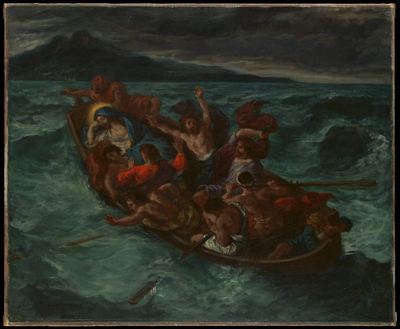
Green waves rise as if to swallow the boat, and the disciples are terrified. Yet Christ, at the bow, has fallen asleep with his head on his arm. Christ Asleep during the Tempest depicts the story of the Sea of Galilee from the Gospel of Mark. Delacroix painted this subject more than six times in the 1850s. Compared with the large works of his youth, the canvas is small and the brushwork rough, so the waves and the sky register first as color and movement rather than as forms.
As a puzzle it is no pushover. The green sea covers more than half the picture. Finish the middle band with the boat and the figures first, then divide the sea into light pieces with foam and dark pieces without, and join them along the grain of the waves.
A Summer in a Friend’s Garden
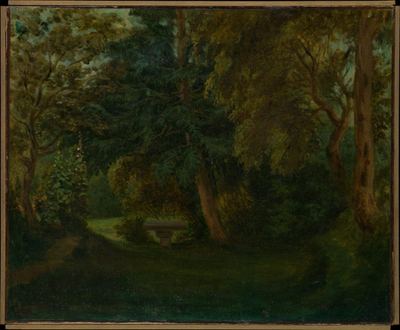
There are no people in George Sand’s Garden at Nohant. There is only a stone bench at the end of a small path running between dark green trees. Nohant was the country house of the novelist George Sand, and Delacroix stayed there in the summers of 1842 and 1843 at the invitation of Sand and Chopin. It was rare for a painter known for history paintings and dramatic scenes to paint such a quiet garden. It reads like a diary entry about a summer spent at a friend’s house.
This painting is also almost entirely green, so it is not easy. Pin down the sky at upper left, the tree trunks on the right and the bench in the center first, then divide the remaining green into yellow-green and blue-green as you go. I recommend 100 pieces or fewer. Why landscapes that are all green, like forests, are especially hard is covered separately in how to choose a landscape puzzle.
A Painter Who Held On to Shakespeare All His Life
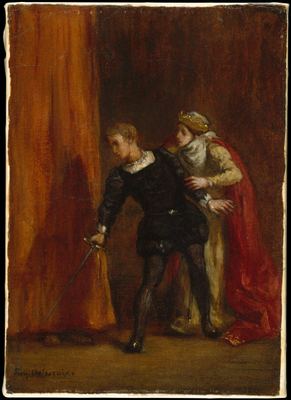
Hamlet and His Mother is a small oil painting 27 centimeters tall. Hamlet, his sword point lowered, glares toward a red curtain, while behind him Queen Gertrude grabs his arm. It is Act 3, Scene 4 of Hamlet, just after he has stabbed Polonius, who was hiding behind the curtain. After seeing an English company perform Shakespeare in Paris in the 1820s, Delacroix could not let go of Hamlet, and from 1834 he spent more than ten years producing a series of Hamlet lithographs. This oil painting repaints one scene from that series. Other paintings drawn from literature are collected in paintings from books and myths.
At higher piece counts it is easy to get lost in the red curtain. Gather the faces and hands of the two figures and the sword first. The curtain darkens toward the bottom, so use that shading to tell vertical position.
A Portrait That Includes His Aunt’s Wrinkles
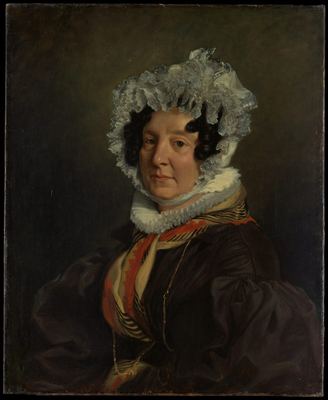
In Madame Henri François Riesener (Félicité Longrois, 1786–1847), a middle-aged woman in a white lace bonnet looks out at us. The sitter, Félicité Longrois, was the wife of the painter Henri François Riesener, who was Delacroix’s maternal uncle. So this is a family portrait of the painter’s aunt. Unlike a commissioned portrait, it has little embellishment, and the wrinkles and fullness of the face are rendered as they are, so you can sense how close the two were.
Fit the white bonnet and collar first, following the direction of the lace folds, and separate the dark background from the purple dress by whether the brushwork has a sheen. The general order for assembling a portrait is in the portrait puzzle guide.
A Large Work Finished 12 Years After It Was Begun
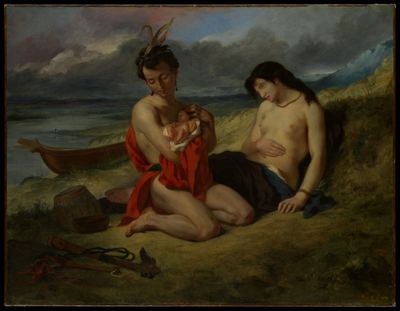
In The Natchez, an exhausted woman lies reclining beside a man holding a newborn on a riverbank. It is the passage from Chateaubriand’s novels Atala and Les Natchez in which a couple fleeing after their tribe has been massacred have a child on the banks of the Mississippi. Delacroix began this painting in 1823, set it aside for a long time, and only finished it in 1835 and sent it to the Salon. It is a Romantic subject chosen in his youth, overlaid with the brushwork of his maturity.
The red cloth and the skin of the two figures occupy the center of the picture, so start there. Small objects like the canoe, the bow and the arrows are the clues that help pieces find their places.
Quiet Faces from a Dramatic Painter
A religious painting, a literary painting, a landscape study, a family portrait, and a large work that took 12 years. The few violent history paintings that come to mind at the name Delacroix do not show this range. The hand that painted storms and swordplay grew quiet before a friend’s garden and set aside embellishment before his aunt. If you had to pick the least Delacroix-like of the five, it would be the empty bench at Nohant, yet if you look at it long enough, it feels like the most personal of them all.