Apron, Vest and Overcoat: Four Layered Costumes from the Balkans
Published
A vest over the blouse, an apron over that, and an overskirt on top of the skirt. Folk dress in the Balkan Peninsula and Anatolia was less about putting on one garment than about stacking many garments, one on top of another. Looking in turn at one apron, one woman’s ensemble and two men’s ensembles gives a sense of how this layering worked.
| Work | Worn by | Materials |
|---|---|---|
| Apron | Women | Wool, metallic thread |
| Ensemble | Women | Wool, cotton, metallic thread, ramie, leather, glass |
| Ensemble | Men | Mixed materials |
| Ensemble | Men | Wool, cotton, silk, ramie, leather |
How a Cloth Covering the Skirt Became the Star of the Outfit
 Solve this painting as a puzzle → about 5 minutes on Easy
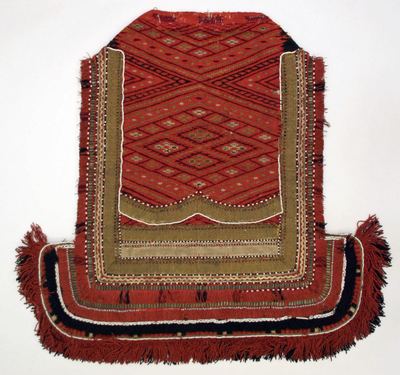
The Apron is narrow at the top and widens toward the bottom. On the red ground at the top, white dots and diamond patterns are woven in layer after layer; below, green and red bands follow one another, and red tassels run all around the edge. In women’s dress in Eastern Europe, the Balkans and Anatolia, the apron was more than something tied on to keep the skirt clean. It was the most eye-catching ornament in the whole outfit. The diamond was widely used as a pattern invoking fertility and protection, and an apron with tassels and metallic thread was festival wear. The pattern is not embroidered; it was woven in along with the cloth.
Six Materials in One Woman’s Outfit
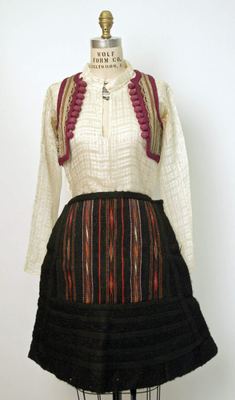
The woman’s ensemble layers a short vest with purple pompom trim over a white checked blouse, with a black skirt with red vertical stripes and a black overskirt below. The list of materials runs to wool, cotton, metallic thread, ramie, animal leather, and even glass. In the Balkans and Eastern Europe, an outfit came together only once many pieces like these were layered, and the color and pattern of each part showed which village a person came from and whether they were married. The materials are so varied because different craftsmen made different parts. The pompoms and glass beads would have jingled and glittered with every step.
Men Wore Layers Too
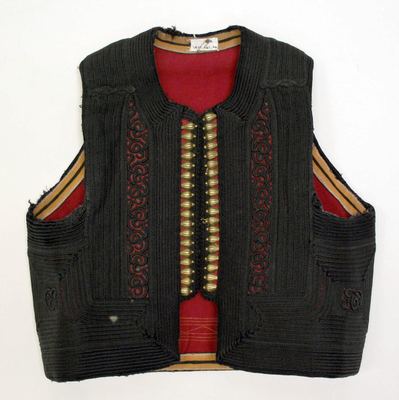
Layering was not only a feature of women’s dress. One man’s ensemble is a short vest of black cloth with black cord wound and stitched on densely to give it a thick texture. A row of metal buttons runs down the front, and red thread is embroidered in swirls across the chest. This kind of applied cord decoration appears often in Balkan men’s dress. Because it made the cloth thicker, it also served to protect the body. The row of buttons was closer to ornament than to a fastening, and how many buttons there were and how large they were spoke of the wearer’s wealth and status.
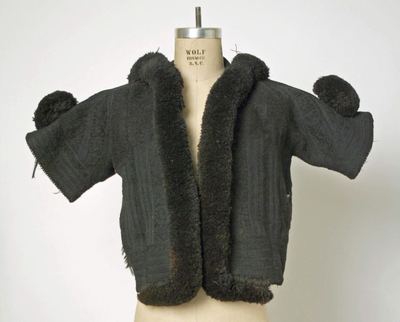
The other man’s ensemble is a short overcoat thickly trimmed with black fleece at the front opening, the cuffs and the shoulders. To get through winter in the mountain regions of the Balkans, an overcoat lined or edged with fleece was essential. Showing the fleece on the outside was meant not only for warmth but also to display how rich the garment was. This overcoat, too, is one part of a multilayered outfit.
Apron Apart, Vest Apart, Overcoat Apart
Set the four side by side and you can see why so many pieces were needed. In the folk dress of this region, each part had its own materials and its own maker. Only by choosing and combining these parts to suit the formality of the day did they become a complete outfit. That is also why wool, cotton, metallic thread, ramie, leather and glass all appear together in a single line of a materials list.
Sorting by Pattern Direction and Texture
On the apron, the diamond pieces at the top and the horizontal band pieces at the bottom separate just by the direction of the pattern. Frame the outer outline first with the tasseled edge pieces, then fill in the inside. Because the pattern repeats, it is easier at 100 pieces with the preview on. The woman’s ensemble divides clearly by color: white blouse, purple pompoms, red-striped skirt, black overskirt. Start with the pompom pieces on the vest and the vertical-stripe pieces on the skirt; 100 pieces is about right.
For the cord-trimmed vest, sort the pieces by the direction the cord runs (vertical, horizontal, curved). Set up the central axis by joining the row of metal buttons and the red lining first, and the rest follows. Forty-eight pieces is plenty. The fleece overcoat is almost all black pieces, but the fleece and the quilted cloth have different textures and can be told apart if you look closely. Start with the white neck of the mannequin and the rounded outline of the shoulders, then work the fleece around the edges. This one, too, is best at 48 pieces.
Because these ways of making clothes come from the same region and a similar climate, they have a lot in common with the leather coats in the Hungarian shepherds’ winter clothes. To see how this layering carries over into vests, blouses and dresses, see a tour of Eastern European embroidery. In the museum’s glass case each stands as a single outfit, but these clothes were originally combinations put together anew each time to suit the formality of the day.