Puzzle Tips for Degas and Lautrec Drawings, Down to the Paper Color
Published
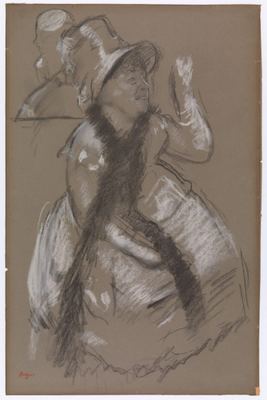
A portrait of a woman sits not on white paper but on paper tinted gray-green. The shadows of the face are in black pastel, the places the light touches are in white pastel, and the rest is simply the color of the paper. Among the 40 works in the Drawings and Prints department are several by Degas and Toulouse-Lautrec, and pictures like these make puzzles entirely different from thickly painted oils. There is little color, the ground is paper, and line decides almost everything.
So how do you solve them? The clue, surprisingly, lies in the way the artists made the pictures.
Unpainted paper becomes the middle tone
 Solve this painting as a puzzle → about 5 minutes on Easy
The picture described at the start is Portrait of Madame Dietz-Monnin. The museum’s records describe it as “pastel on paper tinted gray-green.” On that paper, the artist laid black and white pastel.
In the end, the color of the paper carries the middle tones of the picture. The dark areas are drawn in black, the light areas in white, and the paper is left bare in between. The places left unpainted become the picture as they are.
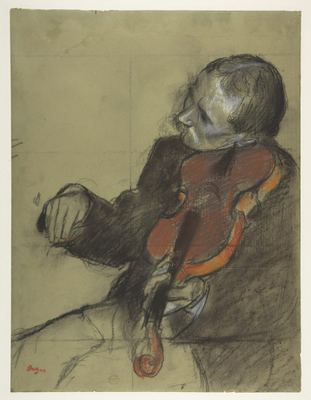
Violinist, Study for “The Dance Lesson” is also drawn in pastel and charcoal on green paper.
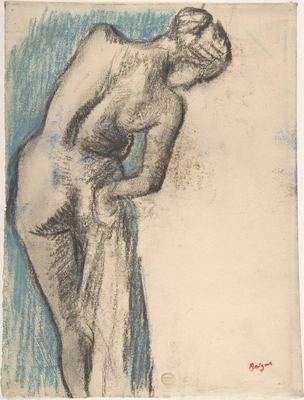
Bather Drying Herself uses charcoal and pastel on a different kind of paper, a pale off-white.
A charcoal grid over the violinist
The violinist study has one more notable piece of information. The museum’s description of materials says it was “squared for transfer,” and that the grid was drawn in charcoal.
This is a method artists used to move a small study onto a large surface. They drew horizontal and vertical lines over the study to divide it into squares, made squares in the same proportions on the large canvas, and copied the picture one square at a time. It is far more accurate than copying the whole thing at once.
The principle is the same as a puzzle: divide the picture into squares and handle them one square at a time. Degas dividing his study into a grid and our judging where pieces go by a grid laid over the preview come from the same idea.
An album printed in a single olive ink
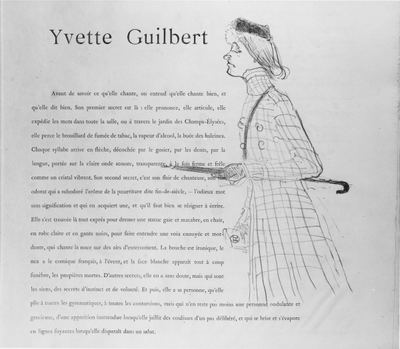
Toulouse-Lautrec’s Yvette Guilbert is the first page of an album published in 1894. According to the museum’s records, the sixteen lithographs in this album were all printed in a single olive ink. The cover page you assemble as a puzzle is likewise built around lettering and line, so there are almost no color clues for guessing where pieces go.
When there is only one color, what remains is brightness and the thickness of line. Not every print is monochrome, though. The same artist’s Cover Design for “Les Vieilles Histoires” is classified as a lithograph hand-colored in 1893.
Dark pieces, light pieces, paper-only pieces
In pictures like these, sort the pieces by density instead of color. The easiest to find are pieces crossed by black pastel, heavy charcoal lines or dark ink, and these give you your reference points. Light pieces with white pastel or strong highlights become a second set of reference points that lock positions in place. The background pieces that show only the paper color are the hardest. So leave them for last.
Once you have built up the outline of the figure with dark and light pieces, the places where the background pieces go narrow down to the remaining gaps. Fill the background from the edges inward. The basic principle is the same as the strategy for pictures with large areas of a single color.
Pages with lettering are a little different. When text takes up a large area, as on the cover of the Yvette Guilbert album, you can work out top and bottom from the line spacing, and even among letter pieces of the same color, the direction in which the lines of text tilt is a clue.
With no color clues, in pictures like these the piece count is the difficulty. I recommend starting at 24 or 48 pieces. If you get stuck, it is better to move to another area or take a short break, as in what to do when a puzzle won’t come together. If you have assembled Goya’s bullfight prints, you will get the feel quickly.
Decisions that show when color is gone
Look long at a picture with almost no color, and what the artist chose becomes clear. Degas set a figure’s pose with a few lines, and Lautrec captured even facial expression in a single color. Because no color is used, every line remains as a record of a decision.
Even a single line crossing one piece lets you feel that decision at your fingertips. It is a tension you rarely feel in an oil-painting puzzle.