Gyehoedo and Chaekgado: Joseon Paintings Made to Record, Not Just to Admire
Published
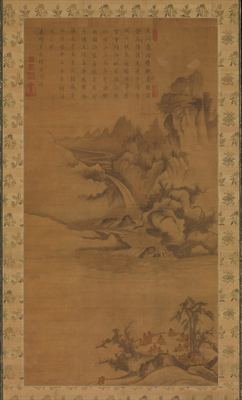
Below a mountain with a plunging waterfall, a few tiny figures sit together in the shade of trees. There is writing at the top and a row of names at the bottom. For a painting meant to be admired, it looks a little like a document. In fact, before paintings hung on museum walls, they were usually objects with a use. They were placed where people prayed, decorated a home, or were made to keep a record of an event.
Two Korean paintings show that use especially clearly: Gathering of Government Officials, a record of a gathering of officials, and Books and Scholars’ Possessions, a ten-panel screen filled with still lifes of books.
Gyehoedo: a gathering recorded once for each person
 Solve this painting as a puzzle → about 5 minutes on Easy
A gyehoedo (契會圖) is, literally, a painting of a gye (契), a fellowship gathering. People who worked in the same government office, or who passed the civil service examination in the same year, would hold a gathering and have one of these made to commemorate it.
This Gathering of Government Officials was painted around 1551, in the early Joseon dynasty, in ink and light color on silk and mounted as a hanging scroll. What deserves attention is how the picture is organized. A gyehoedo follows a set format: at the top, a text giving the name of the gathering; in the middle, a landscape of mountains and water with the gathered people in it; and at the bottom, the names and official titles of those who attended.
It is said that they made as many copies of the same painting as there were attendees and gave one to each. Today that would be like printing a group photo for everyone. But because it was a painting rather than a photograph, the people were painted small and the landscape large. In this gyehoedo, too, the landscape with its waterfall takes up most of the picture, and the people are only a small group in the shade of the trees near the bottom.
The gathering was about the people, so why is the landscape so big? Probably because, for Joseon scholar-officials, simply being together amid mountains and water was itself meaningful. This is, of course, a general explanation of the format. Which gathering this particular painting was made for cannot be determined from the picture alone.
Chaekgado: a screen stacked with books
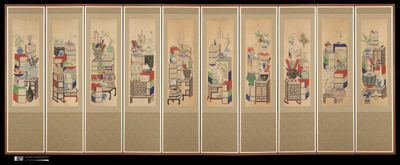
A chaekgado (冊架圖) is a painting of bookshelves with books on them. This one is a ten-panel folding screen made in the early 20th century. On each panel, piles of books, inkstones, brushes, ceramics, vases, and fruit sit on shelves. Since each panel shows different objects, it amounts to ten still-life paintings standing side by side.
As for how chaekgado began, there is a story that King Jeongjo placed a screen painted with books behind his throne to show that he valued learning. I have not been able to confirm whether that really happened. What is commonly found, though, is the explanation that chaekgado started in the royal court and spread to ordinary households.
Along the way, the form changed. At first, it is said, these were paintings that used perspective introduced from the West to place objects precisely in each compartment of a bookcase. As the genre spread among ordinary people, the bookcase frame disappeared, and the objects came to be stacked freely, as on this screen.
Standing a painting of books in a room could likely achieve much the same effect as actually stacking books there. The painting says for you that this is a household that reads. Here, the painting is a decoration that gives the home its face.
A landscape and a still life with similar jobs
On the surface, the gyehoedo and the chaekgado could not be more different. One is a landscape, the other a still life. But in both, the painting has a clear job.
| Gyehoedo | Chaekgado | |
|---|---|---|
| Job | Records a gathering, shared among attendees | Shows the standing of a household |
| Format | Hanging scroll (tall) | Folding screen (wide) |
| Composition | Fixed top, middle, and bottom | An independent still life on each panel |
They also share the fact that neither painter’s name survives. As I wrote in What “unknown artist” means, the clearer a painting’s use, the less people cared about who made it.
A tall scroll and a wide screen
The two paintings have opposite proportions, so they come together in different ways.
The gyehoedo is tall. If you first assemble the writing pieces at the top and the figure and bamboo pieces at the bottom, the top and bottom are set. Join the mountains and waterfall in the middle by watching how dark the ink is and which way the ridgelines run. Compare the white, misty pieces with the preview.
The chaekgado is very wide, so its piece grid comes out flat as well. Start by standing up the vertical blank strips between the panels to make a ten-compartment frame, then fill it one compartment at a time. Since each compartment holds different objects, its pieces rarely get mixed up with those of another. The stripes of the stacked books have a clear direction and make good clues.
Normal (about 48 pieces) suits both paintings. General tips for Korean paintings are in the Joseon painting puzzle guide. If you would like to see more paintings with a clear purpose, Goryeo Buddhist paintings belong to that tradition too.
As you work, there comes a moment when your eye stops on a small piece of writing at the bottom of the picture, or on a single object on a shelf. If you recall then what the painting was used for, a piece stops looking like just a patch of color. A line of names in the gyehoedo is a record that someone sitting there 500 years ago wanted to keep, and a single book in the chaekgado is how some household wanted to be seen by others.