A Child's First Jigsaw Puzzle: How Many Pieces for Each Age?
Published · updated
There are children who finish in five minutes and ask, “Is there another one?” and children who fiddle with a few pieces and get up in frustration. Both happen when the difficulty is set wrong. When doing a puzzle with a child for the first time, it is more realistic to decide based not on age but on how long the child can concentrate and how well they handle pieces with their hands.
Starting lines for preschool, lower grades, and upper grades
For preschoolers, choose a simple painting with distinct colors and shapes, and even at 24 pieces it is good for an adult to stay alongside and do it together. Lower elementary grades can do 24–48 pieces with a painting whose subjects clearly separate, and upper grades and older can start at 48–100 pieces and move up as they get into it.
These are only reasonable starting lines, and children differ a lot. Also note that the piece counts listed here come with an “about.” Because the grid is built to match the painting’s proportions, the Easy level ranges between 18 and 30 pieces depending on the painting. Hawk at Sunrise below is 4×6, exactly 24 pieces, but the wide Dawn is 5×4, 20 pieces.
Since the easiest level is around 24 pieces, even this can be too much for a young child. In that case, divide the work. An adult picks up the pieces one at a time, and the child chooses only where to put them. You can also turn on the preview, point to a dotted cell, and ask, “Is this one the cell near the sun?” The same 24 pieces look much smaller on a phone screen, so for a child whose fingers are still clumsy, a tablet-sized screen or larger is better.
Starting a conversation with a red sun and a brown hawk
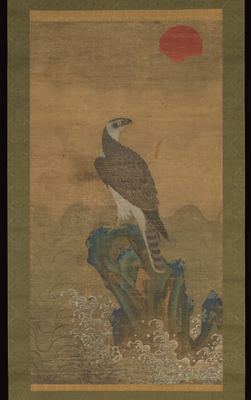 Solve this painting as a puzzle → about 5 minutes on Easy
For a first puzzle, a painting with strong contrast between background and subject is good. Hawk at Sunrise is neatly divided by color into a red sun, a brown hawk, blue rocks, and white waves, so even a child can easily sort the pieces. It is a painting that lets you start a conversation with color names: “Where does the red piece go?” The hazy mountains and sky at the top have little color difference, so leave them for last.
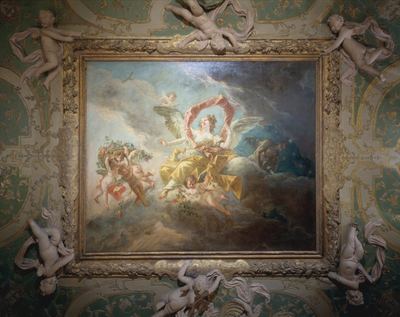
Dawn is also worth recommending for the same reason, since the colors of the sky and the figures separate clearly. It is a photograph that captures a bedroom ceiling painting together with its frame and wall decoration in one shot, so the pieces divide three ways: the green wall outside, the gold frame, and the painting inside. If you put the straight pieces of the frame around first, the frame goes up first and the rest is easier to fill in.
On the other hand, a painting like Bamboo in the Wind, painted only in ink on a silk ground, offers almost no clues to hold onto even at the Easy level. It is best avoided as a first puzzle.
On screen or on paper?
If you solve together on a tablet or a large screen, you can try again as many times as you like without worrying about losing pieces. On days when you want to cut down on screen time, you can print the printable version large and cut it out. The same painting is available both ways, so just pick whichever suits the day.
Online, the hint button is handy when you get stuck. It places pieces that have not yet found their spot, one at a time, starting from the top left of the picture. Pressing it once just before your child gets frustrated keeps the flow from breaking. When a piece gets close to its spot, its outline turns orange, and a single sentence, “When it turns orange, you’re close,” is all the explanation needed, which makes it good to use with children.
If masterpieces feel distant to your child, you can take a photo of a picture your child drew and turn it into a puzzle. The photo is processed only within the browser, never goes to a server, and disappears when you close the tab. For which photos make good puzzles, see making a puzzle from your own photo.
The paper version takes a bit more work. The dotted lines on page 2 of the PDF are only straight horizontal and vertical lines with no curves, so for Hawk at Sunrise, three vertical lines and five horizontal lines, just eight cuts with scissors, give you 24 pieces. Each piece is about 4cm, a good size for small hands to hold. On the other hand, the pieces do not interlock with tabs as they do online, so they slide around easily. Spread out the original picture on page 1 beside them and have the child look at it while placing pieces. Tips for cutting neatly are in how to print the printables.
Don’t miss the moment of finishing
The pride of the moment when a child says “I finished!” carries them on to the next puzzle. When it is done, look at the time it took together, and gently suggest trying one level up next time.
When the puzzle is complete, a card appears over the picture, and a few seconds later you move to the results page. It shows the time taken and the difficulty, and if you solve the same painting again at the same difficulty, your previous best record appears alongside. If you break the record, a message also appears saying how much faster you were than before. It is the perfect number to show when your child shouts “One more time!” Raising the difficulty starts the record over, so just be aware that the first try one level up has no record to compare against.
When moving up a level, choosing the same painting again is less of a burden than a new one. Since it is a painting whose layout they already know, it feels as if only the number of pieces has increased. Hawk at Sunrise is 5×8, 40 pieces, at Normal, and 8×13, 104 pieces, at Hard. If you need more detailed criteria for which level to move to, open how to choose a difficulty. A child who has flown a 24-piece hawk with you will soon reach for the 104-piece hawk too.
Frequently asked questions
At what age, and with how many pieces, should a child start?
How long a child can concentrate matters more than age. Roughly speaking, preschoolers need an adult helping alongside even at 24 pieces, lower elementary grades can do 24–48 pieces, and upper grades and older can start at 48–100 pieces and move up as their interest grows.
What kind of paintings are good to solve with a child?
Paintings whose colors separate clearly, like Hawk at Sunrise with its red sun, brown hawk, blue rocks, and white waves, make pieces easy to tell apart and suit a first puzzle. Paintings with few clues, such as Bamboo in the Wind, painted only in ink on silk, are not recommended as a first puzzle.
What if my child gets stuck and frustrated?
Press the hint button and it places pieces that have not yet found their spot, one at a time, starting from the top left of the picture. Pressing it once just before your child gets frustrated keeps things flowing. If even 24 pieces is too many, have an adult pick up the pieces and let the child choose only where to put them.