How to Solve Goya's Bullfight Prints, Where Only Line and Tone Remain
Published · updated
A bullfighter, trusting his whole body to a single pole, vaults over a charging bull. Below is an empty stretch of sand. Three plates, numbers 8, 10 and 20, from La Tauromaquia, the series of bullfighting prints Francisco de Goya published in 1816, are in the Drawings & Prints category. They are among the hardest of all the puzzles, and much of the reason lies in how the prints were made.
Where Does the Gray Come From?
Prints have no color. There is only black ink, the white of the paper, and the grays between them. But even among grays, the methods that make lines differ from those that make areas. Etching is a technique in which a needle scratches through a coating on a copper plate and the plate is then dipped in acid to bite the lines, so the lines are thin and sharp. Aquatint involves dipping a plate dusted with rosin powder in acid so that a whole area prints as a grainy gray. Drypoint scratches the plate directly with a needle and leaves a soft black line that looks slightly blurred, and burin is a line engraved with a cutting tool.
The medium entry in the collection records spells out these differences. Plate 10 is “etching, burnished aquatint, drypoint, burin”; plate 20 is “etching, aquatint.” In both, the tone of areas rather than lines covers most of the picture, so each piece inevitably carries few clues.
Light Pouring Down on a Diagonal: Plate 10
 Solve this painting as a puzzle → about 5 minutes on Easy
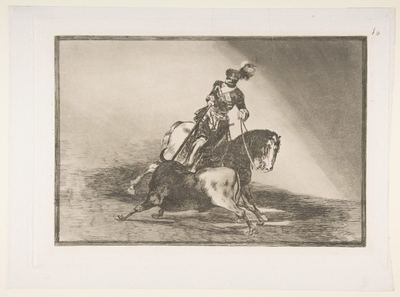
In Charles V spearing a bull in the ring at Valladolid, a knight in a plumed hat drives his lance down from horseback as the bull burrows under the horse. The figures and the bull are bunched from the center toward the bottom, and the top is almost empty gray. What catches the eye is the bright light that fans out from above the knight’s plume down toward the lower right. The area above and to the right of it is pressed especially dark, so the light seems to pour down in a single shaft. Given that the medium record includes “burnished aquatint,” this appears to be the effect produced with that technique.
In the puzzle, this light becomes the only diagonal boundary in the picture. Follow the line separating the light side from the dark side from piece to piece, one row at a time, and the picture splits in two on a slant. The knight’s plume sits where the light begins and the horse’s head sits in the middle of the light, so they fix the midpoint.
A Picture Split Vertically by a Single Pole: Plate 20
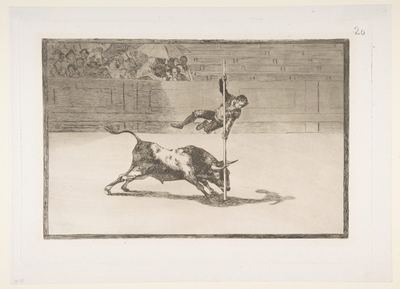
The agility and audacity of Juanito Apiñani in [the ring] at Madrid is exactly what its title says. Planting a pole in the ground, the bullfighter launches himself over the charging bull and hangs from the pole with his legs stretched out. More than the lower half of the picture is empty sand, and toward the top the barrier and the stands form a horizontal band. The spectators are crowded only into the upper left corner, some even holding up parasols, while the upper right is horizontal rows of empty seats. About all that counts as a scene is the single pole splitting the center vertically, the bull passing beneath it, and two long shadows lying across the sand.
If plate 10 comes apart along one diagonal, plate 20 comes apart along one vertical. The pole is a long line, so it ties three or four pieces together at once, and attaching the bull and the shadows to it drops an anchor into the sand. Then finish the band at the top where the joints between the barrier’s planks are visible, and the empty sand becomes a hole closed in on all sides.
With Prints, Start at the Margins
Both prints keep a wide paper margin outside the image, with the plate number printed at upper right. This helps more than you might think. At 48 pieces, the grid is 8 across and 6 down, so the edge is 24 pieces, exactly half. As in an ordinary jigsaw, these pieces have a flat outer side and are easy to pick out, but nearly all of them are the same paper color, so they look alike. What tells them apart is the dark border line surrounding the image. This line runs through the outermost row of pieces or the row just inside it, so in some pieces it passes vertically, in others horizontally, and in the corner pieces it turns. The upper right corner with the number printed in it is a landmark in itself.
Step one row inside the border line and each of the four sides has a different tone. In plate 10, the upper left is light and the upper right and the bottom are dark. In plate 20, the top is the dark band of the stands and the barrier, and the bottom is light sand. When sorting the edge pieces into four sides, look at this inner tone instead of color. By the criteria laid out in is starting with the border always faster?, a print whose image ends in a margin is the kind where taking the border first is the right call.
Inside, follow the lines. If a line is cut off at the edge of a piece, find the piece whose angle and thickness match. This is far more precise than color. Still, what remains to the end is empty sand and empty sky. There, the key is not the picture but the shape of the piece’s tabs. A tab locks into the blank of the neighboring piece, so if you filter the pieces around a hole by shape, the candidates narrow to a few. At 48 pieces or fewer, one dotted cell in the preview is one piece, so counting the remaining empty cells is another approach.
Plate 8 shows a bull tossing a man on its horns, so its composition is different again from these two. That one plate is covered separately in missing plates, a missing cover, missing studies.
Practicing with a Print That Has a Little Color
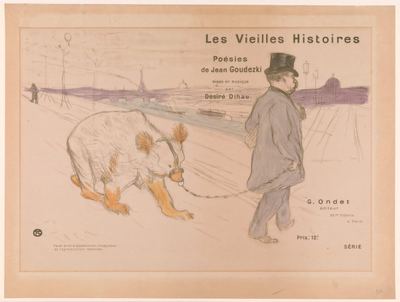
The same category also has prints with color, such as Toulouse-Lautrec’s Cover Design for “Les Vieilles Histoires”. It is a hand-colored lithograph from 1893 in which a man walking along a riverbank leads a muzzled bear on a rope. The clues are the yellow and orange tufts of fur on the bear’s white body and the man’s black hat and purplish coat. The names of the poet and the composer are printed at upper right.
It is not an easy picture. Its large areas are almost all paper color, so it is empty in a different way from Goya. But since it has color clues, it is a good place to get a feel for handling margins before you tackle Goya.
The Sand Left Empty
In habits that cut your finishing time, I said, “When you get stuck, switch areas without hesitation.” Print puzzles are ideal for making that principle second nature. Once you finish plate 20, you can see that all Goya used to depict the bull’s charge was the bull’s body, the pole and a few strands of shadow on the sand. The rest he left empty on purpose, and because of that emptiness the bull feels heavier and faster. It is a part that is easy to pass over when you simply look at the print.
Frequently asked questions
What is Goya's La Tauromaquia?
It is a series of bullfighting prints Goya published in 1816. Three of its plates, numbers 8, 10 and 20, are available as puzzles on this site.
How do you solve a print puzzle that has no color?
By line and tone. In plate 10, a single diagonal boundary made by the light divides the picture; in plate 20, it is a single vertical line, the pole. The angle and thickness of a line cut off at a piece's edge are more precise clues than color.
Do the margins help in a print puzzle?
Yes. A wide paper margin remains outside the image, and the plate number is printed at upper right, so it is easy to pick out the edge pieces first.