How to Spread a 300-Piece Puzzle Over Several Days: Resuming and Pausing
Published
The first time you open a 300-piece puzzle, the scattered pieces draw a sigh before anything else. “When am I going to finish this?”
So people put off starting, or start, close the window partway through, and never come back. But a big puzzle was never meant to be finished in one sitting. A paper puzzle stays spread out on the living-room table for days, and people fit in a few pieces as they pass by. You can do the same online.
It stays put when you close the window
Your progress is saved automatically every time you move a piece. There is no save button, and even if you close the window suddenly, the last state remains. The next time you open the same puzzle, it picks up at the difficulty you were last playing, with the pieces exactly where they were, and even the elapsed time carried over.
A few things are worth knowing so they don’t catch you off guard. Progress is saved separately for each difficulty. If you are working on Expert (about 300 pieces) and switch to Easy (about 24 pieces) for a quick game, your Expert progress stays as it was. It is saved in your browser, so you need to come back on the same device and the same browser to continue. You cannot pick up on a laptop what you were doing on your phone. And if you clear your browser’s browsing data (site data), your progress is erased along with it.
Pause when you step away
When you leave the screen open to do something else for a moment, press the pause button. The clock stops and the picture is hidden. When you come back and press “Resume,” everything continues as before.
If you switch to another tab, the clock stops on its own, but if you leave with the same tab still open, time keeps running. If your completion time matters to you, it is a good idea to press pause in that case. The clock starts the moment you move the first piece, so time spent reading about the work or choosing a difficulty is not counted.
How to stop for tomorrow’s you
When you work in several sessions, each one tends to start with “Where was I?” To cut that time down, tidy the board when you finish for the next person, which is to say, tomorrow’s you.
On the first day, build only the skeleton. Get the edges in place first, along with the lines that divide the picture into large areas (the horizon, the outlines of buildings, the contours of figures). It takes about 30 minutes, and the biggest benefit is that the structure of the picture is already visible the next time you come in.
From the second day on, pick one area and finish only that. “Today, just the trees in the lower left.” If you stop after completing an area, you are left with at least a small sense of having finished something, which makes it easier to open the puzzle again. If you dabble here and there and then trail off, you won’t want to open it again.
Just before you stop, spread any stacked pieces out into empty space on the screen. Starting your next session with every piece visible at a glance feels quite different from starting by digging through a pile.
Choosing a painting to stay with for days
For a painting you will be working on for a long time, it helps if it shows you something new each time you look.
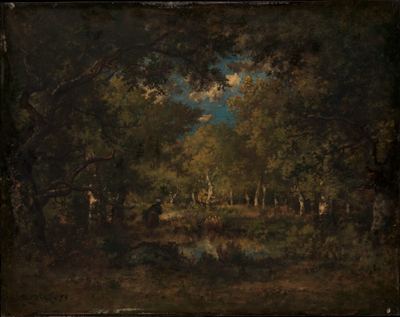 Solve this painting as a puzzle → about 5 minutes on Easy
A painting like The Forest of Fontainebleau, with foliage covering the whole picture, gets tiresome if you try to finish it in a day, but spread over several days it becomes a pleasure. Each time you come back, you see a texture in the trees that you missed the day before.
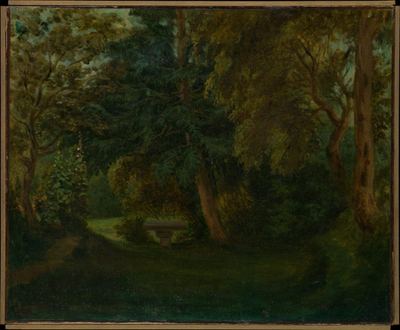
A painting with many scattered elements, like George Sand’s Garden at Nohant, is also easy to divide into areas, so it breaks neatly into one day’s worth at a time.
Dark interior scenes or paintings with large single-color areas, on the other hand, can easily get dull over a long stretch. As I wrote in Taking on 300 pieces for the first time, if this is your first high-piece-count challenge, choosing the painting is half the battle.
It’s fine if it takes several days
Solving a puzzle over several days is not a failure; it is closer to how puzzles were always meant to be done. Like the habit of doing one painting a day, coming in for 10 minutes every day and filling in a little at a time lasts longer than spending three hours in one go.
Along the way, you end up looking at a single painting for days on end. When you ask yourself whether you have ever stayed that long in front of one work in a museum, those few days start to feel like quite a luxury.