Into the Forest Through Three Fontainebleau Paintings by Diaz
Published
You pick up a brown piece, try it here and there, and put it down. The next piece is brown too, and the one after that is a mix of brown and green. When you put together a forest painting as a puzzle, this moment always comes. Leaves, trunks, and shadows pack the picture so densely that it is hard to see where any piece belongs. The same is true of three paintings of the Fontainebleau forest in France by Narcisse-Virgile Diaz de la Peña (1808–1876).
| Work | Date | Medium | Size |
|---|---|---|---|
| Autumn: The Woodland Pond | 1867 | Oil on canvas | 50.2 × 66 cm |
| A Vista through Trees: Fontainebleau | 1873 | Oil on wood | 32.4 × 43.8 cm |
| The Forest of Fontainebleau | 1874 | Oil on wood | 47.3 × 60 cm |
These paintings span seven years, from 1867 to 1874. Diaz kept returning to the same forest to paint until two years before his death.
Painters who went out into a royal hunting ground
The Fontainebleau forest was a royal hunting ground south of Paris. In the mid-19th century, painters gathered in the village of Barbizon on the forest’s edge and painted it, changing the course of French landscape painting. Until then, landscapes had been pieced together from imagination in the studio, but these painters went out into the forest and painted while looking at real trees and light.
What Diaz loved most were the colors of the autumn forest and the sky just before a storm. Hang the three side by side and you wonder how the same forest could be painted so differently.
A path, an opening, and the heart of the forest
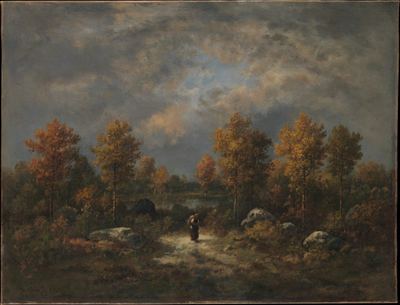 Solve this painting as a puzzle → about 5 minutes on Easy
Autumn: The Woodland Pond has a path. A dirt road runs between trees tinged with gold, and a single figure in dark clothing walks toward us. Gray rocks are scattered along the roadside, and a pond glints through gaps in the trees. The sky takes up nearly half the picture. Putting in a tiny figure to make you feel how big the trees are was one of Diaz’s favorite devices.
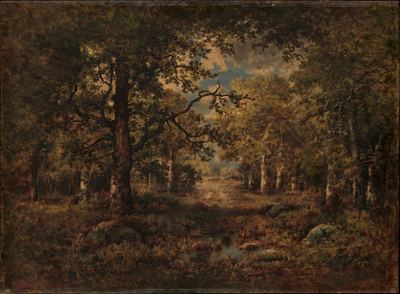
A Vista through Trees is open. A thick oak stands firm on the left, and its branches cover the top of the picture. Between the trees, a bright field can be seen in the distance. It is the smallest panel of the three, so it may have been painted directly in the forest or as a study for a larger painting. There is no evidence to settle which.
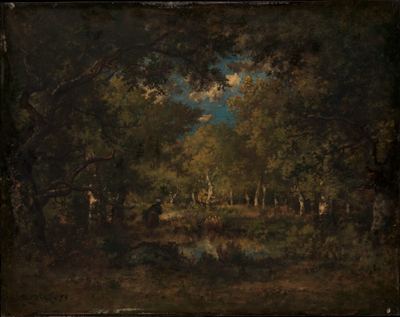
The Forest of Fontainebleau is closed in. The edges are almost black foliage, and toward the center, trunks and bright sky emerge. Beside a pool on the ground, a stooping figure appears small. Instead of setting trees against a bright sky, the composition is arranged so that you look out from inside the dark forest, and before you know it, the viewer is standing in the woods.
Put in this order, they read like the sequence of walking into a forest. You walk along a path, look out into the distance between the trees, and finally stand in the middle of the forest. The painter, of course, did not paint them in this order. The dates run 1867, 1873, 1874, so if anything they are out of step. It is an order the viewer assigns at will.
Pieces where the sky breaks through come first
In all three, the pieces mix brown, green, and gold, and the brushstrokes imitate the shapes of leaves, so the pieces resemble one another. The most reliable clues are pieces that show sky or field. In A Vista through Trees, assembling the bright field in the center first opens a hole in the picture, and in The Forest of Fontainebleau, the blue sky showing through the leaves at the top becomes the reference point. Figures and rocks are very useful too. The figure on the path in Autumn: The Woodland Pond and the figure beside the pool in The Forest of Fontainebleau are the only pieces in their pictures with clearly defined shapes, so they anchor the middle.
Brushstroke direction is another lead. In A Vista through Trees, the brushwork of the leaves at the top differs from that of the grass at the bottom, so you can separate brown pieces into strokes that droop from above and strokes that rise from below. For a painting with very dark edges like The Forest of Fontainebleau, the method of doing the edges first works. Build the frame from the border first, then work the dark pieces inward.
Set the piece count differently for each painting. Autumn: The Woodland Pond is fairly rich in color, so it is fine to start with 100 pieces. The sky, nearly half the picture, comes apart if you divide it by gray, white, and the brightness of the clouds. A Vista through Trees, with all its brown, is tricky, so it is better to begin at 48 pieces. The Forest of Fontainebleau is one of the darkest paintings here, so taking it on at 300 pieces from the start will take a long while. Warm up with 48 or 100 pieces.
You don’t have to finish a long board in one sitting. Your progress is saved, so you can keep going over several days as described in tips for solving across several sessions, and when your hands come to a stop, switching areas, from tips for when you get stuck, works especially well.
A forest that crossed the Atlantic
Dark forest paintings like these were very popular with American collectors of the time, which is why The Metropolitan Museum of Art has several works by Diaz. According to the credit lines, two came in as bequests of Isaac Fletcher and one as a bequest of Collis Huntington. These are forests painted in France that hung in American collectors’ homes before reaching the museum.
Among landscape puzzles, forests are the type that demands the most patience. Still, when you fit the last piece and step back, the places where light seeps in all over the dim picture come alive at once. It is a scene that rewards only those who have looked into the dark forest to the very end.