The One Time Detaille and Drouais Painted Against Type
Published
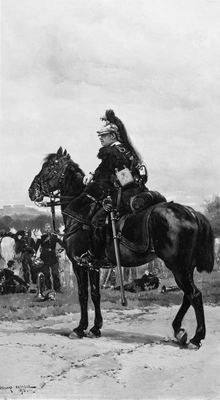
A single soldier sitting quietly on a horse, with no battle at all. It is a painting by Detaille, the military painter known for the accuracy of his uniforms. Drouais, known for his portraits of women, also has a painting of a boy rather than a woman. Every painter tends to come with the impression that “this person always paints this kind of thing,” and each of these two has one work that steps slightly away from it. As it happens, the two paintings already appeared side by side as “paintings with animals” in finding animals in classical paintings. This time, instead of the animals, we look at what happens when a painter paints something he usually didn’t.
| Work | Painter | Subject |
|---|---|---|
| A Dragoon on Horseback | Detaille | A soldier without a battle |
| The Defense of Champigny | Detaille | Large-scale battle (for contrast) |
| Boy with a Black Spaniel | Drouais | Portrait of a boy |
A quiet dragoon, 24 centimeters tall
 Solve this painting as a puzzle → about 5 minutes on Easy
A Dragoon on Horseback is a small panel painting, 24 centimeters tall, with a soldier in a horsehair-crested helmet at the center of the picture. Behind him are only soldiers in camp and a hazy horizon; there is no fighting. Édouard Detaille was a pupil of Meissonier, and after serving in the Franco-Prussian War himself, he made his name as a painter who depicted soldiers’ dress and equipment accurately.
The image is black and white, so you can’t sort by color, but the light and dark are strong. First separate the horse’s black body, the soldier’s bright face and helmet, and the white pieces of sky, then divide the gray background pieces above and below using the height of the horizon. It is a tall, narrow painting, so 48 pieces is about right.
Compared with the 2-meter-wide Defense of Champigny
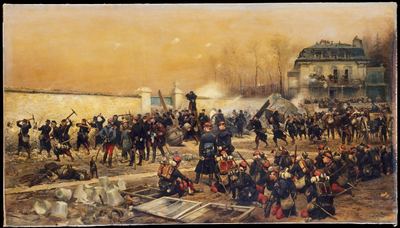
Put this small panel next to The Defense of Champigny and the difference is striking. In this large work, more than 2 meters wide, French soldiers in a snow-covered village aim their rifles at Prussian troops. It shows a battle in the winter of 1870, during the siege of Paris in the Franco-Prussian War, when the French army tried and failed to break through the encirclement at Champigny to the east. It was a war Detaille fought in himself, and it later became the basis for a large panorama he made with de Neuville. The dragoon may have been a figure study for this large work, or a small piece for collectors that could sell without a battle. Even for the same painter, the size and density of the picture differ this much between recording a war and decorating with it.
It is wide and full of figures, so it suits a puzzle with many pieces. It is a good painting to try when you first take on 300 pieces. Set up the mansion on the right and the white wall on the left as pillars on either side, then gather the pieces of the soldiers’ red trousers to fill in the front row. Fit the yellowish sky at the top last, using differences in the brightness of the smoke.
The one boy Drouais painted
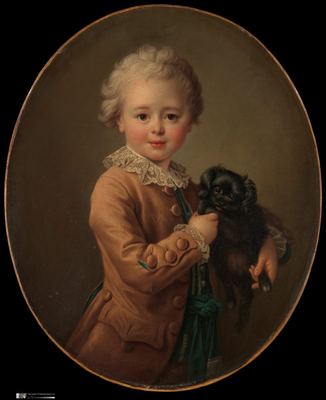
In Boy with a Black Spaniel, a boy with silvery curls and a lace collar holds a black spaniel and looks straight out. It is an oval portrait. François Hubert Drouais was the most popular portrait painter at the French court in the late 18th century and was especially known for portraits of children from noble families, but the other works of his we have introduced were all of women. This boy is the only exception.
Painting a child not as a miniature adult but as a real child, with a dog or a toy, was new for the time. It is not certain who the boy is. Even so, the skill with which Drouais set aside the formality of his portraits of women and captured a child’s natural gestures is worth seeing next to his other portraits.
As a puzzle, it is a relatively friendly painting. Gather bright, distinct pieces such as the face, the lace collar and the dog’s eyes at the center, and attach the apricot-colored areas of the coat following the direction of the folds in the arm. For the dark background, start with the curved pieces that touch the oval border, and fewer pieces will be left over.
One work outside the signature images
Set the two painters’ exceptions side by side and the conclusion is the same. Detaille knew how to paint soldiers without fighting, and Drouais knew how to capture a child’s naturalness even when the sitter was not a woman. If you remember a painter only by a few signature works, you miss the range of what that person could actually do. That these three happened to be grouped in one post as “works with animals” can also be read as a sign that paintings outside the signature images can connect with each other in unexpected ways. The next time I hear a painter’s name, I suspect I’ll first wonder whether there is a painting that person made differently, just once.