From an Actress to a King's Daughter: Drouais's Women of 18th-Century Paris
Published
Teal silk, silver silk, blue covered in flowers, and a white veil. Four portraits of women from 18th-century Paris sit side by side among the European paintings, and all four were painted by François Hubert Drouais (1727–1775), a painter who was born in Paris and died in Paris. The sitters range in status from a stage performer to a king’s daughter, but all of them passed under one man’s brush.
| Work | Date | Size | How it came to the museum |
|---|---|---|---|
| Portrait of a Woman, Said to be Madame Charles Simon Favart | 1757 | 80 × 64.8 cm | Bequest of Isaac D. Fletcher, 1917 |
| Marie Rinteau, called Mademoiselle de Verrières | 1761 | 115.6 × 87.9 cm | The Jules Bache Collection, 1949 |
| Madame Sophie de France | 1762 | 65.1 × 53 cm | Gift of Barbara Lowe Fallass, 1964 |
| Portrait of a Young Woman as a Vestal Virgin | 1767 | 80 × 63.8 cm | Gift of Mrs. Haupt, 1965 |
They were painted within ten years, from 1757 to 1767. Each of the four took a different route into the museum. Portraits by a single painter passed through the hands of different collectors and finally met again in one museum.
An Opera Star Turning from the Keyboard
 Solve this painting as a puzzle → about 5 minutes on Easy
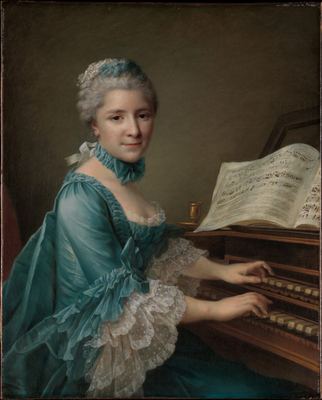
In Portrait of a Woman, Said to be Madame Charles Simon Favart, a woman in a teal silk dress sits at a keyboard instrument and turns her head to look at us. She is said to be Madame Marie Justine Favart, a popular actress and singer at the Opéra-Comique in 18th-century Paris, but the identification is not confirmed.
Madame Favart is known for having built up French comic opera together with her husband, a playwright. Drouais liked to add props that pointed to a sitter’s profession or pastimes, and the score open on the music stand is one such device. Even without a name tag, the painting tells you who this person is.
George Sand’s Great-Grandmother
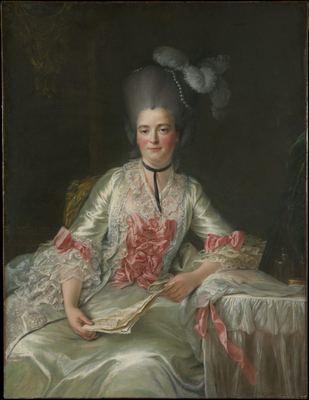
The woman in Marie Rinteau, called Mademoiselle de Verrières wears a silver silk dress and has white feathers in her hair. Marie Rinteau was a singer and actress who performed under the stage name “Mademoiselle de Verrières,” and she was the mistress of the Marshal of France Maurice de Saxe.
The granddaughter of the daughter born to the two of them was the novelist George Sand. That makes the woman in this portrait Sand’s great-grandmother. George Sand’s Garden at Nohant is also available as a puzzle, so if you trace the family of that garden’s owner back up the line, you arrive at this silver dress.
A Princess Who Never Married and Stayed at Versailles
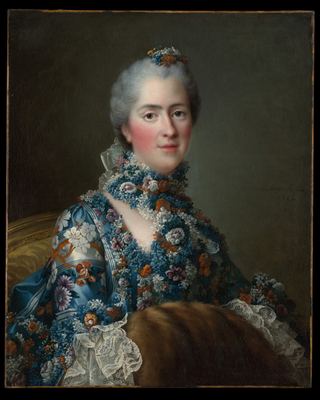
Madame Sophie de France (1734–1782) shows her in a blue dress densely covered in flowers, with a fur muff. Sophie de France was one of the eight daughters of Louis XV; she never married and spent her whole life at Versailles.
It is a portrait from 1762, the period when Drouais was painting the king’s daughters again and again. The floral decoration covering the entire dress pushes splendor as far as it will go. Unlike an opera singer or a nobleman’s mistress, this woman’s place was fixed the moment she was born. Even so, Drouais’s brush treats the princess’s dress with exactly the same care as the actress’s.
A Nameless Woman Dressed as a Priestess
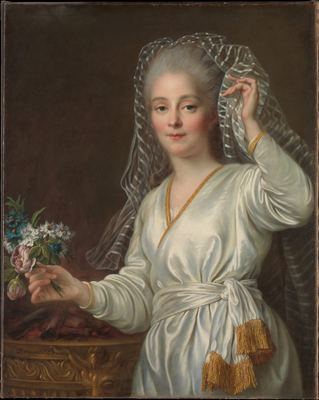
In Portrait of a Young Woman as a Vestal Virgin, a woman in a white veil and white silk offers flowers at an altar. The Vestal Virgins were virgin priestesses in ancient Rome who tended the temple fire. In 18th-century France, portraits that borrowed this guise to express a young woman’s purity were in fashion.
A painting like this, in which a real person is dressed up as a figure from myth or history, is called a costume portrait (or fantasy portrait). Drouais left many such portraits, but there is no record of who this woman was. The other three have names attached, however uncertainly; only this one, the woman he dressed in the clothes of myth, has lost hers.
Put the four together and you can see what portrait painting did in 18th-century Paris. Sometimes it carefully recorded real people, like Madame Favart, Marie Rinteau and Princess Sophie; sometimes it raised a nameless woman into a figure from myth, like the Vestal Virgin. The skill with the sheen of silk and the texture of lace is the same either way.
Dark Backgrounds Last
In all four, a lavishly dressed figure fills most of the picture against a dark, plain background. Fit the pieces of the face and headdress first to fix the figure’s position, and use as clues the areas where every piece has a different pattern, such as Princess Sophie’s floral dress or Marie Rinteau’s ribbons. Clothing with almost no pattern, like the Vestal Virgin’s white silk, has to be sorted out by the shadows in its folds, so it helps to read how to sort pieces by color alongside.
Props like the keyboard, the score, the fan, the fur muff and the gilded altar have clear shapes, which makes them good reference points. The backgrounds in all four are plain brown or dark, so you can fill them in last. One hundred pieces is about right. General tips for assembling figure paintings are in the portrait puzzle guide.
An opera singer, a marshal’s mistress, a king’s daughter, and an unknown young woman. There is no way to know whether these four ever met. What is certain is little more than that they sat, one after another, in one painter’s studio. As you fit the pieces together, you notice anew how the same hand treated such different lives with such constant care.