Two Roman Ideal Landscapes of Places That Exist Nowhere
Published
When we look at a landscape painting, we tend to assume it shows a real place somewhere. In 17th-century Rome, a different kind of landscape painting took root. Instead of copying a single place as it was, painters gathered impressions of many places and invented landscapes that looked more perfect than reality. Two paintings show this current. They were painted nearly 50 years apart, but they share the same roots.
| Work | Painter | Medium | Credit |
|---|---|---|---|
| Landscape with Moses and the Burning Bush | Domenichino | Oil on copper | Gift of Mr. and Mrs. Charles Wrightsman, 1976 |
| Imaginary Landscape | Gaspard Dughet | Oil on canvas | Rogers Fund, 1908 |
Moses in a corner by the lake
 Solve this painting as a puzzle → about 5 minutes on Easy
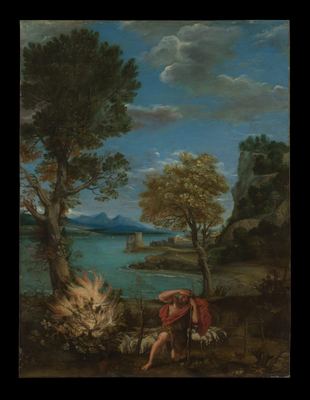
Landscape with Moses and the Burning Bush places a scene from the Bible in one corner of a sweeping landscape of lake and mountains. It is the passage in Exodus where Moses, tending sheep, hears the voice of God from a flame that does not consume the bush.
Moses is in the title, but most of the picture is lake, mountains and trees. The story is set as a small event buried in that broad landscape. Domenichino, a native of Bologna who worked in Rome, refined this way of placing small figures in an ideal landscape, and the approach was later carried on by Poussin and Claude Lorrain.
The material is worth noticing too. Copper is said to have been used often for small works like this because it suits fine detail. Its surface is smoother than a wood panel or canvas, so colors come up clearer and sharper.
As a puzzle, it divides into zones fairly well: blue sky and lake, green trees, brown earth, red clothing. Put together the pieces with Moses, the flame and the flock first, fill the top with the white clouds of the sky, then continue with the green of the trees. 100 pieces is plenty. The figures are very small, so watch for them as you sort pieces.
An imagined place that became a model for English gardens
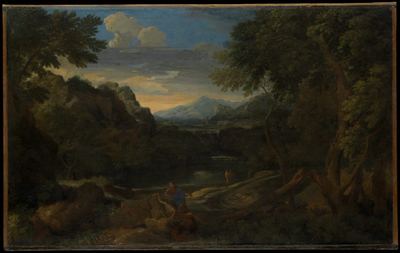
Nearly 50 years later, Gaspard Dughet painted Imaginary Landscape. There is no biblical story and no myth. Rocky mountains, a lake, an evening sky and a few small seated people are all there is.
Dughet was born in Rome and became the brother-in-law and pupil of Nicolas Poussin, specializing in ideal landscapes based on the mountains and lakes around Rome. His method was the “imaginary landscape,” woven together from many places instead of a real location. Eighteenth-century English aristocrats are said to have collected paintings like this and used them as models for designing English-style gardens.
The more you think about it, the stranger it is that an imagined Italian landscape became a reference for making real gardens on English soil. A painting made to be looked at reached beyond the wall and into actual landscaping.
This painting is wide and full of green, so it is no pushover. Build the central band first with the bright pieces of sky and the gray pieces of the lake, attach the dark pieces of the trees on either side, then fill the bottom with the rocks and figures in the foreground. This one is also worth trying at around 100 pieces.
From Domenichino to Dughet
Put the two paintings together and a single line appears. The “small figures in an ideal landscape” that Domenichino refined passed to Poussin and Claude Lorrain, and Dughet was Poussin’s brother-in-law and pupil. Domenichino did not teach Dughet directly, but both stand in the lineage of ideal landscape painting that grew up on the same ground, in Rome.
Landscapes like these were not meant to record exactly what the eye sees. They were a matter of rebuilding, in the painter’s mind, a landscape more harmonious than real nature. With or without a biblical story, the setting was always an ideal world more orderly than reality.
Diaz’s paintings of the Fontainebleau forest are 19th-century French landscapes painted from observation of a real forest, and the Barbizon painters’ sketches are impressions captured quickly on the spot. These two paintings, 200 years earlier, assembled landscapes that never existed out of imagination. Under the same name of “landscape painting,” the attitude of recording the real and the attitude of building the ideal part ways like this. Tips for choosing landscape paintings as puzzles are in how to choose landscape puzzles. After finishing both paintings, you get a curious feeling. The lake and mountains you completed by putting each piece in its place were, from the very start, a landscape someone had assembled from this and that.