Eight Views of Xiaoxiang, a Riverside Never Visited, and Misty Joseon Landscapes
Published
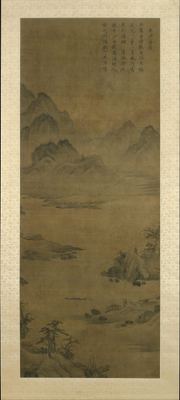
A flock of wild geese settles onto a sandbar, and somewhere beyond the mist a temple’s evening bell rings. The riverside that Joseon dynasty painters loved to paint was a place they had never been: the eight views of the Xiaoxiang (瀟湘) region in southern China, the Eight Views of Xiaoxiang. The Korean painting category has two pictures of this subject, both painted in ink alone on silk.
Scenery known only through poems and paintings
The Eight Views of Xiaoxiang are eight scenes of the Xiaoxiang region in Hunan Province, China. It is said to have been the landscape subject Korean painters favored most, from the late Goryeo dynasty through the Joseon dynasty. The painters did not paint the place from life. Working from an ideal scenery handed down through poems and paintings, they built the riverside in their minds.
So putting these pictures together as puzzles is also a way of rebuilding, piece by piece, a landscape constructed from imagination.
Both are classified as “Korea” in the museum’s records.
| Work | Date | Format | Size |
|---|---|---|---|
| Wild geese descending to sandbar | late 15th–early 16th century | Ink on silk, hanging scroll | 126.4 × 48.9 cm |
| Evening bell from mist-shrouded temple (left); Autumn moon over Lake Dongting (right) | ca. 1450–1500 | Ink on silk, pair of hanging scrolls | 89.9 × 45.4 cm each |
The titles come from the names of the eight views. Each of the eight scenes has a four-character name, and three of them are here: Wild Geese Descending to a Sandbar (平沙落雁), the Evening Bell from a Mist-Shrouded Temple (煙寺暮鐘), and the Autumn Moon over Lake Dongting (洞庭秋月).
Erasing with mist, building with ink
What ties the two pictures together is mist.
 Solve this painting as a puzzle → about 5 minutes on Easy
In “Wild geese descending to sandbar,” the upper half is mountains rising layer upon layer in mist. Coming down, a wide river and sandbar spread out.
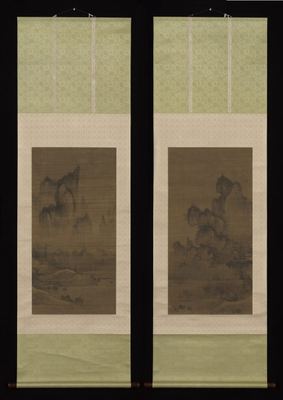
“Evening bell from mist-shrouded temple” depicts mountains rising in mist and a temple set below them.
Distance is created with nothing but the darkness and lightness of ink: near things dark, far things faint. The approach seen in “Evening bell from mist-shrouded temple; Autumn moon over Lake Dongting,” erasing the distance with mist and building up rocks with short brushstrokes, is regarded as a characteristic of 15th-century landscapes of the An Gyeon school.
The artist question must be handled with care. “Evening bell from mist-shrouded temple; Autumn moon over Lake Dongting” is treated as “attributed to An Gyeon (傳 安堅).” An Gyeon is known as the greatest painter of the Joseon dynasty, who painted “Dream Journey to the Peach Blossom Land” in the reign of King Sejong, but while many paintings bear his name, works securely his are so rare they can be counted on one hand. This pair of scrolls, too, only carries his name by tradition and has not been confirmed as his work. “Wild geese descending to sandbar” is by an unknown artist and is described only as belonging to the stream of An Gyeon’s style.
Start with the dark pines and the poem
These pictures have many broad areas that are close to black and white. Where the mist has erased things, the pieces look almost identical, so you need some technique.
Take the dark areas first. In “Wild geese descending to sandbar,” the pines on the riverbank, the small boat and the outline of the sandbar are the darkest; in “Evening bell from mist-shrouded temple,” it is the temple roofs below and the nearby rocks. These pieces become the skeleton. A classical Chinese poem is written in the upper right of “Wild geese descending to sandbar,” so pieces with writing pin down their positions firmly. Just the strokes and the direction of the lines tell you which way is up. Silk yellowed with age can also differ subtly between the edges and the center, so watch for differences in the background color. Fill the faint, misty pieces last, narrowing inward within the frame built from the dark pieces. It is the same method as in strategies for pictures with large solid areas.
48 pieces is about right. “Evening bell from mist-shrouded temple; Autumn moon over Lake Dongting” is a pair of hanging scrolls, so there are two pictures, and you solve them one at a time. If your hands stop, move to a different area for a while, as in what to do when you get stuck. You can find more tips for Korean paintings in the Joseon painting puzzle guide, and on landscape puzzles in general in how to choose landscape puzzles.
Sounds not in the picture
The names of the eight views mix sound and time: the evening bell, the autumn moon, the wingbeats of descending geese. The pictures themselves are silent, but the titles summon sound. In the misty temple of “Evening bell from mist-shrouded temple,” the bell seems to ring, and in “Wild geese descending to sandbar,” you sense the stillness just before the flock settles.
When you fit the last piece, the mist reveals itself. That mist was not painted with a brush. Silk left bare, untouched by ink, takes up half the picture. That is why you keep looking for a long while even after finishing: time spent searching for what is there in the places where nothing was painted.