The Suit of Lights: Four 19th-Century Spanish Toreador Suits and Capes
Published
Gold thread lies thick over crimson silk, and gold flows from the shoulders down to the side seams of the trousers. Here, a garment, neither painting nor sculpture, has become a puzzle. The European Sculpture and Decorative Arts department has three toreador suits and one cape, all four of them clothing worn by Spanish bullfighters in the 19th century.
Doing a puzzle of clothing sounds unfamiliar, but it turns out to be quite fun. The picture is dense with patterns of gold thread and beads, so each piece is like a glittering pattern sample.
| Work | Maker | Date | Materials |
|---|---|---|---|
| Toreador suit | J. Uriarte | Fourth quarter 19th century | Silk, metal, metallic thread, glass, linen |
| Toreador suit | Unknown artist | Fourth quarter 19th century | Silk, metal, glass |
| Toreador suit (jacket) | Unknown artist | 19th century | Silk, metallic thread, glass, cotton |
| Toreador cape | Alejandro Velasco | Fourth quarter 19th century | Silk, metal, glass, cotton |
“Fourth quarter” means the last quarter of a century, roughly 1875 to 1900. The “glass” in the materials column appears to refer to beads. Only two pieces, Uriarte’s and Velasco’s, have a maker’s name in the museum record.
Clothing made to catch the sunlight
In Spanish, the toreador’s suit is called the traje de luces, the “suit of lights.” The name is said to come from the way the gold thread and beads flash in the sunlight of the bullring.
The name says a lot about the garment. It was made to be seen rather than to protect the body. The short jacket and close-fitting knee breeches are shaped for moving quickly in front of the bull. The thick ornamental pieces on the shoulders are showy, but they also served to shield the shoulders from the horns. The tassels along the trouser seams and below the knees sway with every step and draw the eye.
Even so, it is hard to see it as a garment designed for safety. It is closer to formal dress with a fixed form. How it looked in front of the crowd mattered more than how well it protected the body.
Crimson, light green, ivory, and purple
The garments are of the same kind, but set the four side by side and you can see that each shows its own character through color.
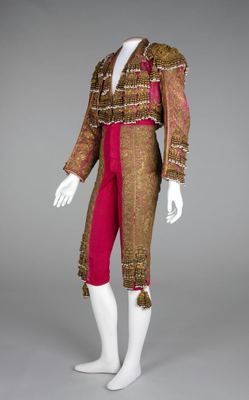 Solve this painting as a puzzle → about 5 minutes on Easy
J. Uriarte’s suit covers crimson silk thickly with gold thread. The shoulders, chest, and trouser seams are all gold.
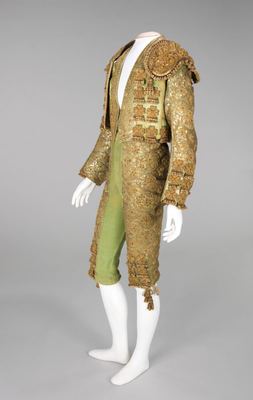
The light green suit is pale green silk embroidered with gold thread and hung with tassels. It is said to have been an unusual color for a bullfighter’s suit.
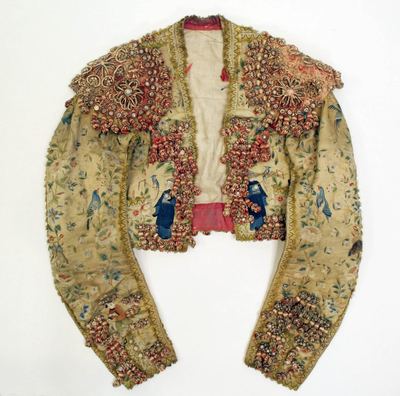
The toreador jacket has blue birds and flowers embroidered on ivory silk. Birds and flowers as the main motif were the taste of the early 19th century, and as the century went on, gold embroidery became the star.
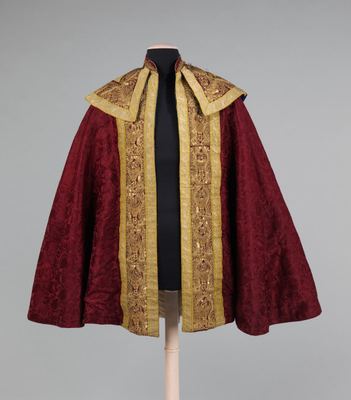
The toreador cape is a parade cape of purple silk edged with bands of gold embroidery. It was worn for the entrance procession before the fight.
Following this periodization, you could read the four pieces as samples of a shift from the floral period to the gold-thread period. Of course, it is too early to draw firm conclusions about changes over time from just four pieces.
Build the silhouette first
In clothing puzzles, pattern units are small and repeat. The gold embroidery is spread densely across the whole picture, so if you sort pieces by color alone, they all look alike.
Fortunately, the garments are displayed on mannequins, so the outlines are clear. If you start with large structures like the shoulder ornaments, sleeves, and trouser seams, the garment’s silhouette takes shape first. After that, use elements that break off sharply at piece edges, such as the tassels below the knees of the trousers or the lines of beads down the front, as reference points. The background is usually a single color, so you can leave it for later. Once all the garment pieces are in, fill inward from the edges as described in Strategies for solid backgrounds.
The suits with dense gold embroidery get sharply harder above 100 pieces, so Normal (about 48 pieces) is a good fit. The toreador jacket has a variety of colors, so it is fine to start it at Easy (about 24 pieces).
Black-and-white prints, golden clothing
There are prints of bullfighting, too. Goya’s bullfight prints captured the movement and light and shadow of the arena in black lines alone. The toreador’s clothing shows the same world from the opposite side, in color and gold. One bullfighting culture survives as black-and-white tension on paper and as the flash of gold thread on silk.
If you want to see more patterns on fabric, you can continue with Clothing and patterns in Islamic art or The story of the embroidered sampler. The gold thread that once flashed in the sunlight of the bullring now sits under museum lighting, but if you zoom in and fit the pieces one by one, you can still see how each strand catches the light.