Why Repeating Patterns Make Islamic Costume Puzzles Harder, Not Easier
Published · updated
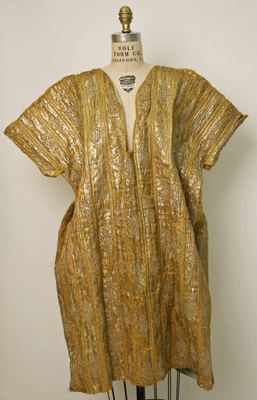
A wedding tunic with floral bands woven in silvery metallic thread covering the body from top to bottom. At first glance it looks like a picture overflowing with clues. The Islamic Costume category gathers clothes that were actually worn in North Africa and the Middle East: a cloak called a burnus, a wedding tunic, a woman’s formal dress, and the like. Assembled as puzzles, every one of them is tricky, but the reason differs from garment to garment. Some are hard because the pattern repeats, and some are hard because there is almost no pattern.
The More Pattern, the More Confusion
You would think more pattern means more clues. Try it and the opposite is true. When a pattern repeats regularly, pieces from different places look almost identical.
 Solve this painting as a puzzle → about 5 minutes on Easy
The Wedding Tunic and Ensemble is exactly like that. Vertical bands woven in silvery metallic thread cover the whole body, and the same floral pattern runs up and down each band. Open it on Normal (6×9, 54 pieces) and two or three bands fit into the width of a single piece. One piece and another are just different heights of the same band, so when you pick one up, there are five or six spots where you think, “It must go here.” You cannot sort by color either. It is all the same gold.
Look for What Appears Only Once
Even a repeating garment has things that appear just once.
Start where the pattern ends. Repetition always stops somewhere. On this tunic, that means the deep V-shaped neckline and the cuffs and hem, where the threads have frayed and stick out. On the sleeves, the bands lie on a slant, at odds with the vertical bands of the body, so looking at a single piece tells you whether it is sleeve or body. There is only one of each of these boundary pieces, which makes them reliable reference points.
Signs of wear are useful too. This is not freshly woven cloth but a garment someone wore, so here and there orange thread pokes out where the weave has unraveled, and the yellow ground shows through where the silver layer has worn off. Even within the same band, each such flaw appears only once, so you could call them fingerprints within the repeating pattern. Zoom in and the disarray looks different in every piece.
The mannequin is a clue as well. All three garments covered here were photographed on mannequins, and the manufacturer’s name is printed in letters on the mannequin’s neck. The pieces with lettering, the metal cap on top of the neck, and the stand visible below the garment have nothing to do with the clothing’s pattern, so they find their places at a glance.
Unlike a painting, a garment has a fixed shape. The sleeves are symmetrical and the neckline is in the middle. Instead of looking at the pattern first, ask “where on the garment is this piece?” and the candidates drop sharply. The same goes for folds and shadows in the cloth: even where the pattern is the same, the direction of the shadow falling over it differs from place to place. It is a version, adapted to clothing, of the approach of using clues other than color.
If several candidates still remain, decide by shape. In this puzzle, pieces join only when they are actually neighbors in the finished picture and their tabs and blanks fit. Try five or six similar-looking pieces in turn, and only the right one will join.
A Cloak with No Pattern, a Dress with Its Pattern in One Place
For garments without repetition, the difficulty comes from the opposite direction.
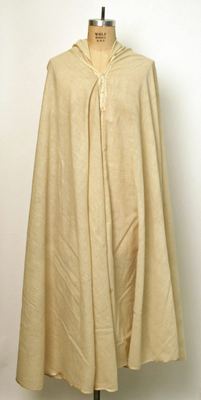
The Burnus (a hooded cloak) is a single cream wool cloak. Its only decoration is a braided cord fastening at the front of the neck. Far from repeating, the pattern does not exist at all, and the wall behind it is white too, so the color contrast is weak. On Easy it comes out as 3×6, 18 pieces, fewer than the stated 24, so each piece takes on a large area. With this garment you have to follow the grain where the weave of the cloth shows through, and the shadows of the folds that fall from the shoulder line and spread outward at the hem.
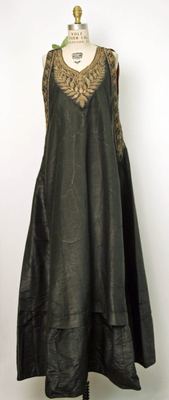
The Dress is the reverse: its embroidery is concentrated in one place. Apart from the gold-thread leaf pattern around the neck and the bands of the shoulder straps, it is almost all lustrous black silk. A few pieces at the top where the embroidery reaches set up the framework, and toward the bottom, the white creases formed in the folds and the horizontal seam near the hem of the skirt separate top from bottom. In stretches like this, the tips from the strategy for puzzles with wide solid areas work just as they are.
Learn the Pattern First at 24 Pieces
Frankly, I would advise against starting this category at 300 pieces. The wedding tunic is 4×6, 24 pieces, on Easy, and at that size about four bands fit into each piece. It is much better to assemble one garment at this level, learn how the pattern behaves, and then move up. The principle of switching areas when you get stuck also works especially well with garments like these.
Clothes Someone Wore on the Most Important Day
A garment like the Wedding Tunic and Ensemble was worn by someone on the most important day of their life. The collection record lists cotton, velvet, and metal-wrapped thread. How densely the gold thread was worked in, and which patterns were chosen, preserve the eye of that region and that era intact.
When people think of art, painting tends to come to mind first. But an object made with this much care to be worn on the body is reason enough to look at it for a long time. As you fit the pieces, you notice how dense each stitch of the embroidery is, and by then you understand, without needing anyone to explain, why this garment is in a museum.