Vivarini's Five-Scene Altarpiece, Still Whole in Its Frame
Published
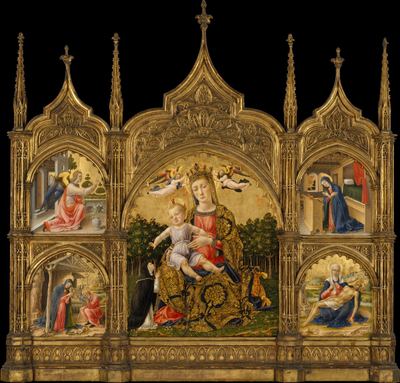
Five scenes sit inside a gilded frame topped with several pointed pinnacles. In the center is the Madonna and Child seated on the ground, flanked by the Annunciation, the Nativity and the Pietà. In dismembered altarpiece panels, we told the story of large altarpieces taken apart and sold as single panels, with panels that once formed pairs scattered around the world. This altarpiece is the opposite. Its five scenes have survived as one piece, original frame and all.
Five Scenes in One Frame
 Solve this painting as a puzzle → about 5 minutes on Easy
The long title of The Madonna of Humility, the Annunciation, the Nativity, and the Pietà doubles as a list of its contents. In the large central compartment, the Madonna and Child sit on the ground before a rose hedge. On the left, above and below, are the angel of the Annunciation and the Nativity; on the right, above and below, are the Mary of the Annunciation and the Pietà.
Five moments from the life of Christ are compressed into a single work: the Annunciation, divided between the angel and Mary; the birth; the Madonna and Child; and the Pietà after death. The frame also appears to be original. Not only the paintings but the structure that held them has come down just as it was made.
The Madonna on the Ground Instead of a Throne
The format of the central scene has a name. The “Madonna of Humility” is a format that shows Mary seated on the ground instead of a throne, and it spread widely in the 14th and 15th centuries.
The four works we saw in Madonna and Child enthroned all showed the Madonna on a splendid throne. The Madonna in this altarpiece sits on the bare ground. She is shown turning down the throne and choosing the lowly place. Having the same figure take the opposite posture to express an attitude of faith: that was how late medieval painting spoke.
A Family of Painters from the Island of Murano
The painter is Bartolomeo Vivarini. He came from a family of painters on the island of Murano in Venice, and his work is marked by hard outlines and lavish gilded frames.
Murano is a small island in the Venetian lagoon. It is famous for glassmaking, but there were also painters, like the Vivarini family, who made their names in painting. This altarpiece is thought to have stood on the altar of a small church or a private chapel. It was more likely a compact, personal altar suited to a small space than a huge altarpiece overwhelming a large church.
Why Wasn’t It Scattered?
Exactly how this altarpiece survived intact cannot be determined from the records we have now. We can make a guess. The larger the altarpiece, the more easily it was divided into panels and sold. By contrast, a format like this, with several scenes gathered in one frame from the start, would have been physically harder to divide. Since the pinnacles and compartments are joined in a single wooden structure, moving it whole may have come more naturally than prying it apart into single panels.
Start with the Gold Frame, One Compartment at a Time
With so many elements, it ranks among the more complex puzzles. Use the gold pieces of the frame to separate the outer border and the compartments first. The pointed tips of the pinnacles and the vertical lines of the columns make reliable reference points. Complete the largest of the five compartments, the Madonna and Child, first, and you can gauge where the other four go; the four corner scenes differ from one another in the colors of the figures’ clothing and their poses, so there is little room for confusion. With so many elements, it is worth recommending even at 300 pieces. Finish one compartment at a time, in order, and you can make it to the end without tiring.
Surviving Whole
After hearing how large altarpieces were broken up and scattered, this work, with its five scenes and frame intact, looks all the more precious. Place this altarpiece beside the other gold paintings in the masters of the Robert Lehman Collection or the gold panel painting puzzle guide, and you feel anew how rare a stroke of luck it is to survive in one’s original form.