From Florence to Ancona: Italian Painting Styles in Four Enthroned Madonnas
Published
A gold ground, a tall throne, and on it the Virgin holding her child. Few scenes were painted as often in medieval and Renaissance Italy. Yet depending on which city the painter came from, the same scene becomes an entirely different picture. The four enthroned Madonnas in the Robert Lehman Collection were painted by artists from Florence, Venice, and the Marche region on Italy’s east coast. The earliest dates from the 1330s and the latest from 1487, nearly 150 years apart.
| Work | Painter | Region | Date |
|---|---|---|---|
| Madonna and Child Enthroned (center of a small triptych) | Bernardo Daddi | Florence | ca. 1335–39 |
| Madonna and Child Enthroned with Saints Peter, Bartholomew, Catherine of Alexandria, and Paul (portable triptych) | Matteo di Pacino | Florence | ca. 1370–74 |
| Madonna and Child Enthroned with Two Donors | Lorenzo Veneziano | Venice | ca. 1360–65 |
| Madonna and Child Enthroned (Crivelli-style altar panel) | Nicola di Maestro Antonio | Marche (Ancona) | possibly ca. 1487 |
A palm-sized traveling altar: Daddi
 Solve this painting as a puzzle → about 5 minutes on Easy
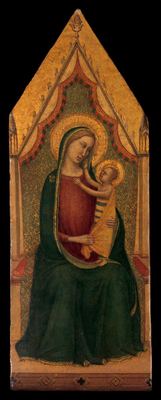
Daddi’s Madonna and Child Enthroned is only 10 centimeters wide. It is the center panel of a triptych that could be opened and closed, an object carried on journeys or set open in a room for prayer.
Bernardo Daddi belonged to the generation of Giotto’s pupils. He ran a large workshop in Florence and produced many paintings like this for private devotion. The Virgin seated on a throne beneath a pointed triangular gable: the basic form of the type is all here.
Ten scenes folded in: Matteo di Pacino
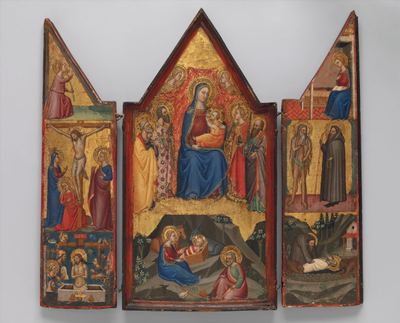
Some thirty years later, in the same Florence, Matteo di Pacino made a far more ambitious triptych. The center panel of this portable triptych holds the Madonna and Child with four saints, and below them the Nativity. The two wings are filled compartment by compartment, from the Annunciation to the Crucifixion to the stories of hermit saints.
Opened out, it is 45 centimeters wide, yet it holds more than ten scenes. It seems the owner wanted every subject of prayer gathered into a single object. The story of the hermits Onophrius and Paphnutius on the right wing is a rarely seen subject. Nearly every scene of the faith is folded into one small wooden panel.
Venice’s soft Gothic: Lorenzo Veneziano
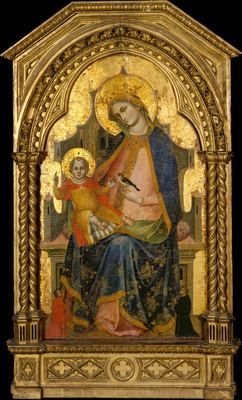
Stand in front of Madonna and Child Enthroned with Two Donors and the air changes. Lorenzo Veneziano was the painter who, in mid-14th-century Venice, shed the Byzantine manner and brought in the softness of the Gothic.
Two things are worth a close look. The bird the child holds is read as a symbol foretelling the Passion. And low on either side of the throne kneel a tiny man and woman: the donor couple who commissioned the painting. Painting patrons much smaller than the Virgin was the custom of the time, and separating holy figures from real people by size was a convention of the painting of this period. The original carved Gothic frame also survives, so you can see in full what a Venetian altarpiece first looked like.
The splendor of the Adriatic: Nicola di Maestro Antonio
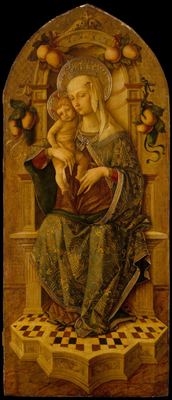
The latest of the four, Nicola di Maestro Antonio’s Madonna and Child Enthroned, is 1.4 meters tall, the largest of the group. Nicola di Maestro Antonio was a painter from Ancona on the east coast, and he leaned heavily on Carlo Crivelli, who worked in the same region.
The garlands hung thick with fruit, the robes rich with gold patterning, and the firm outlines are all traces of Crivelli. The black-and-white checkered marble floor spreading out below also stands out. It is thought to have originally formed the center of a large altarpiece, together with several panels of saints.
Gold gables and a checkered floor
All four set the enthroned Madonna and Child at the center against a gold ground, but they vary in complexity. In Daddi’s small panel, the triangular gable is the clearest reference point, so start there. 24 pieces is plenty. Matteo di Pacino’s scenes are divided into many compartments, so fit the central Madonna and Child first and then fill the wings in order from top to bottom. With so many elements, it is worth trying at 300 pieces.
For Lorenzo Veneziano, start with the frame carved with layers of columns and arches, and the edges of the painting inside fall into place. The small donor couple at the Virgin’s feet are easy to miss, so keep an eye out for them. 100 pieces is recommended. For Nicola di Maestro Antonio, the black-and-white grid of the floor is a good clue that pins down exactly where pieces go, so begin there. 100 pieces suits this one as well.
The same convention, different faces
Line them up again by date. The simple basic form of 1330s Florence (Daddi), the soft Gothic of 1360s Venice (Lorenzo Veneziano), the dense, rich composition of 1370s Florence (Matteo di Pacino), and the lavish ornament of the Adriatic coast in 1487 (Nicola di Maestro Antonio). A single image changes its clothes again and again as it crosses cities and years.
After the era when large altarpieces were broken up and sold piece by piece, these four, too, each found their own way into a single museum. Madonna and Child puzzles and the guide to gold-ground panel painting puzzles show other facets of the same subject. Still, putting these four together side by side leaves the clearest impression of how differently painters dreamed within the fixed convention of the enthroned Madonna and Child.