Why One Man's Collection Holds Both Botticelli and Bellini
Published
A baby lying in a manger gives off its own light. This is a small panel Lorenzo Monaco painted around 1406–10. The Robert Lehman Collection holds many panels by nameless painters that other posts have covered, but it also includes names everyone in art history knows: Botticelli, Giovanni Bellini, Carlo Crivelli, Lorenzo Monaco. Put the four painters’ works side by side and you can see how one person’s collection spans some 80 years of Italian painting.
| Work | Painter | Date | Region |
|---|---|---|---|
| The Annunciation | Botticelli | ca. 1490 | Florence |
| Madonna and Child | Giovanni Bellini | ca. 1470 | Venice |
| An Apostle | Carlo Crivelli | ca. 1471–73 | Adriatic coast |
| The Nativity | Lorenzo Monaco | ca. 1406–10 | Florence |
A Palm-Sized Botticelli
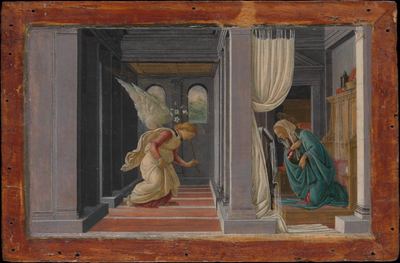 Solve this painting as a puzzle → about 5 minutes on Easy
The Annunciation is a small panel 31 centimeters wide. Against a loggia, the angel Gabriel kneels and Mary bows her head. It is one of the most common subjects in Renaissance painting.
Botticelli painted this scene in several sizes around 1490. This small panel is thought to have belonged to the predella (the strip along the bottom) of a large altarpiece, or to have been made for private devotion. A painter famous for large works like The Birth of Venus fit precise architectural perspective and gentle figures together onto a palm-sized surface.
As a puzzle, the many gray architectural pieces can look daunting at first. Once you know that the straight lines of the floor tiles and columns all converge on a single vanishing point, the way forward becomes clear. Assemble the colored pieces first, such as the angel’s pink robe and Mary’s blue one, then fill in the architecture by following the direction of the lines.
Venetian Light, Painted by Bellini
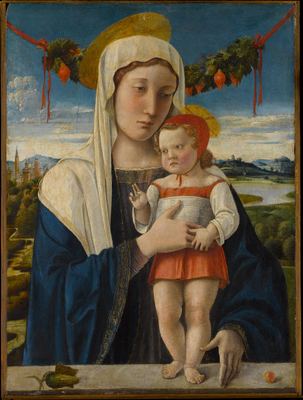
Madonna and Child shows the Child standing on a stone parapet, supported by Mary. Giovanni Bellini laid the foundations of Venetian painting and was the teacher of Titian and Giorgione.
Look at the background. Although this is an early work, still made with tempera and gold leaf, the landscape already holds soft light and air. The view running to a river, city walls and blue hills foreshadows the light of the Venetian painting to come. The stone parapet in front of Mary and the Child looks like a boundary drawn between the world of the picture and the viewer.
The picture divides cleanly into color zones: the blue mantle, the white veil, the red garment, the sky and the green landscape, so it holds up well even at 300 pieces. The flesh-toned pieces for faces and hands are few, so find them early, and build the mantle along the bright lines of its folds.
Crivelli’s Bold Outlines
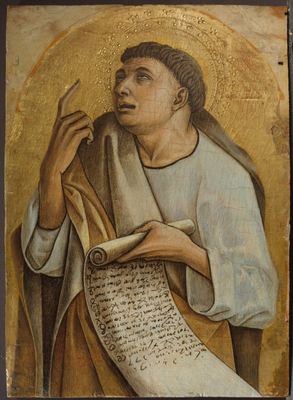
An Apostle shows a figure holding open a scroll and pointing to the sky. Carlo Crivelli was Venetian by birth but worked in small towns along Italy’s east coast, leaving altarpieces lavish with gold leaf and raised ornament.
We have already introduced a painting by an artist influenced by Crivelli: the work by Nicola di Maestro Antonio in the Madonna enthroned post. This panel comes from the source of that influence, Crivelli’s own hand. His hallmark is a thick, firm line around his figures, and here too the fingers and drapery folds are as crisp as sculpture.
The figure fills the frame, so start with the face, the hands and the pieces carrying the scroll’s lettering, then join the white robe and brown mantle along the direction of their folds. Gold-background pieces are easy to tell apart if you sort them by whether they carry the pattern tooled into the halo.
The Glowing Child: Lorenzo Monaco’s Nativity
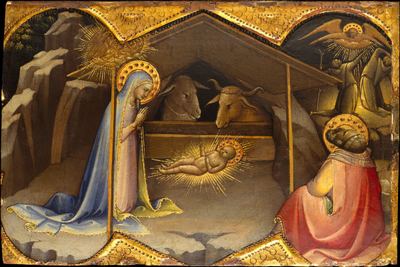
The earliest of the four is The Nativity, mentioned at the start.
The self-luminous Child comes from the visions of Saint Bridget. What Saint Bridget of Sweden, in the 14th century, reported from her vision of Christ’s birth later became the standard iconography for the Nativity in Western art. Lorenzo Monaco was a monk-painter of the Camaldolese order in Florence and, with his gracefully flowing drapery and bright colors, a leading figure of the International Gothic style.
The color zones are fairly distinct. Fix the Child’s light and the two faces first, set up the center with the straight lines of the stable, then fill in the rocks and gold leaf. For this picture and the Crivelli, 48 or 100 pieces is plenty.
From Florence to the Adriatic
In chronological order, they run from 1406 (Lorenzo Monaco) to 1490 (Botticelli). Geographically, they cover Italy from Florence (Lorenzo Monaco, Botticelli) to Venice (Bellini) and the Adriatic coast (Crivelli).
That a single private collection embraces such a wide span of time and place means Robert Lehman did not fixate on a particular painter or school but followed the broad current of Italian painting. Like Kelekian in A Thousand Years Gathered by One Collector, it shows how widely one person’s eye can range.
Paintings Whose Names Survived
Most of the other paintings covered here have lost their painters’ names, or survive only under nicknames. The difference shows more clearly when you compare them with the works by nameless painters in the gold panel painting puzzle guide or Madonna and Child puzzles. These four, by contrast, have kept the names Botticelli, Bellini, Crivelli and Lorenzo Monaco clearly attached to this day. That the names survived may also mean that someone has cherished these paintings especially, for a very long time.