What Is Impressionism? Meaning, Key Features, How It Got Its Name and the Main Painters
Published
Impressionism is an art movement that began in France in the late 19th century. Its painters cared less about describing a subject carefully than about catching the “impression” that the light and color of one moment made on them, and they did it with short, quick brushstrokes. Those painters are called the Impressionists. Monet’s water lilies, Renoir’s figures in sunlight and Degas’s ballet dancers are all Impressionist paintings.
The name started as an insult
In the spring of 1874, a group of painters who wanted to show their work without depending on the jury of the Salon (the official, state-run exhibition) held their own group show in the Paris studio of the photographer Nadar. Among the paintings Monet sent was Impression, Sunrise, a harbor at sunrise in the mist, laid down in a handful of strokes. The critic Louis Leroy borrowed its title for a mocking review that called the painters “Impressionists.” The painters took the name for themselves, and it became the name art history still uses.
The group exhibition was held eight times, up to 1886. Only one painter showed work at all eight: Camille Pissarro.
Five features of Impressionism
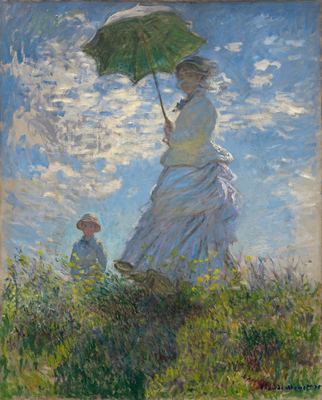
- They painted outdoors. They left the studio and painted what they saw, in sunlight. Monet painted Woman with a Parasol - Madame Monet and Her Son (1875) quickly, in one go, on a windy hill, and bare canvas still shows through in patches of the sky.
- Short, broken brushstrokes. Instead of spreading color smoothly, they set short strokes side by side. Up close you see brushmarks; from a distance you see the scene.
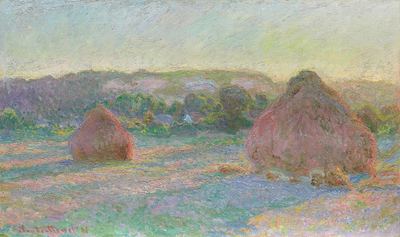
- Shadows have color. They did not paint shadows black or brown but blue or violet. In Monet’s Stacks of Wheat (End of Summer), the stacks glow red-orange and their shadows on the ground are bluish violet.
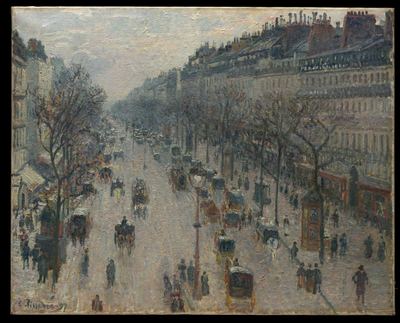
- The same subject in different light. They painted the same place again and again across seasons and times of day. Monet painted more than twenty-five canvases of wheat stacks, and Pissarro painted The Boulevard Montmartre on a Winter Morning as one of fourteen views from the same hotel window.
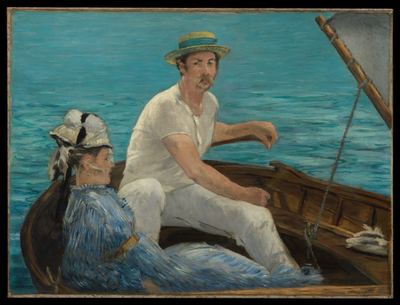
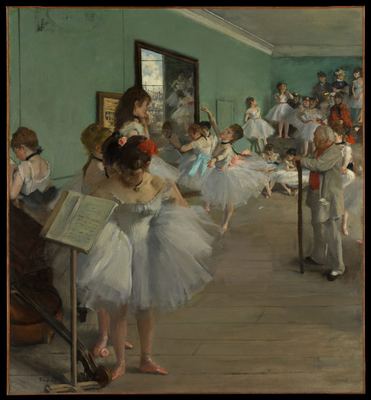
- Life here and now. In place of myth and history, they painted everyday life in the city they lived in: boating, railway stations, cafés, the ballet rehearsal room. Manet’s Boating and Degas’s The Dance Class are examples.
The main painters
- Claude Monet: the painter whose picture gave Impressionism its name. Until the end of his life he painted the water lily pond in his garden at Giverny. See Monet’s water lilies.
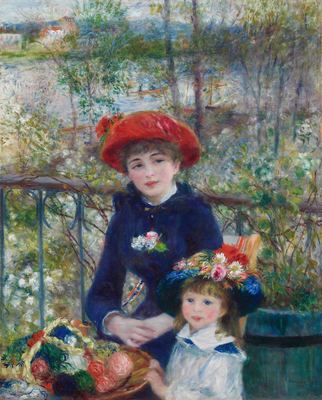
- Pierre-Auguste Renoir: people in sunlight. From around 1881 he went back to drawing clear outlines, as in Two Sisters (On the Terrace).
- Edgar Degas: painted dancers in rehearsal rooms and waiting areas more often than on stage.
- Camille Pissarro: the one painter who took part in all eight exhibitions, something like the group’s elder brother.
- The others include Alfred Sisley, Berthe Morisot, Mary Cassatt and Gustave Caillebotte. Édouard Manet never once took part in the Impressionist exhibitions, but he had a strong influence on all of them.
What came next: Post-Impressionism
The next generation, Cézanne, Van Gogh, Gauguin and Seurat, is grouped together as the Post-Impressionists. The term comes from an exhibition the British critic Roger Fry organized in London in 1910. Each of these painters moved away from catching passing light, and each in a different direction. Cézanne rebuilt the shapes of things as solid masses, Van Gogh turned to color and brushwork that carried emotion, Gauguin to flat areas of color, and Seurat to pointillism, based on color theory.
Seeing Impressionism through puzzles
Put an Impressionist painting together as a jigsaw puzzle and you can feel its features in your hands. That is because the direction of the brushstrokes and the brightness of the color tell you where a piece goes, more than the outlines of shapes do. Where a similar color spreads over a wide area, like sky or water, zoom in and look at the grain of the brushmarks. Seven Paris paintings from 1874 to 1897 can be followed in order in the Impressionists and after. If you are planning to see Impressionist originals soon, there are tips in warming up before an Impressionism exhibition.
Frequently asked questions
What does Impressionism mean?
It is an art movement that began in France in the late 19th century. Rather than describing a subject in careful detail, its painters tried to catch the impression made by the light and color of a single moment, using short, quick brushstrokes. The painters themselves are called the Impressionists.
Where did the name Impressionism come from?
It came from Impression, Sunrise, a painting Monet showed at the group's first exhibition in Paris in 1874. The critic Louis Leroy borrowed the title to mock the painters as "Impressionists," and the name stuck.
Who are the main Impressionist painters?
Claude Monet, Pierre-Auguste Renoir, Edgar Degas, Camille Pissarro, Alfred Sisley, Berthe Morisot, Mary Cassatt and Gustave Caillebotte, among others. Édouard Manet never took part in the Impressionist exhibitions, but he had a strong influence on the group.
How is Post-Impressionism different from Impressionism?
Post-Impressionism is the name given to the next generation, including Cézanne, Van Gogh, Gauguin and Seurat. Starting from the Impressionists' interest in passing light, each went a different way: the structure of form (Cézanne), color and brushwork charged with feeling (Van Gogh), and color theory (Seurat).