Monet's Water Lilies, from a Pond with a Bridge to Nothing but the Water's Surface
Published
This year marks 100 years since the death of Claude Monet (1840–1926). In Korea, where this site is based, an Impressionist exhibition marking the centenary is running at the Asia Culture Center in Gwangju, and the international masterpieces show at the MMCA Gwacheon includes Monet’s pond with water lilies. Both are covered in before an Impressionism exhibition. This post follows how Monet came to paint a single pond for decades, through the four Monet paintings on this site.
This site has nothing to do with either exhibition, and the water lily painting shown there isn’t here. The four works below are other Monet paintings that the Art Institute of Chicago and the National Gallery of Art have released into the public domain.
1875: a windy hillside
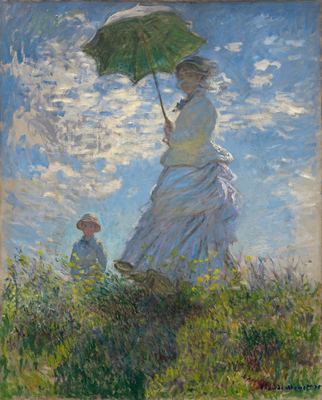 Solve this painting as a puzzle → about 5 minutes on Easy
The starting point is outdoors. Monet painted Woman with a Parasol - Madame Monet and Her Son in 1875 in Argenteuil, outside Paris, looking up from the foot of a hill at his wife Camille and their son Jean. He painted it fast, in one go, so fast that bare canvas shows through in places across the sky. With the veil and the skirt blowing in the wind, you can see that already Monet was trying to catch the light and air of a moment more than the shapes of things.
1877 and 1890: the same spot, again and again
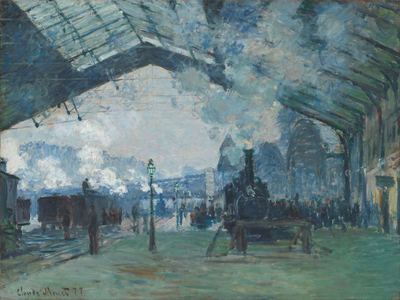
Arrival of the Normandy Train, Gare Saint-Lazare was painted in 1877 inside a Paris railway station. Monet rented a studio near the station, got permission to work there, and that year left about a dozen paintings of the station seen from different spots. What he was after, it is said, was less the trains than the steam and light shifting under the glass roof.
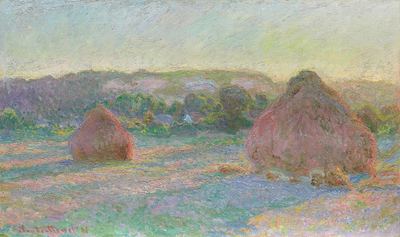
Thirteen years later he went a step further. Stacks of Wheat (End of Summer) is one of a series from 1890–91 showing stacks of wheat in a field near his house in Giverny. Monet painted the same stacks more than twenty-five times, in different seasons and at different times of day. This is where the series, keeping the subject the same and changing only the light, really took hold, and the same approach carried straight over to the pond.
1900: a bridge over the pond
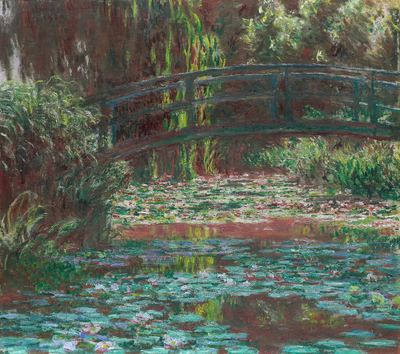
Monet lived in Giverny from 1883. In 1893 he bought the land across the road from his house, brought in water and dug a pond. He planted water lilies and built an arched Japanese-style wooden bridge, and in 1899 and 1900 he painted several pictures of the bridge from the same spot. The Art Institute of Chicago’s Water Lily Pond is one of them, from 1900.
The green bridge arches across the top of the picture from the left edge all the way to the right, and the pond below is almost covered in lily pads. Pink and red flowers crowd the band just under the bridge. Below that runs a strip of reddish-brown reflection, and at the bottom, pink and white flowers float among blue-green pads. Up to this painting, it is still a garden view. The bridge, the grasses at the water’s edge and the trees at the top give the picture its frame.
After that, only the water
From then on Monet moved toward water lily paintings that dropped the bridge and showed the surface of the water close up, and he kept painting this pond until his death in 1926. The bank and the sky disappear from the picture, leaving only lily pads and the clouds and trees reflected in the water. With nothing left to tell you which way is up, the painting becomes the surface of the water itself. The Art Institute of Chicago also has a much larger painting from 1917–19 under the same title, Water Lily Pond. The pond with water lilies hanging at the MMCA Gwacheon, from 1917–1920, is one of these late water lilies too.
When you see one of the late water lilies in a museum, it pays to look twice. Up close, the brushstrokes are so loose you can’t tell whether they are flowers or water; only a few steps back do the lilies and their reflections separate. If you put together the 1900 Water Lily Pond as a puzzle first, you know what the pond looked like when the bridge was still there, and you see the difference.
Putting together the Water Lily Pond puzzle
The dark green curve of the bridge is your most reliable guide line. Join that curve first and the picture splits into the trees above and the pond below. The pond changes color at each height, so sort the pieces first into three bands: the one thick with pink and red flowers, the reddish-brown reflection, and the blue-green pads. The top divides into the left side, with green stems hanging down vertically, and the right, with clumps of yellow-green leaves.
Brushstrokes are spread evenly over the whole picture, so 100 pieces is about right. If it’s your first time, learn where the bridge and the color bands go at 48 pieces, then move up. There are more tips for paintings where similar colors spread over a wide area in how to solve puzzles with large plain areas.
Put the four together in order of date and Monet’s fifty years sort themselves out in your hands: from a single moment on a hillside, to series of the same subject, and finally down to one pond. Other painters working in Paris in the same years are in seven Paris paintings from 1874 to 1897.
Frequently asked questions
Where did Monet paint his water lilies?
In the garden of his own house in Giverny, a village northwest of Paris. Monet lived in Giverny from 1883, and in 1893 he bought the land across the road from his house, brought in water, dug a pond and planted water lilies.
What is the Water Lily Pond puzzle on this site?
It is a 1900 painting in the Art Institute of Chicago that looks at the arched Japanese-style wooden bridge over the pond. It is one of several bridge paintings Monet made from the same spot in 1899 and 1900.
How many pieces should I use for the Water Lily Pond puzzle?
Brushstrokes are spread evenly over the whole picture, so 100 pieces (Hard) works well. If it's your first time, learn the green curve of the bridge and the color bands of the pond at 48 pieces first.