What Is Post-Impressionism? Meaning, Key Features, Cézanne, Van Gogh, Gauguin and Seurat
Published
Post-Impressionism is the name for the painters who came after the Impressionists and each went in a different direction: Paul Cézanne, Vincent van Gogh, Paul Gauguin, Georges Seurat and others. The name makes it sound like a single group or style, but it is really closer to a label for the period “after Impressionism.” The four painters’ pictures look nothing alike.
The name came from London in 1910
The first person to use the term was the British critic Roger Fry. When he organized an exhibition in London in 1910 called Manet and the Post-Impressionists, he needed a name to group together the paintings of Cézanne, Van Gogh, Gauguin and others who came after Manet. Cézanne, Van Gogh and Gauguin had all died by then, and none of them had ever called himself a Post-Impressionist.
What changed from Impressionism
The Impressionists caught the light and color of a passing moment quickly, with short brushstrokes. The Post-Impressionists inherited those bright colors and broken brushstrokes, but felt that the impression of a moment was not enough. So each added something different. The features of Impressionism are summed up in what Impressionism is.
- The structure of form (Cézanne). He saw things as solid masses and rebuilt the picture firmly.
- Color and brushwork charged with feeling (Van Gogh). He painted the colors he felt rather than the colors he saw, and put force and direction into each stroke.
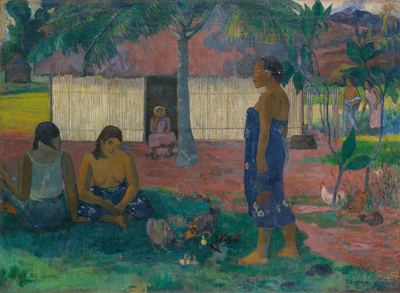
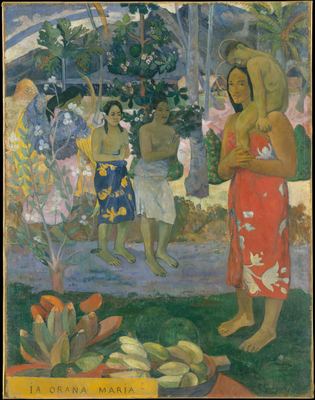
- Flat areas of color (Gauguin). He reduced shadow and the sense of volume and filled his outlines with broad areas of color.
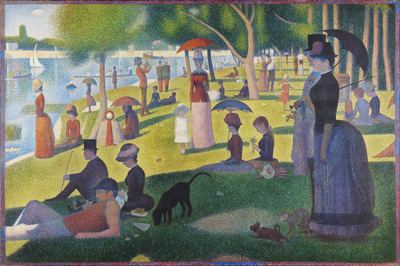
- Color theory (Seurat). He placed calculated dots of pure color so that they mixed in the viewer’s eye.
Main painters and works
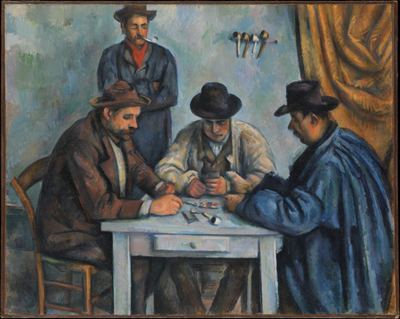
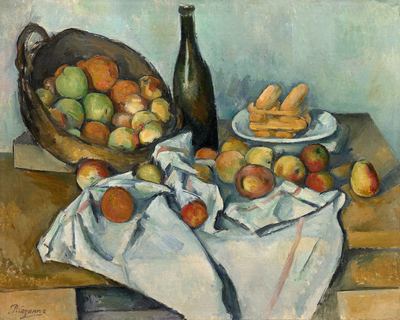
Paul Cézanne (1839–1906) was a painter from Aix-en-Provence in the south of France. He belonged to the same generation as Monet and took part in the first Impressionist exhibition in 1874, but afterward went his own way, alone, in his home town. The Card Players (1890–92) is the version with four figures from a series he painted five times using farmers from around Aix-en-Provence as models. Many read its subject as the balance of forms the figures make rather than the tension of the card game. In The Basket of Apples (about 1893), the bottle tilts, the plate looks as if seen from above, and the front edge of the table does not line up on either side of the cloth. This is read as the result of rebuilding the scene by choosing the best angle for each object, rather than copying it from a single viewpoint.
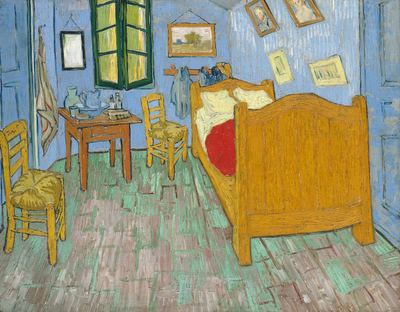
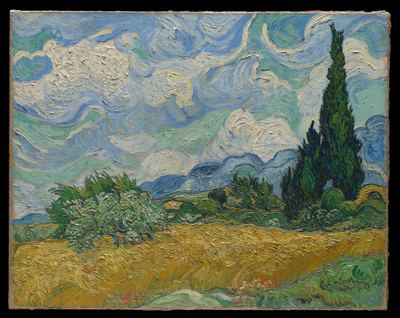
Vincent van Gogh (1853–1890) put his feelings into color and brushwork. The Bedroom (1889) shows his room in the Yellow House in Arles. It is the second version, painted in Saint-Rémy the following September from the picture he first made in October 1888. He wrote to his brother that the painting should suggest “rest or sleep,” and that he wanted to express this through color alone. Wheat Field with Cypresses (1889) is the first version, now at the Metropolitan Museum of Art, painted outdoors between late June and early July that year. The brushstrokes of the wheat, the trees and the clouds all run in different directions. Six of Van Gogh’s paintings are in Van Gogh at the Met.
 Solve this painting as a puzzle → about 5 minutes on Easy
Paul Gauguin (1848–1903) left for Tahiti in the South Pacific in 1891. Ia Orana Maria (Hail Mary), painted that year, shows the Virgin and Child as a Tahitian woman and child. Why Are You Angry?, from 1896 during his second stay in Tahiti, shows women gathered in front of a hut, with chickens. Both pictures have few shadows, and their broad areas of color are clearly divided.
Georges Seurat (1859–1891) created pointillism, placing dots of pure color side by side. A Sunday on La Grande Jatte (1884–86) hung in the last Impressionist exhibition in 1886. There is more in what pointillism is.
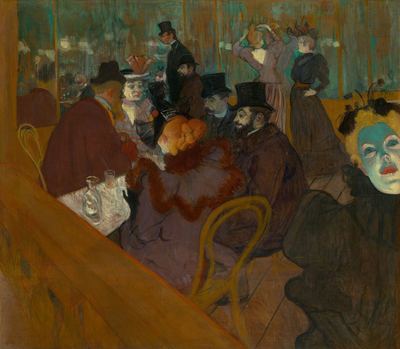
Henri de Toulouse-Lautrec (1864–1901), who painted the nights of Montmartre, is also often grouped with them. At the Moulin Rouge (1892–95) shows people seated around a cabaret table, with the artist himself passing by, small, in the background.
What came next: 20th-century art
The influence of Post-Impressionism led straight into 20th-century art. Cézanne’s way of rebuilding form is considered a major influence on Cubism, and the strong color and flat color areas of Van Gogh and Gauguin a major influence on Fauvism and Expressionism. To see Paris paintings from 1874 to 1897 in date order, see the Impressionists and after; for the highlights of the Art Institute of Chicago, see paintings not to miss at the Art Institute of Chicago.
Seeing Post-Impressionism through puzzles
The four painters call for different strategies as puzzles, too.
- Cézanne by planes. In The Card Players, the four figures’ clothes divide into brown, white, blue and dark blue-gray. Start with the white shirt in the middle and the cards on the table, then sort left from right by clothing color.
- Van Gogh by brush direction. Where one color covers a wide area, look at the grain of the brushstrokes. In Wheat Field with Cypresses, the wheat runs sideways, the trees upward and the clouds in circles.
- Gauguin by color boundaries. The broad areas of color are clearly divided, which makes him the easiest of the four. Sort the pieces by color, then join them along the boundary lines.
- Seurat zoomed in. Zoomed out, the dots blend together and look alike. Start with the large figures, and zoom in to check the colors of the dots.
If you are new to this, start with Gauguin at 48 pieces and move on to Cézanne, Van Gogh and Seurat in that order. Even within the same “Post-Impressionism,” you will feel your hands choosing pieces differently for each painting.
Frequently asked questions
What does Post-Impressionism mean?
It is the name given to Cézanne, Van Gogh, Gauguin, Seurat and others who came after the Impressionists and each went in a different direction. It is not the name of a single style or group so much as a label for the period after Impressionism.
Where did the name Post-Impressionism come from?
The British critic Roger Fry used it for an exhibition he organized in London in 1910, Manet and the Post-Impressionists. The painters did not choose the name themselves; it was given to them afterward.
How are the Post-Impressionist painters different from one another?
Cézanne rebuilt the forms of things as solid masses, Van Gogh moved toward color and brushwork charged with feeling, Gauguin toward flat areas of color, and Seurat toward pointillism based on color theory.
What influence did Post-Impressionism have on later art?
Cézanne's way of rebuilding form is considered a major influence on Cubism, and the strong color and flat color areas of Van Gogh and Gauguin a major influence on Fauvism and Expressionism.