Before an Impressionism Exhibition, Warm Up with Puzzles of Other Paintings by the Same Artists
Published
If you put together one painting by each artist as a puzzle before you go, you have something to hold on to when you stand in front of originals you have never seen. “I know this brushwork.” This winter in Korea, two exhibitions are showing Impressionist paintings: one at the Asia Culture Center in Gwangju, titled in Korean “Impressionism, Brilliant Moments: Monet, Renoir, Van Gogh and Cézanne,” and Water Lilies and Chandelier at the National Museum of Modern and Contemporary Art (MMCA) in Gwacheon. The tips below were written with those two shows in mind, but they work for Impressionist paintings in any museum.
To be clear from the start: this site has no connection with either exhibition, and none of the works on show are here. The paintings below are other works by the same painters, released into the public domain by The Metropolitan Museum of Art in New York, the Art Institute of Chicago and the National Gallery of Art in Washington.
The two exhibitions at a glance
| Exhibition | Venue | Dates | What is on show (as reported) |
|---|---|---|---|
| Impressionism, Brilliant Moments (title translated from Korean) | Asia Culture Center, Gwangju | Sep 23, 2026 – Feb 21, 2027 | 21 original works by 11 Impressionist masters from the Israel Museum, Jerusalem, marking the 100th anniversary of Monet’s death |
| Water Lilies and Chandelier | MMCA Gwacheon | Oct 2, 2025 – Jan 3, 2027 | 44 works by 33 international artists from the museum’s collection, 16 of them from the Lee Kun-hee Collection donated in 2021 |
The Gwangju show was announced as including a Monet pond with water lilies, a Van Gogh wheat field with poppies, a Renoir vase of roses and a Cézanne country house by a river. The Gwacheon show takes its title from a Monet painting of a pond with water lilies (1917–1920) and Ai Weiwei’s Black Chandelier, and paintings by Renoir and Pissarro hang there too. Hours and admission can change, so it is best to check each institution’s website before you go.
Monet: close up and far away
 Solve this painting as a puzzle → about 5 minutes on Easy
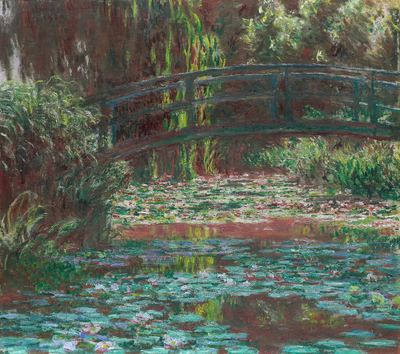
Both exhibitions have a Monet water lily painting. The Art Institute of Chicago’s Water Lily Pond (1900) looks at the Japanese-style wooden bridge over the pond in his garden at Giverny. It is the pond as it was before Monet left out the bridge and painted only the surface of the water. Put it together as a puzzle and your hands learn that the pond is built up in bands of different color at each height. In front of a water lily painting at an exhibition, go up close and then step back a few paces. Up close you see brushmarks that could be flowers or water; from farther away they separate into lilies and the sky reflected in the water. The story of how Monet came to the pond is in Monet’s water lilies.
Renoir: clear faces, soft backgrounds
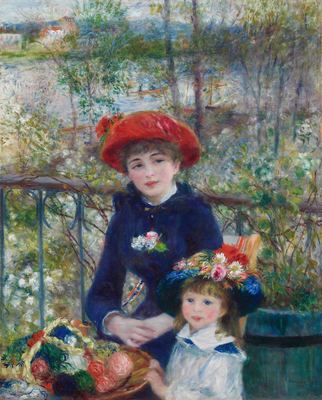
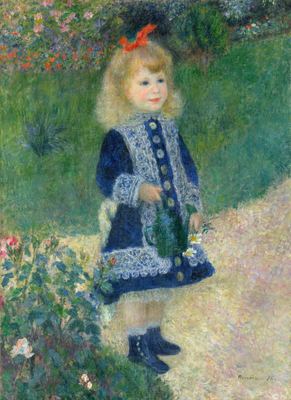
Around 1881, Renoir began to have doubts about the soft, blurred Impressionist style and turned back toward outlines. The Art Institute of Chicago’s Two Sisters (On the Terrace) (1881) comes from that time. The girls’ faces are smooth, while the flowers and the river behind them loosen into softness. In the puzzle, too, the face and hat pieces find their places quickly, but the green background pieces are left to the end. That difference is the difference in how Renoir painted. Solve A Girl with a Watering Can from 1876 and By the Seashore from 1883 side by side and the change shows even more clearly. If you meet a Renoir flower painting at an exhibition, notice how sharp the outlines of the petals are.
Van Gogh: the direction of the brushstrokes is the clue
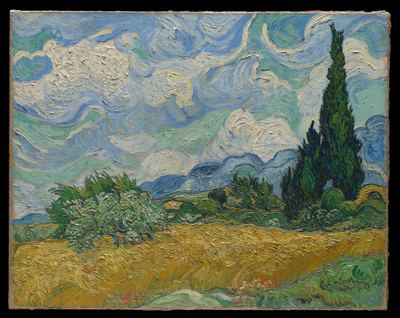
A Van Gogh wheat field is coming to the Gwangju show. The Met’s Wheat Field with Cypresses (1889) is a wheat field too. Solve it as a puzzle and you find that the direction of the brushstrokes is the best clue there is. The wheat is short strokes lying sideways, the cypresses are strokes shooting upward, and the clouds are strokes curling round. Even pieces of the same color sort themselves out by the direction of their strokes. In front of an original, stand at an angle to the canvas and the thickly raised brushmarks show their direction more clearly. More Van Gogh paintings are gathered in the Met’s six Van Goghs.
Cézanne: a different angle for each object
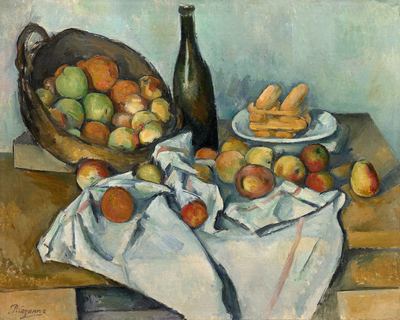
Look closely at the Art Institute of Chicago’s The Basket of Apples (c. 1893). The bottle leans, the plate is seen from above, and the front edge of the table does not line up from left to right on either side of the cloth. It is read not as a view from a single spot but as a picture rebuilt by choosing, for each object, the angle from which it shows best. When you assemble it as a puzzle, these misalignments show up at the joins between pieces. The Cézanne coming to Gwangju is a landscape. In a landscape, too, check whether the houses and trees are stacked up as solid blocks, and you will recognize the same hand. The Met’s The Card Players is a good one to solve alongside it.
Pissarro: fourteen times from the same window
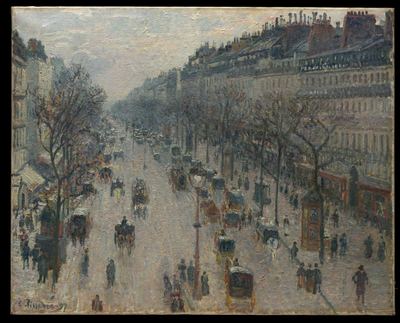
Pissarro is on the walls at Gwacheon. The Met’s The Boulevard Montmartre on a Winter Morning (1897) is one of fourteen paintings he made over two months from the same hotel room window. The colors are pale and close to one another, so as a puzzle it is no pushover, but it comes apart once you set up the skeleton first with the diagonals of the boulevard and the edges of the buildings. Painting the same place again and again with only the light changing is close to the way Monet worked in his series.
One painting per artist is enough
You do not need to solve them all. One painting per artist, on Easy (about 24 pieces) or Normal (about 48 pieces), is plenty. If you are going with a child, it turns into a game at the exhibition: find a painting by an artist you did as a puzzle. Afterward, open the same painting again at the next piece count up. Having seen the originals, you will see the same painting differently. Why a puzzle makes you look at a painting longer is in why a painting looks different once you solve it as a puzzle, and seven Paris paintings from the same period are in seven Paris paintings from 1874 to 1897.
Frequently asked questions
How long do the two exhibitions in Korea run?
According to press reports and Korea's culture portal, the Impressionism show at the Asia Culture Center in Gwangju runs until February 21, 2027, and Water Lilies and Chandelier at the MMCA Gwacheon runs until January 3, 2027. Check opening hours and admission on each institution's website before you go.
Can I solve the works from these exhibitions as puzzles on this site?
No. This site has no connection with either exhibition and has none of the works on show. The puzzles are other works by the same painters, released into the public domain by American and Dutch museums, for getting to know each painter's style in advance.
What can I do with a child before going to an exhibition?
Solve one painting per artist on Easy (about 24 pieces), then have your child look for paintings by the same artists at the exhibition. What you noticed in the puzzle, such as the direction of Van Gogh's brushstrokes or the way Monet changes between close up and far away, can be checked again in front of the originals.