What Is Pointillism? Why Seurat Painted in Dots Instead of Mixing His Colors
Published
Pointillism is a way of painting in which you don’t mix paints on the palette. Instead you place small dots of pure color side by side on the canvas. If you need green, rather than applying green paint, you set blue dots and yellow dots close together. Up close you can see each dot, but take a few steps back and the dots mix in the viewer’s eye into a single color.
Who started it, and why
Pointillism was started in the mid-1880s by the French painter Georges Seurat (1859–1891). Seurat believed that mixing colors made them muddy, and he took the idea of setting pure colors next to each other so they would mix in the eye from the color theory of his day. Painters who shared the idea, Paul Signac among them, followed him, and critics called them Neo-Impressionists, meaning the generation after Impressionism. The painters themselves are said to have preferred the term Divisionism, for the way they divided color into separate touches.
Seurat died at thirty-one. That is why there are only a handful of large pointillist paintings by him.
How it differs from Impressionist brushwork
Both apply color in short, broken touches. The difference is speed and planning. The Impressionists worked outdoors, catching the light of a passing moment with quick brushstrokes. Seurat did the opposite and labored for a long time in the studio. He worked out in advance what color of dot would go where and how densely, and he painted many studies for a single picture.
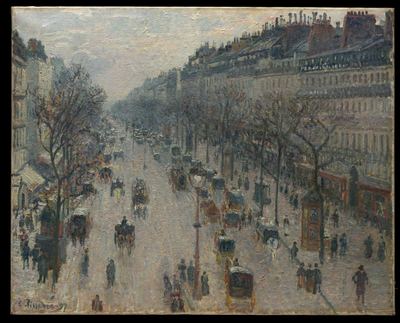
That difference carries into the mood of the paintings. If an Impressionist painting shimmers with wind and sunlight, the people in Seurat’s paintings stand still like statues. You can see it clearly when you set his work beside Impressionist paintings from Paris in the same years. The features of Impressionism itself are covered in what is Impressionism.
Two key works
 Solve this painting as a puzzle → about 5 minutes on Easy
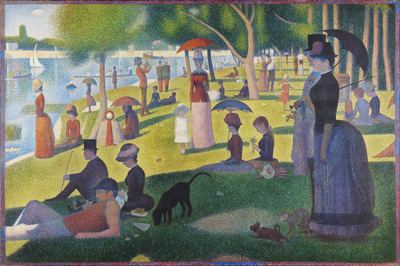
The Art Institute of Chicago’s A Sunday on La Grande Jatte (1884–86) is the defining work of pointillism, and Seurat spent two years on it. On a canvas more than three meters wide, he painted Parisians spending a Sunday afternoon on an island in the Seine using nothing but small dots of color. It was his first attempt on a large scale at setting dots of pure color side by side, and it was shown in 1886 at the eighth and last Impressionist exhibition.
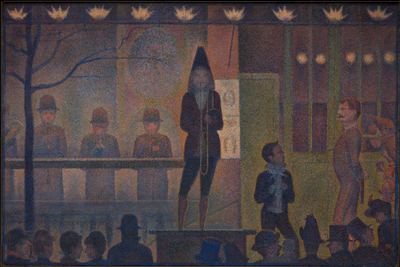
The Metropolitan Museum of Art’s Circus Sideshow (Parade de cirque) (1887–88) shows the stage outside a circus where performers drum up an audience under gaslight. It is the only night scene among Seurat’s major pointillist paintings. Only the nine gas lamps shine bright among the dark dots of violet, brown and orange, and for a festive scene it is strangely quiet.
Pointillism as a puzzle
Pointillist paintings are on the tricky side as puzzles. When you look at the pieces zoomed out, the dots blend together and everything looks alike. You need to zoom in and look at the colors of the dots.
- Start with the big shapes. In La Grande Jatte, pick out the large figures first, such as the woman with the parasol, the man in a formal suit and the girl in white. In Circus Sideshow, the bright dots of the gas lamps and the trombone player’s face are your landmarks.
- Sort by brightness. The grass in La Grande Jatte divides into bright yellow-green in the sun and dark blue-green in the shade.
- Look at which way the dots run. Even within the same painting, the dots on the river line up horizontally and those on the grass vertically, which gives you a clue to where a piece belongs.
If it’s your first time, start with 48 pieces. For Circus Sideshow, 24 to 48 pieces is recommended. After staring at the pieces, look at the whole picture again, and you’ll understand with your hands why Seurat wanted people to step back a few paces to look.
Trying pointillism at home or in class
Pointillism is easy to try for yourself. Dip a cotton swab or the end of a pencil in paint, dab a leaf using only blue and yellow dots, then hold the paper at a distance and see whether it looks green. If you do this after finishing the puzzle, you’ll see right away why the colors of the dots in Seurat’s paintings were mixed the way they were.
Frequently asked questions
What does pointillism mean?
It is a painting technique in which, instead of mixing paints on the palette, the artist places small dots of pure color side by side, so that from a distance the colors mix in the viewer's eye.
Who started pointillism?
The French painter Georges Seurat started it in the mid-1880s, and Paul Signac and others carried it on. Its best-known work is A Sunday on La Grande Jatte (1884–86) at the Art Institute of Chicago.
How is pointillism different from Impressionism?
The Impressionists caught the light of a passing moment quickly with short brushstrokes. Pointillism worked out the color and placement of every dot in advance according to color theory and applied them slowly and carefully. That is why it is called Neo-Impressionism, the generation after Impressionism.