Self-Portrait with a Harp
The artist herself at a harp: the life-size self-portrait Rose Adélaïde Ducreux showed at the 1791 Paris Salon, when few doors were open to women painters. Full commentary ↓
Couldn't load the puzzle image.
Turn on piece outlines to see piece positions on this picture too
Drag the pieces into place · When zoomed in, drag an empty spot to move around
You can also play with a keyboard — Tab to the board, thenSpace pick a piece, Arrow keys move it (with Shift for small steps),Esc deselect, R rotate a piece (Shift+R the other way)
Self-Portrait with a Harp is an oil painting by Rose Adélaïde Ducreux (1791) in the collection of The Metropolitan Museum of Art. It measures 193 × 128.9 cm.
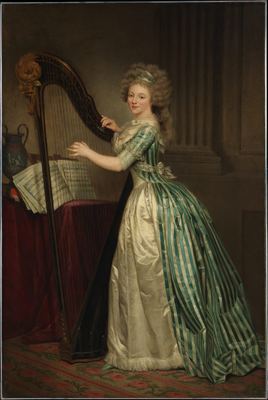
In the pictureA woman in a blue-striped silk dress plays the harp and turns her head to look our way. On the table at left lie sheet music and a water carafe, and behind her are a stone column and a niche. The canvas is nearly 2 meters tall, close to life-size.
BackgroundRose Adélaïde Ducreux, daughter of the portrait painter Joseph Ducreux, exhibited this picture at the Paris Salon of 1791. Held just after the French Revolution, it was the first Salon open to painters who were not members of the Royal Academy, a rare opportunity for a woman painter. Her choice to paint herself with a harp rather than with painting tools is read as an effort to present the ideal of the cultivated woman of her day. She died in Santo Domingo in 1802.
Puzzle tipThe stripes of the dress are the key clue. They curve with the folds of the skirt, so matching their direction nearly settles each piece's position. The gold column and strings of the harp and the red carpet are each easy to tell apart, so taking it on at 300 pieces is not too much.
- Artist
- French, Paris 1761–1802 Santo Domingo
- Classification
- Paintings
- Medium
- Oil on canvas
- Dimensions
- 193 x 128.9 cm
- Credit line
- Bequest of Susan Dwight Bliss, 1966
Source: The Metropolitan Museum of Art ↗
In these collections: Portrait and Self-Portrait Puzzles
Stories about this work
- 1655 and 1791: Two Painters Paint Themselves
An enigmatic self-portrait by a pupil of Rembrandt, and a life-size portrait a woman painted of herself when the door was narrow for women painters. Two works set 136 years apart.
- Why It Pays to Do the Face Last in a Portrait Puzzle
The face takes up only 3 to 4% of the picture, so it pays to do it last. Where each portrait gets stuck, and how to find an eye split across two pieces.