1655 and 1791: Two Painters Paint Themselves
Published
In the darkness, a young man in a wide-brimmed black hat looks our way. A hundred and thirty-six years later, a woman painter portrayed herself life-size with a harp at her side. It is not even certain that the man is the painter himself, while the woman’s identity and intentions are both clear. A self-portrait shows how the painter wanted to be seen, and placing the two side by side shows how much the scale of that self-assurance differed from era to era.
| Work | Artist | Date | Size |
|---|---|---|---|
| Portrait of a Man (Self-Portrait?) | Willem Drost | 1653 or 1655 | 86.7 × 72.4cm |
| Self-Portrait with a Harp | Rose Adélaïde Ducreux | 1791 | 193 × 128.9cm |
The question mark in the title
 Solve this painting as a puzzle → about 5 minutes on Easy
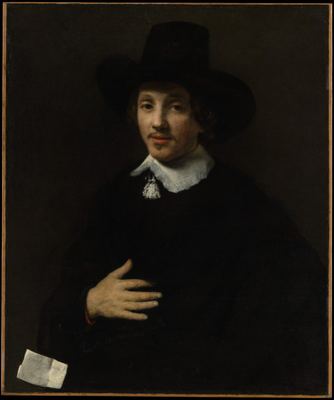
In Portrait of a Man, a young man in a wide-brimmed black hat stands before a dark background. Willem Drost was a painter who trained in Rembrandt’s workshop in the early 1650s. He died in Venice at twenty-six, and not many of his works survive.
The title itself carries a question mark (“Self-Portrait?”). It is thought to be a self-portrait, but this is not certain. Because he died young and few records remain, there is no way to confirm that this face is really his. The method of making only the face and hands emerge from a dark background was learned directly from his teacher. The single sheet of white paper visible below the edge of his garment is read as a mark of a painter or a scholar.
A woman painter standing life-size
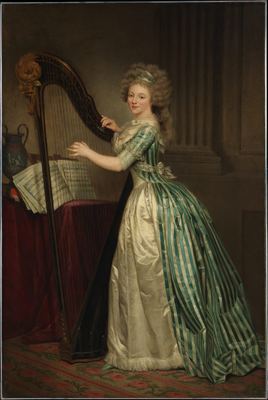
Self-Portrait with a Harp, from 136 years later, is the opposite in every way. Rose Adélaïde Ducreux was the daughter of the portrait painter Joseph Ducreux, and she showed this painting at the Paris Salon of 1791.
When it was painted matters. This Salon, held just after the French Revolution, opened its doors for the first time to painters who were not members of the Royal Academy, and it was a rare opportunity for women painters. Through that gap the Revolution briefly opened, Ducreux hung a commanding, life-size self-portrait (193 centimeters tall).
The composition is calculated too. Standing with a harp instead of brushes and a palette is read as a choice meant to show the ideal of the cultivated woman of the time. She introduced herself by putting forward music, the accomplishment that era expected of women, ahead of her profession as a painter. It was probably quite a clever piece of self-presentation. She died in Santo Domingo in 1802.
A faint record and a record she set herself
Drost’s portrait, without our even knowing whether it shows the painter himself, barely puts forward a face and hands from the darkness. Ducreux reveals her full figure life-size, with her identity and intentions stated.
This is hard to explain by differences in personality alone. A nameless young painter leaving his own face in 17th-century Holland, and a woman painter squeezing through a gap in the institutions to make herself known in France just after the Revolution, were in different situations from the start. On one side the record survived only faintly; on the other, she set down the record clearly herself.
Black surfaces and a striped dress
As puzzles they differ in both size and tone, so you approach them differently. Drost’s is not easy, with its wide black areas. The portrait puzzle guide says to save the face until the end, but in this painting the only light areas are the face, the white collar, the hands and the paper at the bottom, so it is better to build a framework with those pieces first and set the curved pieces of the hat brim on top. Divide the black pieces into the glossy ones of the clothing and the flat ones of the background. 48 pieces is about right.
With Ducreux’s, the biggest clue is the direction in which the stripes of the dress curve along the folds of the skirt. Get the direction right, and the position is nearly settled. The golden column and strings of the harp and the red carpet are each easy to tell apart as well, so even 300 pieces is manageable.
The figure chosen in front of the mirror
A self-portrait is painted looking in a mirror, but in the end it is a painting in which you choose how you will appear. Drost (if it is indeed his face) borrowed his teacher’s method and buried himself in darkness, while Ducreux revealed herself fully in front of a narrow door the times had briefly opened. Look at them alongside Drouais’s women of Paris, and you can feel even better how much the pose of a portrait changes with era and social standing.