Stela of King Intef II Wahankh
A limestone stela with a king offering a jar and bowl beside horizontal and vertical hieroglyphs: a monument of Intef II, 11th Dynasty king at Thebes. Full commentary ↓
Couldn't load the puzzle image.
Turn on piece outlines to see piece positions on this picture too
Drag the pieces into place · When zoomed in, drag an empty spot to move around
You can also play with a keyboard — Tab to the board, thenSpace pick a piece, Arrow keys move it (with Shift for small steps),Esc deselect, R rotate a piece (Shift+R the other way)
Stela of King Intef II Wahankh is a stone object by an unknown maker (ca. 2108–2059 B.C.) in the collection of The Metropolitan Museum of Art.
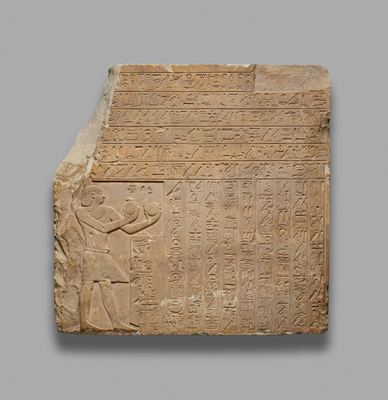
In the pictureOn a nearly square limestone slab, six horizontal lines of text are carved at the top, and below them, on the right, nine vertical columns. At lower left the king, wearing a short curled wig, a broad collar and a kilt with a triangular front panel, stands facing right and holds out a round jar and a bowl with both hands. There is also short text in front of and above the king, and near the bottom of the first vertical column an oval ring (cartouche) enclosing the king's name can be seen. The upper left corner and the left edge are roughly broken away. The stone is a pale yellowish brown, and the text and figure are carved in shallow relief.
BackgroundIntef II Wahankh was an 11th Dynasty king who ruled Thebes in the 21st century B.C., expanding his territory by fighting northern powers during the First Intermediate Period, when Egypt was divided into north and south. Mentuhotep II of the same dynasty later reunified the country, so this stela is a record from before the Middle Kingdom began. The text is said to be a hymn to the sun god Ra and the goddess Hathor. It measures 44.5×46cm, 11.5cm thick, and weighs 29.8kg. "Wahankh" in the title is this king's Horus name, and the museum's record does not specify a findspot.
Puzzle tipThe king at lower left is the clearest reference point. Fit the king, the jar and the bowl first, then place the horizontal text at the top by the lines that divide its registers, and the vertical text below by its dividing lines and the cartouche. The broken upper left corner has a rough texture and is found quickly. Fill the gray background last. In the vertical columns the signs are all of similar size, so the dividing lines are the only clue; start at the top where they meet the horizontal registers and work down. Up to 100 pieces is manageable.
- Period
- First Intermediate Period
- Dynasty
- Dynasty 11
- Medium
- Limestone
- Dimensions
- H. 44.5 × W. 46 × Th. 11.5 cm, 29.8 kg (17 1/2 × 18 1/8 × 4
- Credit line
- Rogers Fund, 1913
Source: The Metropolitan Museum of Art ↗
Stories about this work
- Mentuhotep II, Who Reunited a Divided Egypt, and Four Carved Works
A war record from just before reunification, a queen's stone sarcophagus, a shrine wall, and a later king's dedication. The story of a Theban king who made Egypt whole again, read through stone.