Mentuhotep II, Who Reunited a Divided Egypt, and Four Carved Works
Published · updated
Green and yellow bands still remain on the side of a stone sarcophagus 2.6 meters long. Its owner was Queen Henhenet, who died in childbirth, and her husband was Mentuhotep II, the king who joined a divided Egypt back together. The post on the ruined temple of Amenemhat I told the story of the 12th Dynasty, and there are four carved works tied directly to this king, a generation earlier. They are a war record of a predecessor just before unification, the stone sarcophagus and shrine of a queen buried in his temple, and an object a later king dedicated in his honor.
| Work | Dynasty | Material | Acquisition |
|---|---|---|---|
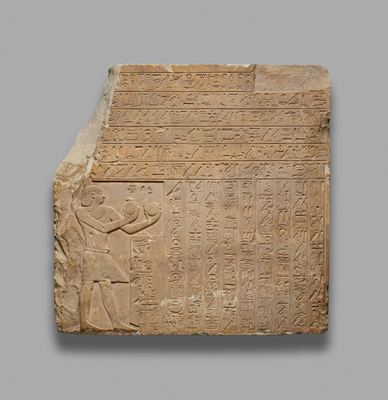
| Stela of King Intef II Wahankh | 11th Dynasty | Limestone | Rogers Fund, 1913 |
| Sarcophagus of the Hathor Priestess Henhenet | 11th Dynasty | Limestone, sandstone, paint | Gift of the Egypt Exploration Fund, 1907 |
| Part of the shrine of Queen Henhenet | 11th Dynasty | Limestone, paint | Gift of the Egypt Exploration Fund, 1906 and 1907 |
| Ritual Implement Dedicated by a King Senwosret to Nebhepetre Mentuhotep II | 12th Dynasty | Hornblende granite | Rogers Fund, 1924 |
The stela of a king who prepared for unification
 Solve this painting as a puzzle → about 5 minutes on Easy
The story begins with Stela of King Intef II Wahankh. Intef II ruled Thebes in the 21st century B.C. At a time when Egypt was split into north and south, he was the king who fought the north and expanded his territory.
The stela has six horizontal registers and nine vertical columns of hieroglyphs, and it is carved with the king holding out a jar and a bowl in his two hands. Intef II was succeeded by his son Intef III, and the next king, Mentuhotep II, finally achieved unification. So this stone is a record from just before the Middle Kingdom was born. From a time when the country had not yet become one, the voice of a king who prepared for unification survives here.
As a puzzle, the direction of the lines of text is a big clue. The upper half has horizontal lines and the lower part vertical columns, so the direction alone lets you separate top from bottom. The king at lower left and the broken upper-left corner have certain positions, which makes them good reference points. 48 pieces is about right.
A queen asleep in the temple of the king who unified Egypt
Mentuhotep II, who followed Intef III, joined north and south into one. He built his own temple at Deir el-Bahri on the west bank of Thebes and placed inside it six small shrines for queens and priestesses.
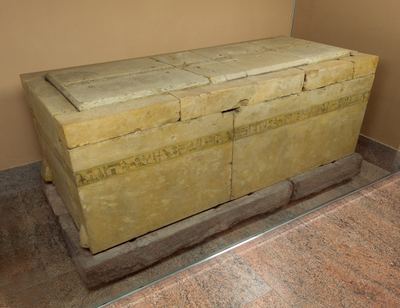
Sarcophagus of the Hathor Priestess Henhenet belonged to one of those queens. Henhenet was a queen of Mentuhotep II and also a priestess of the goddess Hathor. The 2.6-meter stone sarcophagus retains painted bands of green and yellow, along with inscriptions.
This sarcophagus also holds a far more personal story. Examination of her mummy showed that she died giving birth. For that reason, it is said to be cited often in discussions of the lives of ancient Egyptian women. Beside the great history of the king’s unification, one woman’s death has survived alongside it.
It is easier to assemble if you judge top and bottom by the height of the green and yellow bands that wrap around the sides. 100 pieces is about right.
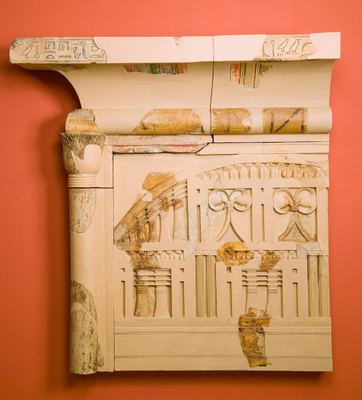
Part of the shrine of Queen Henhenet pairs with that sarcophagus. It is a wall from Henhenet’s shrine, one of the six small shrines inside the Deir el-Bahri temple, so it forms a pair with her sarcophagus in the same museum. Carved with columns and a door, the wall is a reduced version of a real building, and it was originally painted all over. Set up the large frame first with the straight lines of the columns and door carved in relief. 48 pieces will do.
A dedication several generations later
The last object leaps across time.
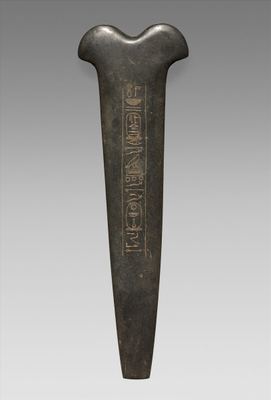
Ritual Implement Dedicated by a King Senwosret to Nebhepetre Mentuhotep II was made by one of the 12th Dynasty kings named Senwosret. It is a ritual implement called a “peseshkef,” used to open the mouth of the dead so that they could eat and speak in the afterlife. The inscription says that a king named Senwosret dedicated it to Mentuhotep II, who founded the Middle Kingdom. In other words, a later king honored the predecessor who had achieved reunification as if he were a god.
Mentuhotep II was revered long after his death. Several generations later, a descendant of the dynasty that followed still dedicated a ritual implement to him, which tells you how greatly his achievement of making Egypt one again was remembered.
This implement is less than 1 centimeter wide and tall and narrow. The grid comes out very flat, so it is better to lower the piece count and solve it at around 24 pieces.
A dynasty founded and remembered
Placed in chronological order, the four works form a single story. Intef II expanding his territory in a divided country, Mentuhotep II finally achieving unification, Queen Henhenet buried in his temple and her death, and a descendant who honored him like a god several generations later. The process by which a dynasty is founded and remembered is carved across four pieces of stone.
If Meketre’s fleet, which prepared for life in the afterlife with model boats, was made for one individual’s afterlife, these four works sought to record and honor the history of a nation. Other conventions of Egyptian sculpture are in conventions of Egyptian statues, and tips for the whole category are in the Egyptian art puzzle guide.
War, unification, death, memory. As you assemble the four works in turn, the story of a dynasty passes through your fingertips. What stays longest in the mind among them is the sarcophagus of a queen who died in childbirth in the midst of the history of unification.