What Is Baroque Art? Meaning, Key Features, from Caravaggio to Rembrandt and Vermeer
Published
Baroque art is the art that flourished in Europe, centered on the 17th century. Where the Renaissance pursued balance and harmony, the Baroque tried to stir the viewer with strong contrasts of light and dark, tilted compositions and a single moment of movement. Caravaggio’s figures in darkness, Rembrandt’s The Night Watch and Vermeer’s women by the window are all paintings of this age.
A name from a misshapen pearl
A widely known theory says the name Baroque comes from the Portuguese barroco, meaning an irregularly shaped pearl. At first it was a disparaging word for art seen as overly ornate and out of balance, but today it is the name of an era.
The ground Baroque art grew from differed by region. In Italy and Spain, the Catholic Church wanted dramatic pictures that would move the faithful directly. In the Protestant Dutch Republic, by contrast, merchants and citizens rather than the church bought paintings and hung them at home. So even within the Baroque, the Netherlands saw a great rise in portraits, genre scenes, landscapes and still lifes.
Five features of Baroque art
- Strong light-dark contrast. Light pours onto the figures alone against a dark background. This stage-lighting effect is explained separately in what is chiaroscuro.
- A moment in motion. Rather than a fixed pose, painters caught the instant just as someone is about to act.
- Diagonal compositions. Figures and light, flags and lances cut across the picture at a slant, building tension.
- Figures like real people. Even saints and mythological figures were painted without idealization, down to wrinkles and rough hands.
- Everyday life becomes the subject. Especially in the Netherlands, kitchens, taverns and family parties took center stage.
Between the Renaissance and the Baroque
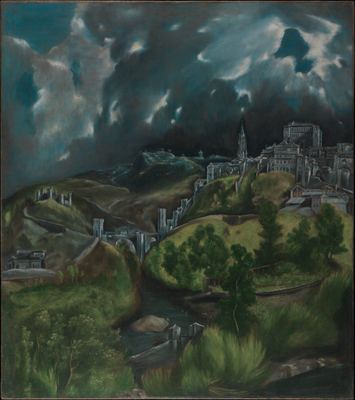
In the late 16th century came Mannerism, which deliberately twisted the balance of the Renaissance. El Greco’s View of Toledo (about 1599–1600) paints the city under a dark blue-green sky that looks as if a storm is rolling in. It is a picture that puts the mood the painter felt ahead of the actual terrain.
Italy and France: Caravaggio and after
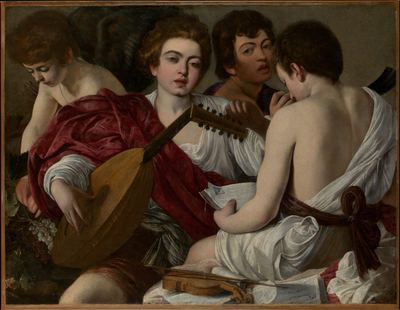
The painter who opened the door to Baroque painting was Caravaggio. The Musicians, from about 1597, is an early work made for his first patron, Cardinal del Monte, and against its dark background only the boys’ skin and white clothing glow. Caravaggio’s strong light and dark and his lifelike figures spread to painters all over Europe.
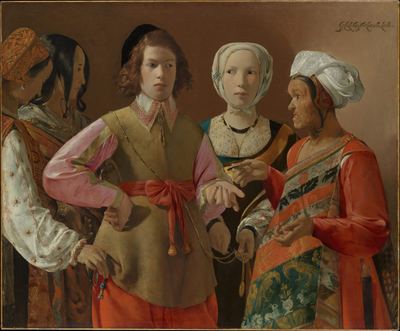
Georges de La Tour, from the Lorraine region of France, was also influenced by him. La Tour is famous for night scenes lit by a single candle, but The Fortune-Teller from the 1630s is a bright daytime scene. While an old fortune-teller reads a young man’s palm, women quietly lift his purse and medal, a story that follows the “swindlers and the naive young man” theme that began with Caravaggio.
The Dutch Golden Age
The 17th-century Netherlands grew rich on trade, and with many citizens buying paintings, there were many painters too.
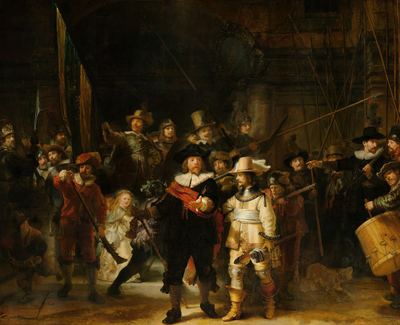
- Rembrandt: The Night Watch of 1642 is a group portrait of a civic militia. Breaking with the custom of lining people up in a row, he painted them in motion just before they march out. The name “Night Watch” was given after the varnish darkened; it is actually a daytime scene. Eight paintings by Rembrandt
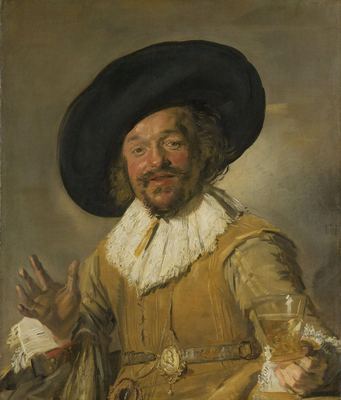
- Frans Hals: A portrait painter in Haarlem who left his brushstrokes visible, dashing them on quickly so that the sitter seems caught in a moment of movement. The Merry Drinker is a man who looks as if he is just about to raise his glass in a toast.
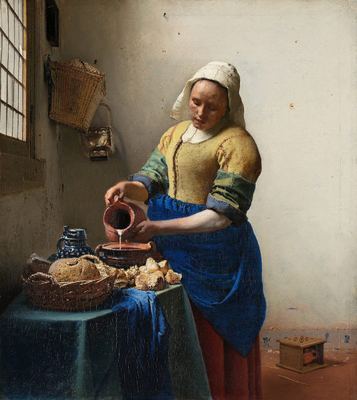
- Vermeer: Instead of dramatic light, he painted the quiet light that comes through a window. The Milkmaid is a painting of an ordinary household task. Eight paintings by Vermeer
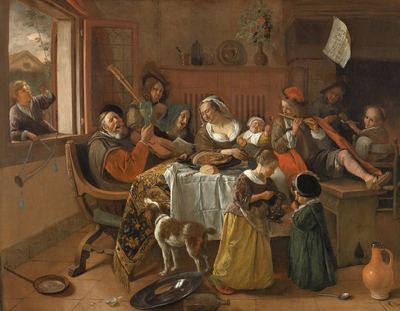
- Jan Steen: The painter of noisy households. In The Merry Family (1668), while the adults sing and drink, the children too play the pipe and puff on a pipe of tobacco.
You can see these painters in one place at the Rijksmuseum in Amsterdam, summed up in must-see paintings at the Rijksmuseum.
What came next: the Rococo
In 18th-century France came the Rococo, lighter and more graceful, shedding the weight of the Baroque. The era before the Baroque is covered in what is Renaissance art.
Seeing the Baroque through puzzles
Baroque paintings have wide dark areas, so they tend to be hard as puzzles. On the other hand, the places the light falls are clear, which makes it easy to decide on an order.
- Bright areas first. Join the pieces that catch the light, such as faces, hands and white collars, first to set up the skeleton of the figures.
- Work the dark with the preview. Even pieces that look black differ slightly, with hints of brown, olive or red. Turn on the preview and compare.
- Follow the diagonals. Slanting lines across the picture, like the lances and flag in The Night Watch or Hals’s brushstrokes, are clues for joining pieces.
- Start with daytime scenes. The Fortune-Teller and The Merry Family are bright and good for beginners. Take on The Musicians and The Night Watch once you’re comfortable.
If you’re new to this, start at 48 pieces, and drop the piece count one level for dark paintings.
Frequently asked questions
What is Baroque art?
It is the art that flourished in Europe, centered on the 17th century. It tried to stir the viewer's emotions with strong contrasts of light and dark, diagonal compositions and scenes that catch a single moment of movement.
Where does the name Baroque come from?
A widely known theory says it comes from the Portuguese barroco, meaning an irregularly shaped pearl. At first it was a disparaging word for art seen as overly ornate and out of balance.
Who are the main Baroque painters?
They include Caravaggio in Italy, Rubens in Flanders, Velázquez in Spain, and Rembrandt, Frans Hals and Vermeer in the Netherlands. Georges de La Tour in France was also influenced by Caravaggio.
How is the Baroque different from the Renaissance?
Where the Renaissance pursued balanced compositions and calm harmony, the Baroque emphasized movement and dramatic moments with strong light-dark contrast and diagonal compositions.