What Is Renaissance Art? Meaning, Key Features, and the Main Painters and Works
Published
Renaissance art is the art that began in Italy in the 14th century and spread across Europe through the 16th. Renaissance is French for “rebirth,” a name that comes from the effort to revive the culture of ancient Greece and Rome, forgotten for more than a thousand years. Painters moved away from the medieval way of showing the divine world through symbols and tried instead to observe people and nature directly and paint them just as they appear to the eye.
Before the Renaissance: pictures on a gold ground
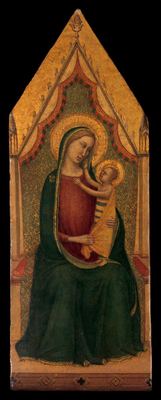
What the Renaissance changed is easiest to see next to the paintings that came before it. Bernardo Daddi’s Madonna and Child Enthroned, painted around 1335–39, has a background of solid gold leaf. The gold did not stand for a sky or a room but for the sacred world, and how deep the space in the picture went did not matter. In the tender gesture of the child stroking his mother’s chin you can already see a wish to paint human feeling, but the space is still flat. Gold-ground paintings are collected separately in why early Renaissance altarpieces have gold backgrounds.
Five features of Renaissance art
- Space built with perspective. Linear perspective, worked out in Florence in the early 15th century, draws parallel lines so that they meet at a single point in the picture (the vanishing point), creating depth on a flat surface. The principle is explained separately in what is perspective.
- Volume from light and shadow. Instead of filling outlines with color, painters divided the side that catches the light from the side in shade, giving faces and clothing bulk.
- Observing people and nature. They studied the proportions and muscles of the human body, trees and rocks, even the way distant mountains look hazy, by looking for themselves.
- The return of ancient myth. Alongside Bible stories, Greek and Roman myths became the subject of major paintings again.
- Oil paint spreads. The oil technique refined in Northern Europe crossed into Italy and gradually replaced tempera, in which pigment is bound with egg yolk.
The early Renaissance, born in Florence
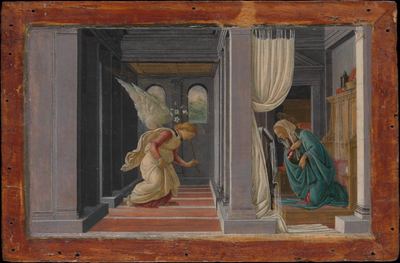
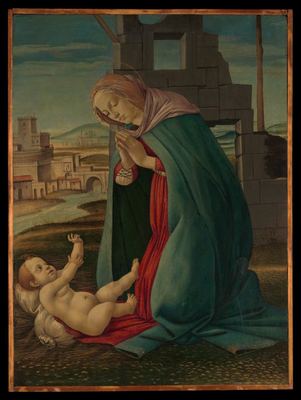
Fifteenth-century Florence was the center of the Renaissance. Botticelli’s The Annunciation, painted around 1490, is a small panel 31 cm wide, yet the columns of the loggia and the floor tiles all run to a single vanishing point. It sets the soft curves of the figures inside a precisely built architectural space. In Madonna Adoring the Child from the same years, crumbling ruins, a distant city and a river stretch out behind the figures in place of gold leaf. The symbols in Florentine Madonna paintings are covered in the symbolism of Florentine Madonnas.
The High Renaissance: Leonardo and Raphael
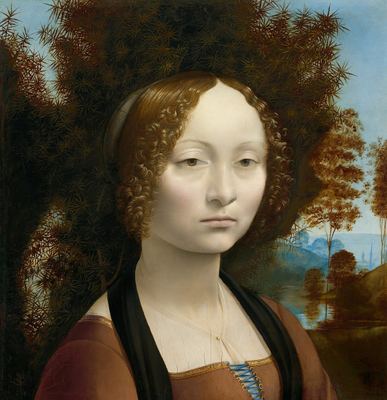
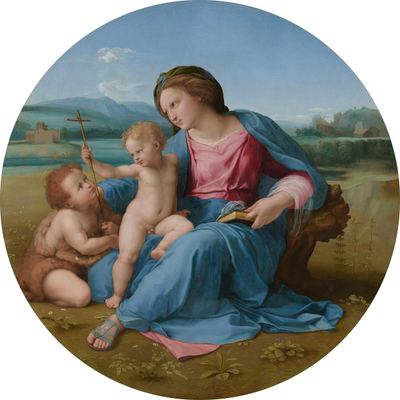
The early 16th century, when Leonardo da Vinci, Michelangelo and Raphael were all at work, is the High Renaissance. Leonardo’s Ginevra de’ Benci (about 1474–78), painted in his twenties, is the earliest of his portraits of women, and the juniper behind her (ginepro in Italian) plays on the sitter’s name. Raphael’s The Alba Madonna (about 1510) seats Mary and two children in a stable triangular composition inside a round picture. Both paintings are in the National Gallery of Art in Washington.
Venice: a Renaissance painted in color
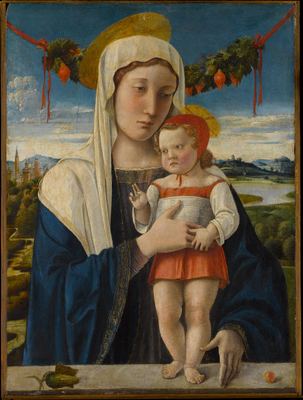
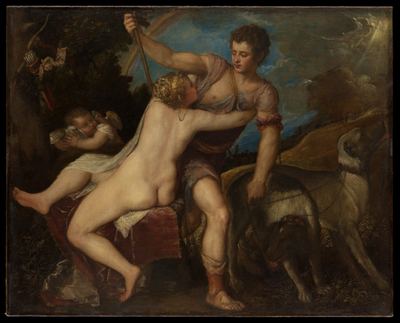
Venetian painters put color and light ahead of line. Giovanni Bellini laid the foundations of Venetian painting, and his Madonna and Child of about 1470 still uses tempera and gold leaf, yet soft air already hangs over the landscape behind. His pupil Titian loved to paint the myths of Ovid. Venus and Adonis shows Venus holding back Adonis as he sets off to hunt, a composition Titian repeated many times.
The Northern Renaissance
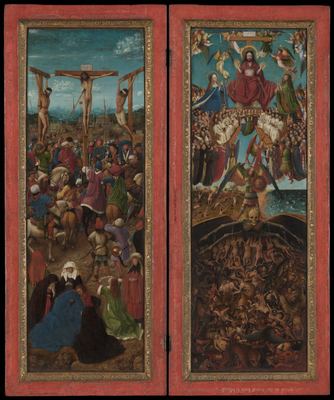
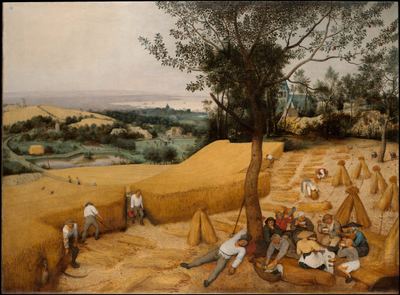
In Flanders and the Netherlands, north of the Alps, the focus was the minute depiction of the things in front of the painter rather than ancient sculpture. Jan van Eyck perfected the technique of layering thin coats of oil paint to get jewel-like color. The Crucifixion; The Last Judgment fits hundreds of figures, a distant city and even snow-covered mountains onto two panels 56 cm tall. Pieter Bruegel’s The Harvesters (1565) takes as its subject not the Bible or myth but the season and the farm work itself, and is counted as a starting point of Western landscape painting.
What came next: the Baroque
In the late 16th century came Mannerism, which stretched the human body and twisted compositions, and then, in the 17th century, the more dramatic light and movement of Baroque art.
Seeing the Renaissance through puzzles
Put a Renaissance painting together as a puzzle and perspective becomes something you can feel in your hands.
- Straight lines first. In a picture with architecture, like The Annunciation, the lines of the columns and floor tiles meet at one point. The slant of a line tells you where its piece goes.
- Read gold by its patterns. A gold ground may look all the same, but the round rims of halos and the patterns tooled into the gold are your clues.
- Sort by clothing color. Set colors, such as Mary’s blue cloak and red dress, form large areas. Find the skin-tone pieces of faces and hands early.
- Distance last. Faraway landscapes, as in The Harvesters, are painted hazy and bluish. Finish the trees and figures in front first, then fill the distance into the remaining gaps.
If you’re new to this, start at 48 pieces, and try van Eyck and Bruegel, with all their detail, at 100 pieces or more once you’re comfortable.
Frequently asked questions
What does Renaissance mean?
It is French for "rebirth." It refers to the movement in 14th- to 16th-century Italy that set out to revive the culture of ancient Greece and Rome, and in art it means the period when painters tried to observe people and nature directly and paint them as they really look.
What are the key features of Renaissance art?
Painters used linear perspective to build deep space and light and shadow to give figures volume. They studied the human body and nature from life, and alongside Bible stories they painted ancient myths again. This is also when the oil painting technique refined in Northern Europe spread.
Who are the three great Renaissance painters?
Leonardo da Vinci, Michelangelo and Raphael are usually named. They are the painters who define the High Renaissance of the early 16th century.
How is the Northern Renaissance different?
It is the Renaissance in Flanders (today's Belgium) and the Netherlands, which put its effort into the minute depiction of the things in front of the painter rather than ancient sculpture. Jan van Eyck layered thin coats of oil paint to get jewel-like color, and Bruegel made the seasons and farm work themselves the subject of a painting.